All species › Waterfowl › Ducks, swans and geese › Silver Teal
Silver Teal | Spatula versicolor
Zilvertaling | Pato capuchino | Marreca-cricri
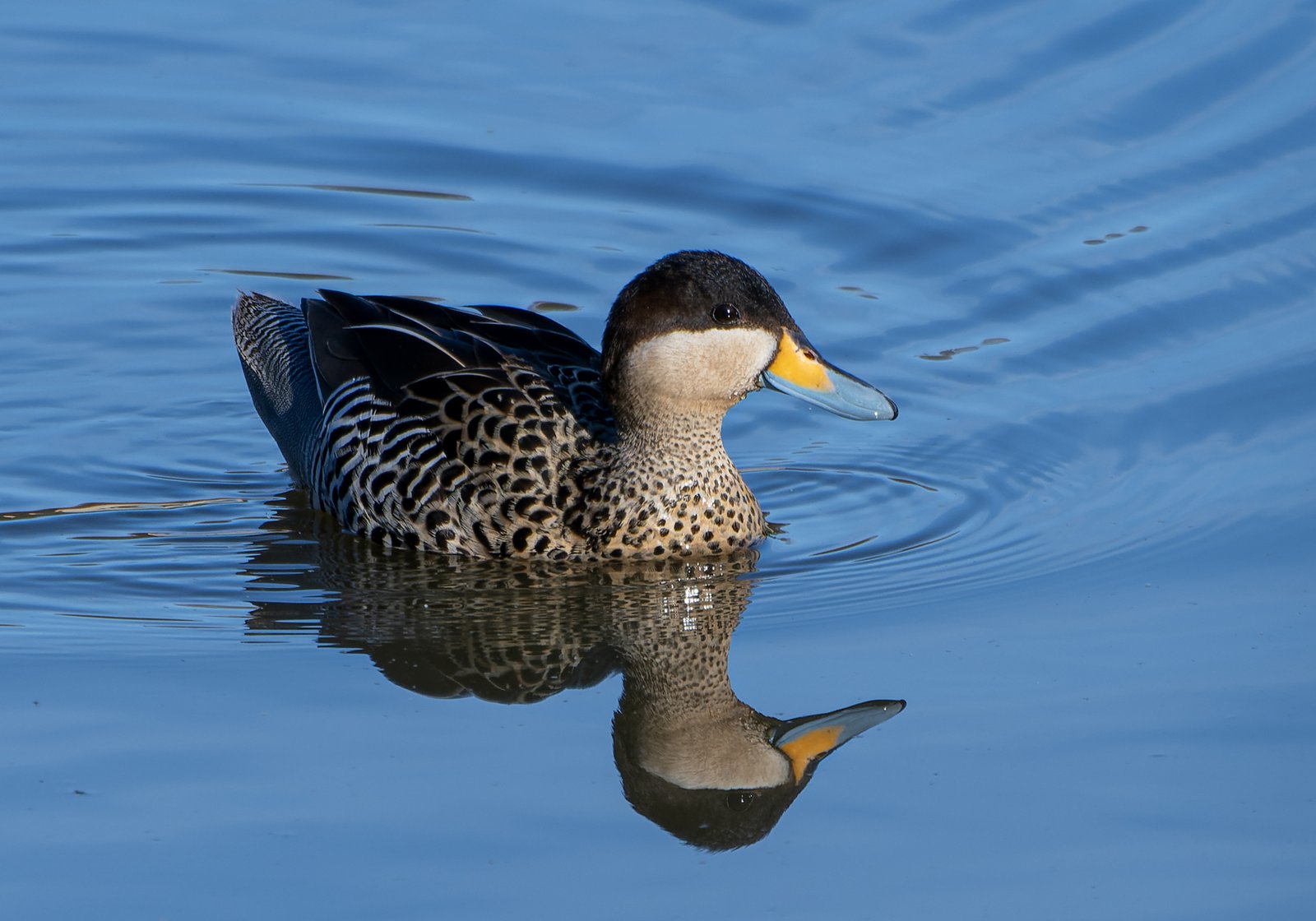
The Silver Teal is a small teal of the fresh waters of southern South America, with a black cap, creamy-white cheeks and a blue bill with a yellow base. In the guide area it lives only in the lowlands of Bolivia, at the northern edge of its range. Birds from the south move north in the austral winter.
Voice
Fairly quiet. The male gives a soft, whistled peep and a rattling note, the female a low, soft quack.
Recording: Bernabe Lopez-Lanus — CC BY-NC-SA 3.0 · xeno-canto
Identification
38–43 cm. The crown and nape are blackish brown down to below the eye; the cheeks and throat are creamy white. The bill is blue with a yellow-orange patch at the base. The breast and flanks are buff, the breast spotted dark and the flanks densely barred dark; the rear end and undertail are finely barred black and white, giving a silvery impression. In flight a glossy green speculum with a white trailing edge. The sexes are almost alike; the female is slightly duller.
Confusion species
Puna Teal Spatula puna is larger, with a larger, all-blue bill without a yellow base and less heavily marked breast and flanks; it lives in the high Andes. Brazilian Teal Amazonetta brasiliensis is plainer brown, without a black cap, and the male has a red bill.
Habitat
Freshwater marshes, lagoons, pools, flooded grassland and rice fields in the lowlands, also in the Chaco. It dabbles in shallow water for seeds, aquatic plants and small invertebrates. The nest is on the ground in dense vegetation near water.
Where the bird is most at home, classified by the vegetation units of the Andes and the west coast.


Range and movements
In Bolivia in the lowlands of the south and east: resident in the south, in the Chaco; further north, in Santa Cruz and into the Beni, mainly in the austral winter. Absent from Colombia, Ecuador and the Galápagos; in Peru at most exceptional. Outside the guide area in Paraguay, southern Brazil, Uruguay, Argentina, Chile and the Falkland Islands.
- Resident
- dark = core range, pale = thinly spread
How and when to look
On lagoons and marshes in the Chaco and south-eastern Santa Cruz, mainly from May to September. The birds often sit in pairs or small groups at the edge of the vegetation.
Conservation status
Least Concern (LC). Common in most of its range; drainage of marshes locally reduces its habitat.
Scientific name
Spatula versicolor | (Vieillot, 1816)
Vieillot described the species in 1816 as Anas versicolor; because it was later moved to another genus, the author and year stand in brackets. The genus Spatula was introduced in 1822 by Boie. The genus name is Latin spatula, 'spoon, spatula', after the broad bill. The species name versicolor is Latin for 'variegated, of several colours'. The specimen the first description was based on came from Paraguay.