All species › Waterfowl › Ducks, swans and geese › Puna Teal
Puna Teal | Spatula puna
Punataling | Pato puna | Marreca-da-puna
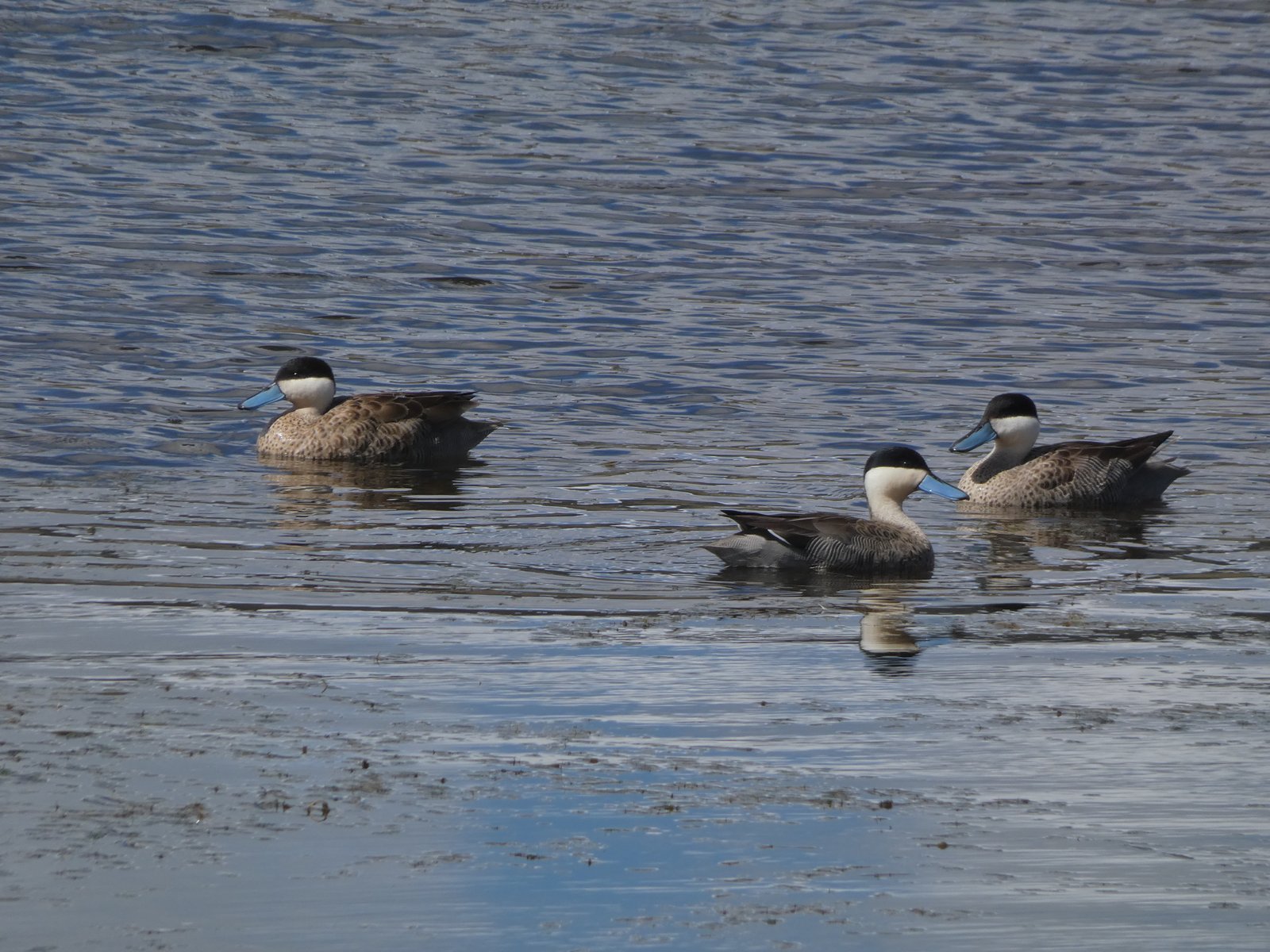
The Puna Teal is a teal of the lakes of the high Andes, with a black cap, creamy-white cheeks and a large, pale blue bill. It was formerly treated as a subspecies of the lowland Silver Teal. On the lakes of the altiplano it is one of the most numerous ducks.
Voice
Fairly quiet. The male gives a soft, rattling whistle, the female a low, hoarse quack.
Recording: Cristian Pinto — CC BY-NC-SA 4.0 · xeno-canto
Identification
43–49 cm. The crown and nape are black, down to just below the eye; the cheeks, throat and foreneck are creamy white. The bill is large and pale blue, with a black ridge. The breast and flanks are buff with fine dark barring, and the back is brown with pale fringes. In flight a glossy green speculum with a broad white trailing edge. The sexes are alike; the female is slightly duller.
Confusion species
Silver Teal Spatula versicolor is smaller, with a yellow patch at the base of the bill, a more heavily spotted breast and a finely barred rear end, and lives in the lowlands. Yellow-billed Teal Anas flavirostris has a yellow bill and a speckled brown head without a black cap. Crested Duck Lophonetta specularioides is larger and grey-brown, with a dark bill and a long, pointed tail.
Habitat
Fresh and brackish lakes, lagoons, pools and bogs (bofedales) in the puna and on the altiplano, mostly between 3000 and 4600 m. It dabbles in shallow water for seeds, aquatic plants and small invertebrates, also along the edges of salt lakes. The nest is on the ground in dense vegetation, often near water.
Where the bird is most at home, classified by the vegetation units of the Andes and the west coast.


Range and movements
In Peru in the Andes of the north and centre south to Lake Titicaca, especially on the high plateaus of Junín, Cusco and Puno. In Bolivia on the altiplano and in the western Andes. Absent from Colombia and Ecuador and from the Galápagos. Outside the guide area in northern Chile and north-western Argentina.
- Resident
- dark = core range, pale = thinly spread
How and when to look
On the lakes around Lake Titicaca and Lake Junín, often in flocks with Yellow-billed Teal and Crested Ducks. The large blue bill and white cheeks can be seen from afar.
Conservation status
Least Concern (LC). Common on highland lakes; the species is hunted locally, and pollution and water extraction by mining affect some lakes.
Scientific name
Spatula puna | (Tschudi, 1844)
Tschudi described the species in 1844 as Anas Puna; because it was later moved to another genus, the author and year stand in brackets. The genus Spatula was introduced in 1822 by Boie. The genus name is Latin spatula, 'spoon, spatula', after the broad bill. The species name puna refers to the Puna, the high plateau of the central Andes, not necessarily the type locality. The specimen the first description was based on came from Peru.