All species › Waterfowl › Ducks, swans and geese › Rosy-billed Pochard
Rosy-billed Pochard | Netta peposaca
Peposaka-eend | Pato picazo | Marrecão
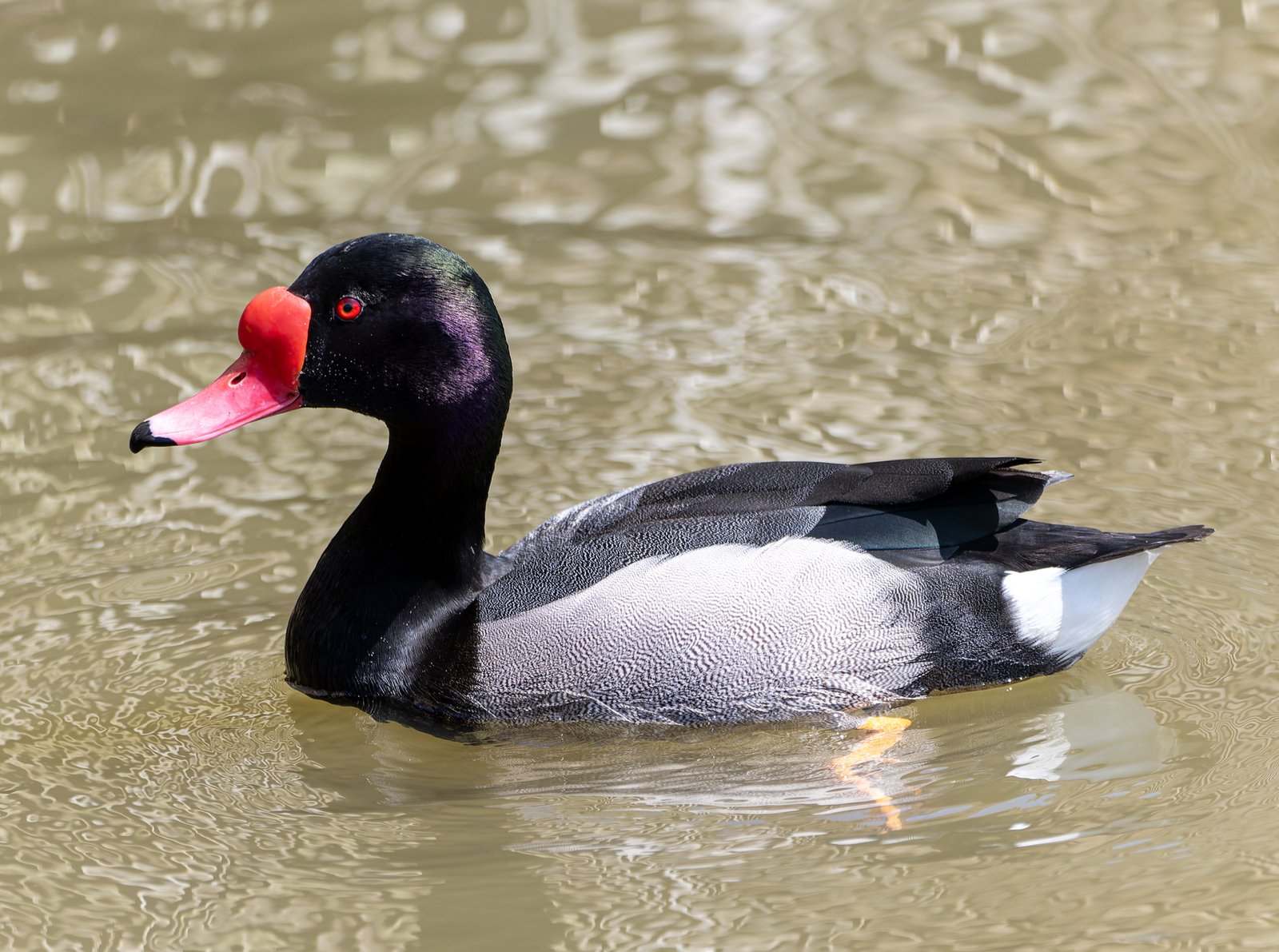
The Rosy-billed Pochard is a large diving duck of southern South America; the male is recognisable by its rosy-red bill with a large knob. In the guide area it occurs only in the lowlands of Bolivia, at the northern edge of its range. More often than other diving ducks it feeds at the surface, like a dabbling duck.
Voice
Mostly silent. In display the male gives a soft grunting or whistling note, the female a hoarse krra.
Recording: Bernabe Lopez-Lanus — CC BY-NC-SA 3.0 · xeno-canto
Identification
53–57 cm, heavily built. The male has a black head, neck and breast with a purple gloss, a blackish back, finely grey-vermiculated flanks and white undertail coverts; the bill is rosy red with a large, rounded knob at the base, and the eye is red. The female is warm brown, with a paler throat, a pale area around the base of the bill, white undertail coverts and a grey-blue bill with a dark tip, without a knob. In flight both sexes show a broad white wing stripe and white underwings.
Confusion species
Southern Pochard Netta erythrophthalma, very rare in the guide area, is darker: the male is chestnut-brown with a pale, bluish-grey bill without a knob, and the female has pale markings on the head and no white undertail coverts. No other duck in the guide area has a rosy-red bill with a knob; Comb Duck Sarkidiornis sylvicola has a black knob and black-and-white plumage.
Habitat
Freshwater marshes, shallow lagoons and lakes with abundant floating and submerged plants, flooded grassland and rice fields in the lowlands. It eats mainly plant food such as seeds, leaves and roots, and also invertebrates; it feeds at the surface, dabbling and diving. The nest is a heap of plant material in reeds or dense marsh vegetation.
Where the bird is most at home, classified by the vegetation units of the Andes and the west coast.


Range and movements
In Bolivia in the lowlands of the east and south, especially in Santa Cruz and the Chaco; numbers increase in the austral winter, when birds from Argentina move north. In Peru only as a rare vagrant. Absent from Colombia, Ecuador and the Galápagos. Outside the guide area in Paraguay, southern Brazil, Uruguay, Argentina and central Chile.
- Resident
- dark = core range, pale = thinly spread
How and when to look
Search lagoons and marshes rich in aquatic plants in the lowlands of Santa Cruz and the Chaco during the austral winter. The male's rosy-red bill can be seen even at a distance.
Conservation status
Least Concern (LC). The species is numerous in the south of its range and is heavily hunted there; drainage of marshes locally reduces its habitat.
Scientific name
Netta peposaca | (Vieillot, 1816)
Vieillot described the species in 1816 as Anas peposaca; because it was later moved to another genus, the author and year stand in brackets. The genus Netta was introduced in 1829 by Kaup. The genus name is from Ancient Greek netta, 'duck'. The species name is the Guaraní name of this duck and means 'showy wings', after the white wing stripe visible only in flight. The specimen the first description was based on came from Paraguay and Buenos Aires, Argentina.