All species › Waterfowl › Ducks, swans and geese › Southern Pochard
Southern Pochard | Netta erythrophthalma
Bruine krooneend | Pato Morado | Paturi-preta
The Southern Pochard is a dark diving duck with an African and a South American population. In northern South America the species has declined steeply since the 1970s, most strongly in the Andes, along the Caribbean coast and in the Pacific lowlands. In the guide area it is now a very rare sight.
Voice
Mostly silent. In display the male gives a soft, nasal whistle, the female a rasping krrr.
No recording with a suitable Creative Commons licence is available for this species yet.
Identification
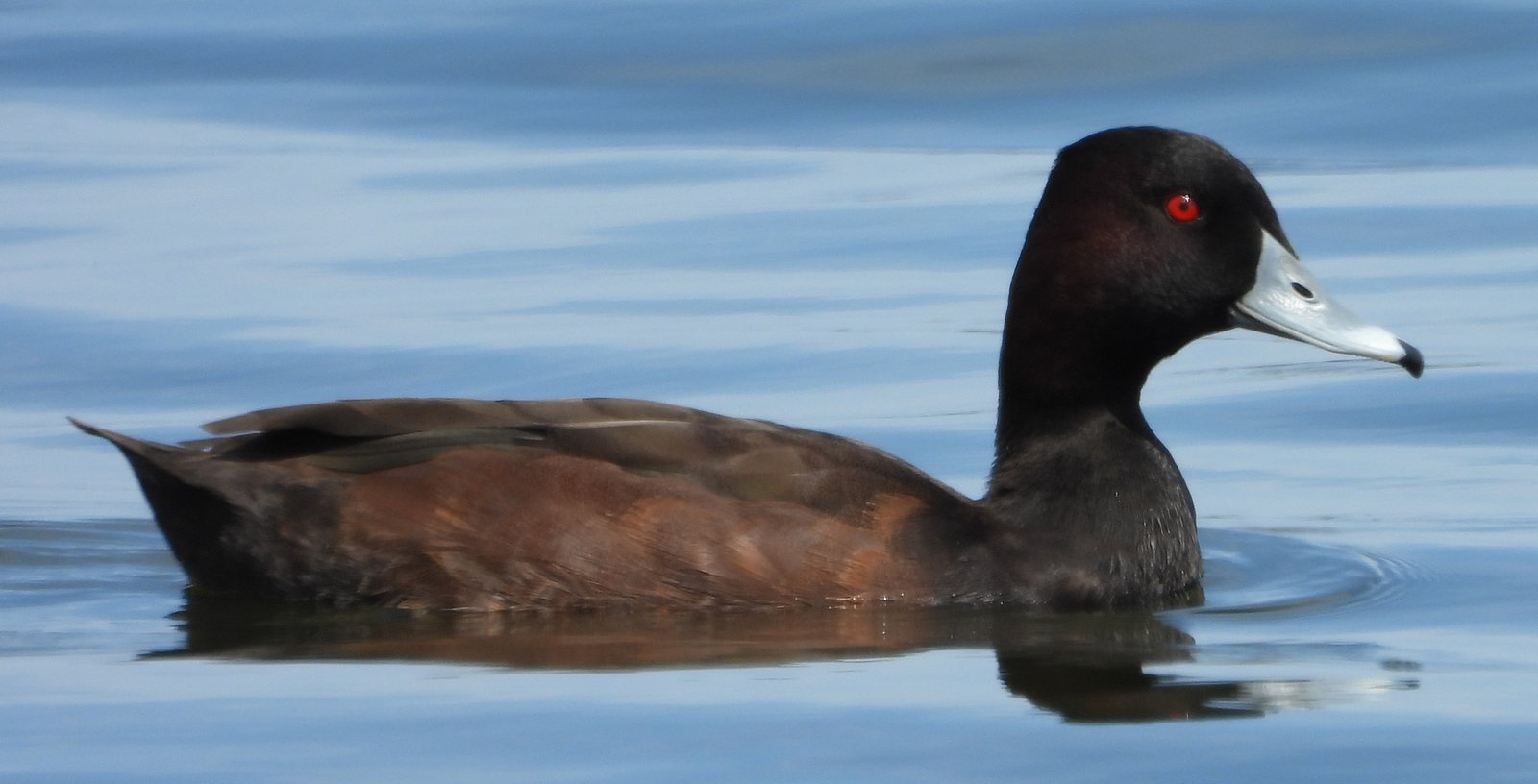
48–51 cm, a medium-sized diving duck with a fairly high, rounded head. The male is dark chestnut-brown, with a blackish breast, a dark back, warm brown flanks, a red eye and a pale, bluish-grey bill with a black tip. The female is dark brown, with a pale patch at the base of the bill, a pale, downcurved stripe behind the eye and a pale throat; her eye is brown. In flight a broad white stripe across the flight feathers. Young birds resemble the female.
Confusion species
The female Rosy-billed Pochard Netta peposaca is paler brown, with white undertail coverts and no pale stripe behind the eye. The female Ring-necked Duck Aythya collaris is greyer brown, with a white eye-ring and a pale ring around the bill, and has a grey wing stripe. The female Lesser Scaup Aythya affinis has a sharply defined white patch at the base of the bill and a yellow eye. The female Ruddy Duck Oxyura jamaicensis is smaller, with a stiff tail and a pale cheek crossed by a dark stripe.
Habitat
Freshwater lakes, ponds and lagoons with open water and submerged vegetation, also deeper marshes and reservoirs, from the lowlands up into the Andes. It dives for seeds, roots and leaves of aquatic plants and for invertebrates. The nest is in dense waterside vegetation, close to the water.
Where the bird is most at home, classified by the vegetation units of the Andes and the west coast.


Range and movements
In Colombia formerly local in the Andes and the Caribbean lowlands, now very rare; recent records mainly in the north and a single one in the south-west. In Ecuador lost as a breeding bird since the middle of the twentieth century, with only a single recent record of a wandering bird. In Peru too, where the species formerly occurred in the north-west and in the Andes, recent confirmed records are virtually lacking. Absent from Bolivia and the Galápagos. Outside the guide area in Venezuela, eastern Brazil and locally in Argentina, and in eastern and southern Africa.
- Summer visitor (c. Apr–Sep)
- Passage (Mar–Apr, Oct–Nov)
- dark = core range, pale = thinly spread
How and when to look
A sighting is most likely on lakes and lagoons rich in aquatic plants in northern Colombia, near the Venezuelan border. Among other diving ducks look for a uniformly dark duck with a red eye and a pale bill, and document every sighting with photographs.
Conservation status
Least Concern (LC), thanks to the African population. The South American population has declined steeply and is estimated at no more than 5,000 to 10,000 birds; hunting and habitat loss through siltation, dredging and the removal of waterside vegetation are considered the causes. In Ecuador the species is regarded as Critically Endangered.
Scientific name
Netta erythrophthalma | (Wied-Neuwied, 1833)
Wied-Neuwied described the species in 1833 as Anas erythrophthalma; because it was later moved to another genus, the author and year stand in brackets. The genus Netta was introduced in 1829 by Kaup. The genus name is from Ancient Greek netta, 'duck'. From Greek eruthros, 'red', and ophthalmos, 'eye', so 'red-eyed'. The specimen the first description was based on came from Belmonte, Bahia, Brazil.