All species › Waterfowl › Ducks, swans and geese › Fulvous Whistling Duck
Fulvous Whistling Duck | Dendrocygna bicolor
Rosse fluiteend | Suirirí bicolor | Marreca-caneleira
The Fulvous Whistling Duck is a warm tawny whistling duck with one of the largest ranges of any duck: the Americas, Africa and southern Asia. In the guide area it is much more local than the other whistling ducks and found mainly in the north. It lives in flocks in marshes and rice fields.
Voice
A squeaky, two-syllable whistle, pi-cheeoo, mainly in flight and at night.
Recording: José María Loaiza B. — CC BY-NC-SA 4.0 · xeno-canto
Identification
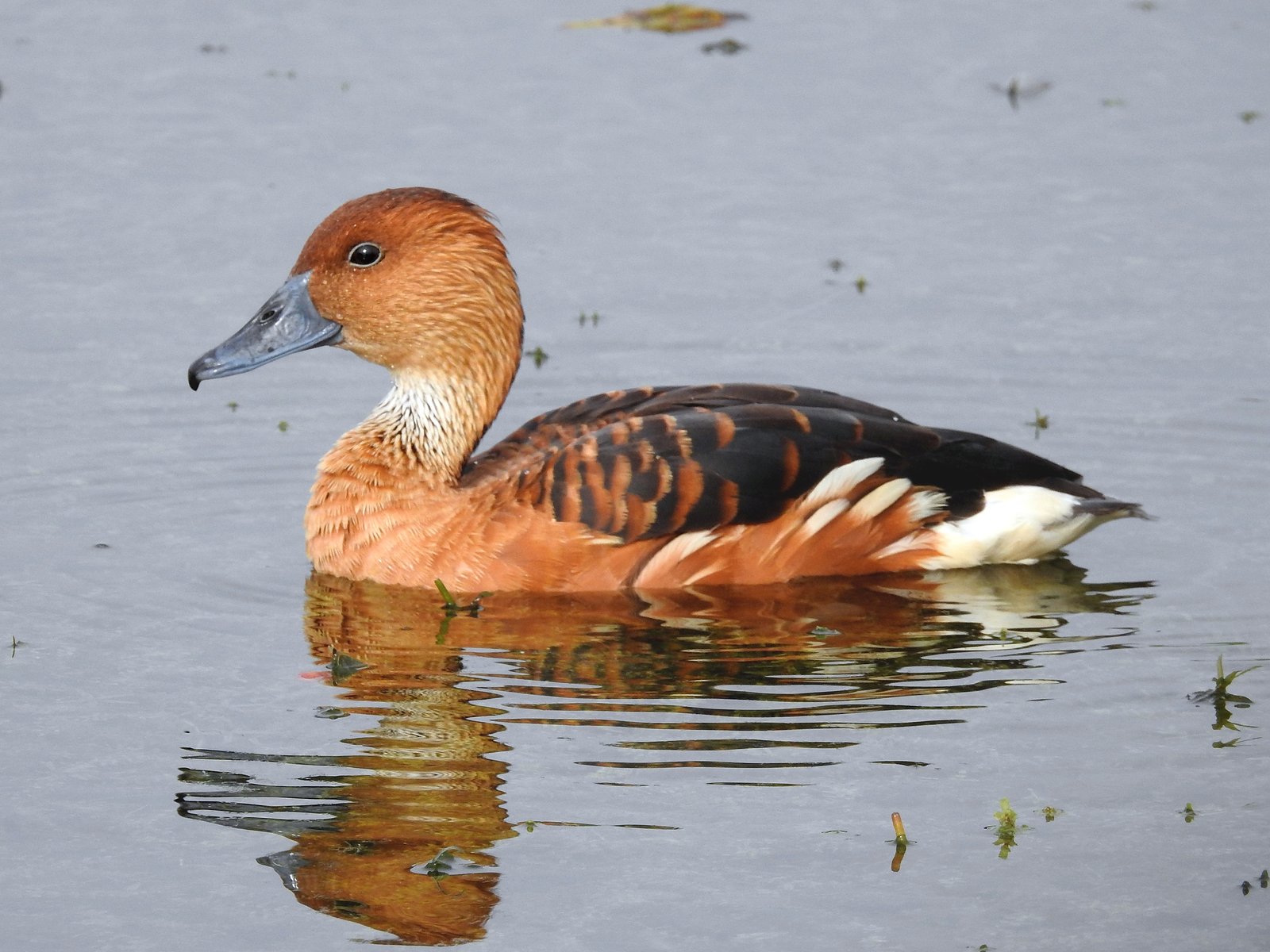
45–53 cm, with a long neck, long blue-grey legs and a grey bill. The head, neck and underparts are warm tawny, with a dark stripe down the hindneck and a paler, finely streaked patch on the side of the neck. Long cream feathers on the flanks form a pale stripe along the body. The back is dark brown with rufous feather edges. In flight the dark wings without white and the white band on the rump stand out. The sexes are alike; juveniles are duller.
Confusion species
Black-bellied Whistling Duck Dendrocygna autumnalis has a red bill, a black belly and a broad white wing band; juveniles have a grey bill, but do show the white wing band. White-faced Whistling Duck Dendrocygna viduata has a white face and a black belly; juveniles are greyer, with finely barred flanks and without the cream flank stripe.
Habitat
Freshwater marshes with floating plants, flooded grassland, shallow lakes and above all rice fields, in the lowlands up to about 1000 m, locally higher in Andean valleys. It feeds by dabbling and diving on seeds, rice and aquatic plants, often at night. The nest is a platform of plant material in dense vegetation in or just above the water.
Where the bird is most at home, classified by the vegetation units of the Andes and the west coast.


Range and movements
In Colombia in the Caribbean lowlands, the Cauca and Magdalena valleys and locally in the llanos. In Ecuador and Peru rare and local, with scattered records. In Bolivia local in the savannas and rice fields of the eastern lowlands. Absent from the Galápagos. Outside the guide area in the southern United States, Mexico, Central America, Venezuela, the Guianas and from eastern Brazil to Argentina, and further in sub-Saharan Africa, Madagascar, India and Bangladesh.
- Resident
- dark = core range, pale = thinly spread
How and when to look
The chances are best in the rice fields and marshes of the Caribbean lowlands and the Cauca valley in Colombia. There flocks sometimes mix with Black-bellied Whistling Ducks.
Conservation status
Least Concern. The use of pesticides in rice fields and the control of ducks as pests have led to local declines.
Scientific name
Dendrocygna bicolor | (Vieillot, 1816)
Vieillot described the species in 1816 as Anas bicolor; because it was later moved to another genus, the author and year stand in brackets. The genus Dendrocygna was introduced in 1837 by Swainson. The genus name is from Greek dendron, 'tree', and kuknos, 'swan'. Latin bicolor means 'two-coloured'. The specimen the first description was based on came from Paraguay.