All species › Waterfowl › Ducks, swans and geese › Black-bellied Whistling Duck
Black-bellied Whistling Duck | Dendrocygna autumnalis
Zwartbuikfluiteend | Suirirí piquirrojo | Marreca-cabocla
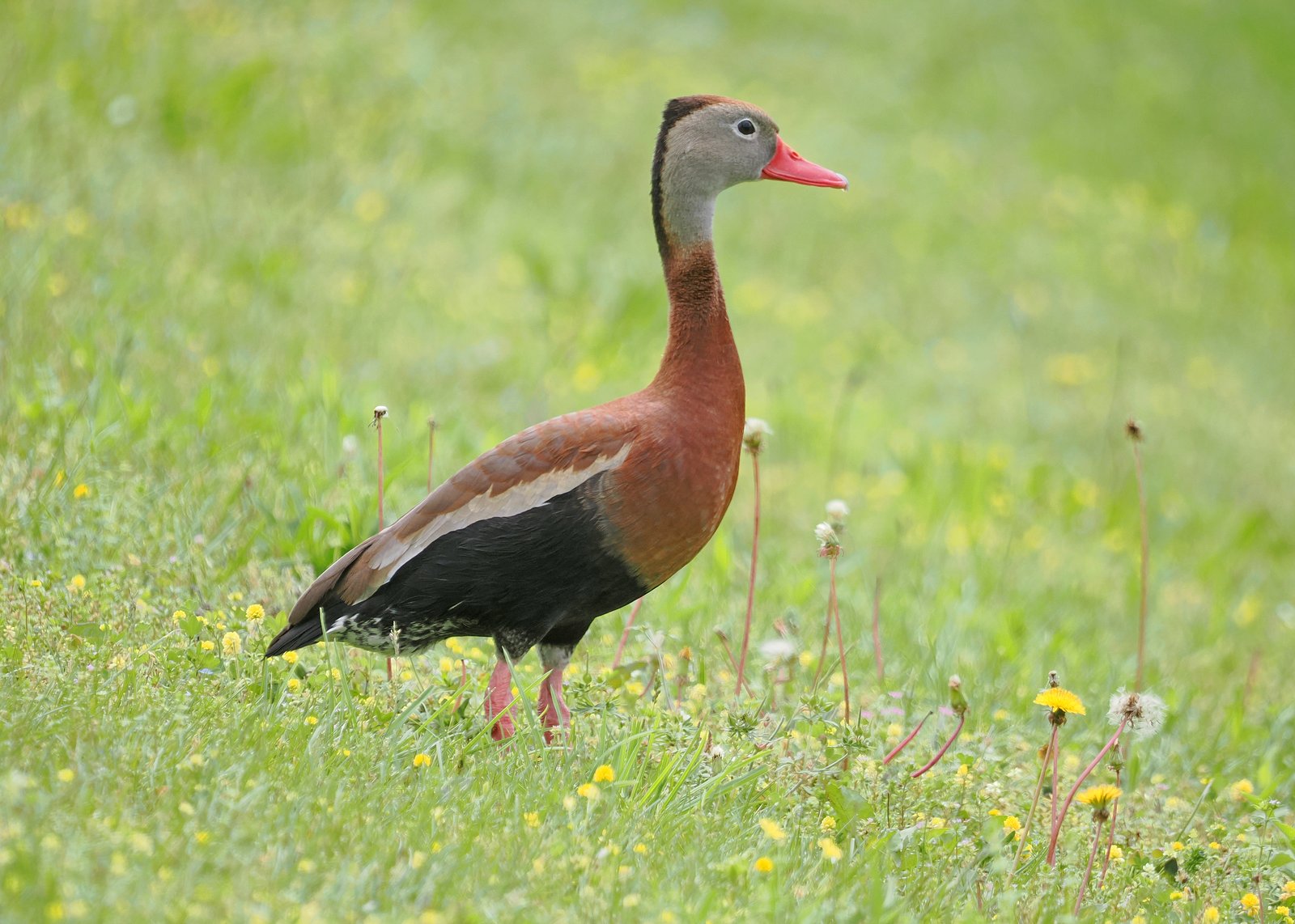
The Black-bellied Whistling Duck is the most widespread whistling duck of the guide area, with a red bill and pink legs. It lives in flocks in marshes and rice fields and, unlike most ducks, often perches in trees. It also nests in tree cavities.
Voice
A high, shrill whistle of four to six syllables, pee-chee-chee-wee, often in flight; flocks give a sustained whistling.
Recording: José María Loaiza B. — CC BY-NC-SA 4.0 · xeno-canto
Identification
47–56 cm, with a long neck and long pink legs. The bill is bright red to orange-red. The face and upper neck are grey, with a white eye-ring; the crown and a stripe down the hindneck are rufous. The breast and back are warm chestnut, the belly and flanks black, and the undertail coverts white with black spots. The wing has a broad white band that contrasts strongly with the black flight feathers in flight. The sexes are alike; juveniles are duller, with a grey bill, grey legs and a greyish, mottled belly.
Confusion species
White-faced Whistling Duck Dendrocygna viduata has a white face, a dark bill and no white wing band. Fulvous Whistling Duck Dendrocygna bicolor is largely tawny, with a grey bill, a white band on the rump and no white on the wing. Juvenile Black-bellied Whistling Ducks with a grey bill can be recognised by the white wing band.
Habitat
Fresh and brackish marshes, lagoons, riverbanks, mangroves, flooded grassland and rice fields, from sea level to about 1000 m, locally higher. It feeds mainly at night on seeds, rice, grasses and aquatic plants, and to a lesser extent on invertebrates. By day it sits on banks or in trees. The nest is in a tree cavity, sometimes on the ground in dense vegetation; the species also uses nest boxes.
Where the bird is most at home, classified by the vegetation units of the Andes and the west coast.


Range and movements
In Colombia widespread in the lowlands east and west of the Andes and in the major valleys. In Ecuador mainly in the west, with large numbers in the rice fields and marshes of Guayas and Los Ríos, and locally in the eastern lowlands. In Peru in the north-west along the coast and in the Amazonian lowlands. In Bolivia in the northern and eastern lowlands. Absent from the Galápagos. Outside the guide area from the southern United States through Mexico and Central America to Venezuela, the Guianas, Brazil and northern Argentina.
- Resident
- dark = core range, pale = thinly spread
How and when to look
In the rice fields and marshes around Guayaquil in western Ecuador flocks are often seen, also resting in trees along the fields. At sunset flocks fly, whistling, to their feeding areas.
Conservation status
Least Concern and locally numerous. The species benefits from rice farming, but in some areas it is hunted or controlled as a pest in rice fields.
Scientific name
Dendrocygna autumnalis | (Linnaeus, 1758)
Linnaeus described the species in 1758 as Anas autumnalis; because it was later moved to another genus, the author and year stand in brackets. The genus Dendrocygna was introduced in 1837 by Swainson. The genus name is from Greek dendron, 'tree', and kuknos, 'swan'. Latin autumnalis means 'of autumn'. The specimen the first description was based on came from the Americas.