All species › Waterfowl › Ducks, swans and geese › White-faced Whistling Duck
White-faced Whistling Duck | Dendrocygna viduata
Witwangfluiteend | Suirirí Cariblanco | Irerê
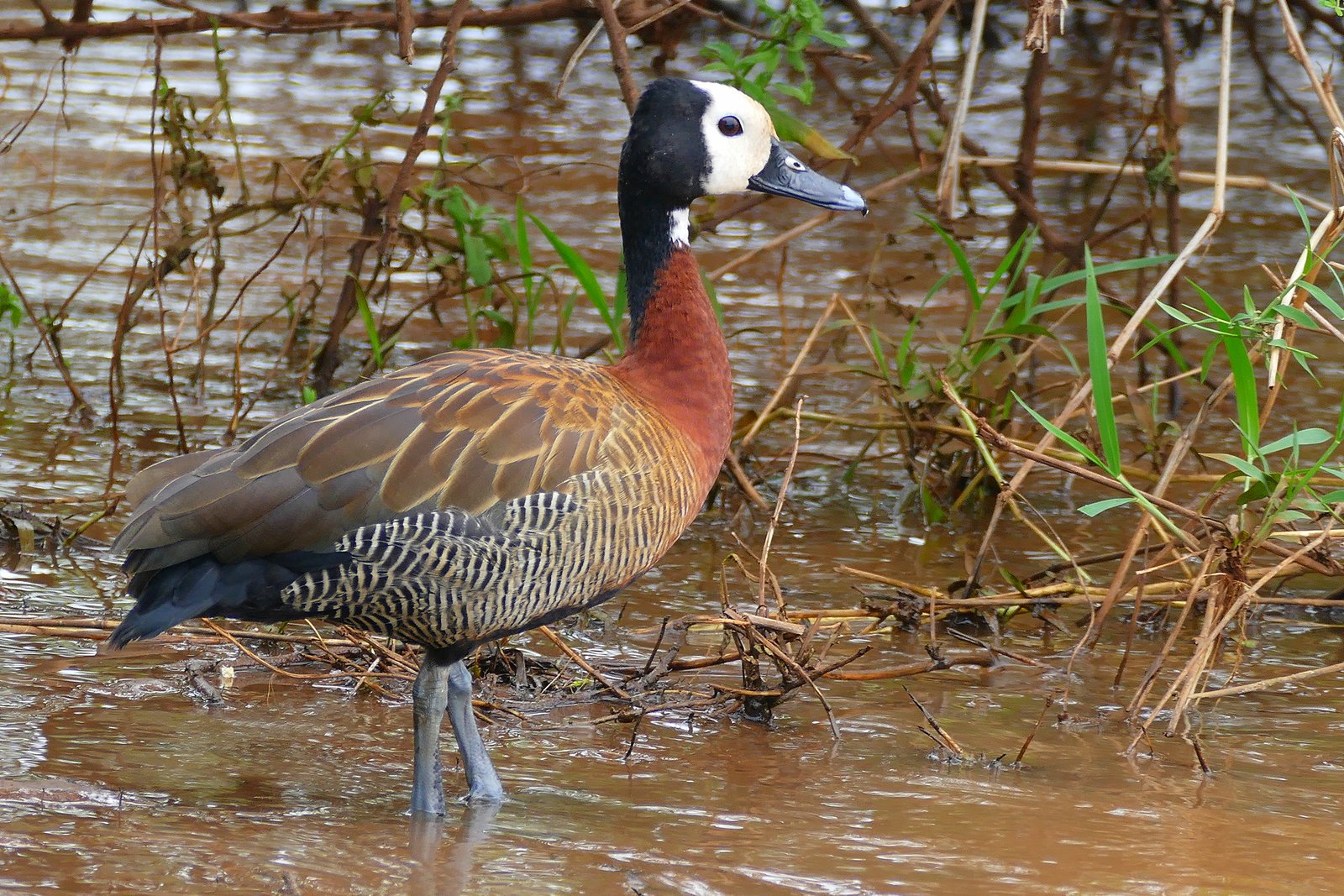
The White-faced Whistling Duck is an upright, long-necked duck with a white face that lives in large, noisy flocks on marshes and wet savannas. It occurs in tropical South America and in sub-Saharan Africa, a distribution rarely found among ducks. Flocks are often active at night and then give themselves away by their clear, three-note whistle.
Voice
A clear, three-note whistle, wee-wee-weeoo, from which the Brazilian name irerê is also derived; flocks call a lot, also in flight and at night.
Recording: Romuald Mikusek — CC BY-NC-SA 4.0 · xeno-canto
Identification
43–48 cm, with a long neck, long grey legs and a dark bill. The front of the head is white, the hindcrown and hindneck are black. The neck and breast are chestnut, the centre of the belly is black and the flanks are finely barred black and white. The back and wings are brown with pale feather edges. In flight the wings are entirely dark, without white. The sexes are alike; juveniles have a greyish-brown face and less contrasting markings.
Confusion species
Black-bellied Whistling Duck Dendrocygna autumnalis has a red bill, a grey face without white, an entirely black belly and a broad white wing band that shows mainly in flight. Fulvous Whistling Duck Dendrocygna bicolor is largely warm tawny, with cream flank stripes and a white band on the rump in flight. Juvenile White-faced Whistling Ducks without a white face can be recognised by the finely barred flanks and the entirely dark wings.
Habitat
Freshwater marshes, shallow lakes, river backwaters, flooded savannas and rice fields in the lowlands, mostly below 500 m. It feeds mainly at dusk and at night on seeds, aquatic plants, small snails and insects, dabbling or walking in shallow water. By day it rests in flocks on banks and sandbars. The nest is on the ground among tall grass or reeds near water.
Where the bird is most at home, classified by the vegetation units of the Andes and the west coast.


Range and movements
In Colombia in the Caribbean lowlands, the Magdalena and Cauca valleys and the llanos. In Ecuador rare and local. In Peru local in the Amazonian lowlands. In Bolivia widespread in the Beni savannas and the eastern lowlands. Absent from the Galápagos. Outside the guide area in Venezuela, the Guianas, Brazil, Paraguay, Uruguay and northern Argentina, and in sub-Saharan Africa and Madagascar.
- Resident
- dark = core range, pale = thinly spread
How and when to look
In the Beni savannas of Bolivia and the llanos of Colombia large flocks often rest along shallow pools in the dry season. At dusk, listen for flocks flying over, whistling, to their feeding areas.
Conservation status
Least Concern. The species is hunted locally, and the draining of marshes reduces its habitat; rice fields offer partial replacement.
Scientific name
Dendrocygna viduata | (Linnaeus, 1766)
Linnaeus described the species in 1766 as Anas viduata; because it was later moved to another genus, the author and year stand in brackets. The genus Dendrocygna was introduced in 1837 by Swainson. The genus name is from Greek dendron, 'tree', and kuknos, 'swan'. Latin viduata means 'widowed' or 'in mourning', after the black and white head plumage. The specimen the first description was based on came from Cartagena, Colombia.