All species › Waterfowl › Screamers › Southern Screamer
Southern Screamer | Chauna torquata
Kuifhoenderkoet | Chajá | Tachã
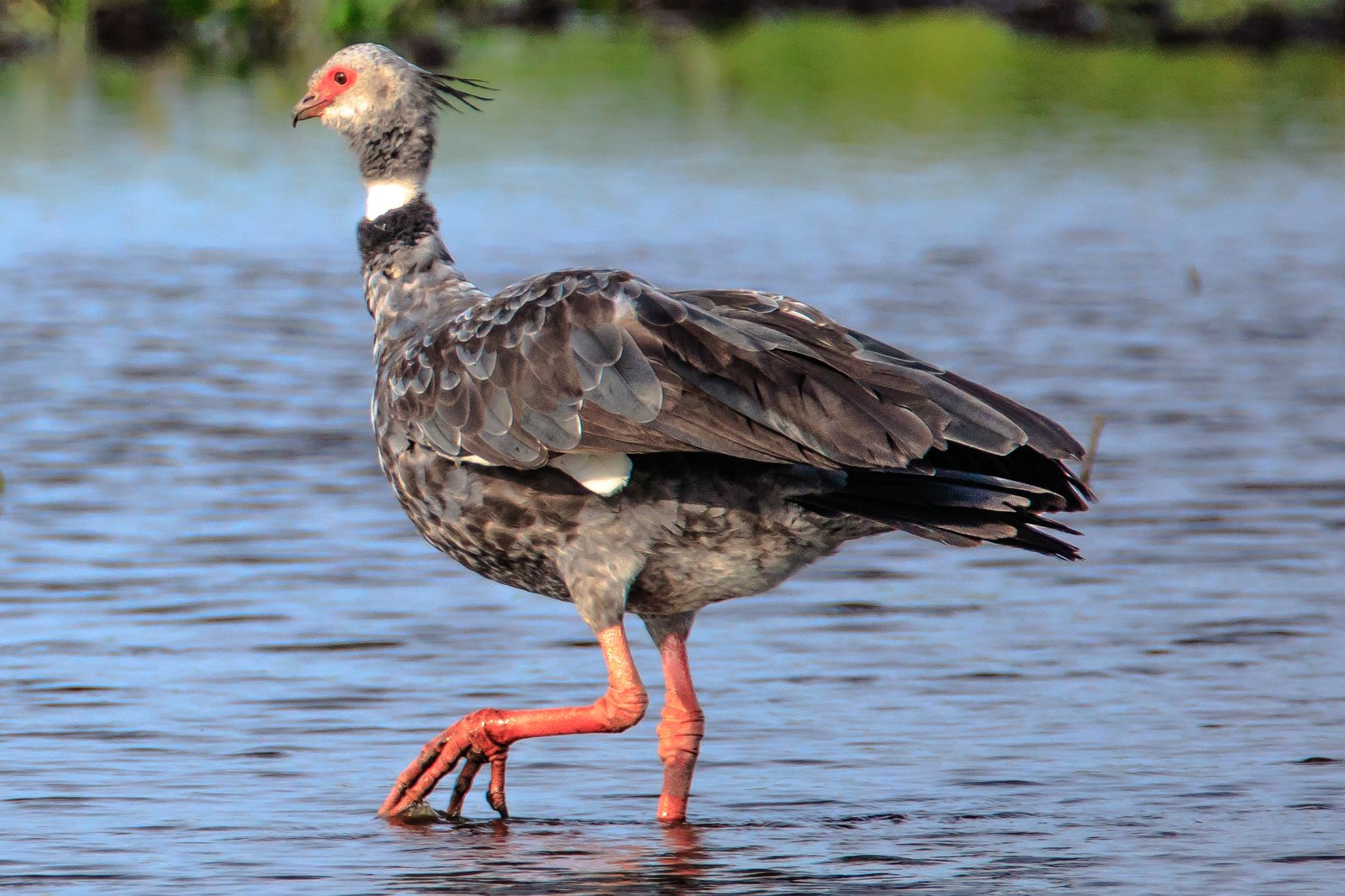
The Southern Screamer is a large, grey, goose-like bird of the wet savannas of southern South America. In the guide area it occurs only in the lowlands of Bolivia and the extreme south-east of Peru. Pairs give themselves away over long distances with their loud, trumpeting duet, and the birds often soar high in the sky like a raptor.
Voice
A very loud, trumpeting cha-ha or cha-ya, often given by the pair in duet, also in flight and at night; the Spanish name chajá derives from it. It carries for kilometres.
Recording: Bobby Wilcox — CC BY-NC-SA 4.0 · xeno-canto
Identification
83–95 cm, heavily built, with a small head, a short, chicken-like bill and long, thick legs. The plumage is grey, darker on the back and wings. A short crest sits at the back of the head. A narrow white collar encircles the neck, with a broader black band below it. Bare red skin surrounds the eye, and the legs are pink to red. Each bend of the wing carries two sharp spurs. In flight the wings are broad and rounded, with white underwing coverts. The sexes are alike.
Confusion species
Horned Screamer Anhima cornuta is blackish with a white belly, has a long, thin ‘horn’ on the forehead and lacks the white and black neck ring; it lives more in marshes in forested country. Geese do not occur in this part of the guide area.
Habitat
Wet savannas, flooded grassland, marshes and the shores of shallow lakes and lagoons in the lowlands, also damp pastures. It grazes on land and in shallow water on leaves, shoots and seeds of aquatic plants and grasses. It often rests and calls from a tree, bush or high bank. The nest is a large heap of plant material in shallow water or in dense marsh vegetation.
Where the bird is most at home, classified by the vegetation units of the Andes and the west coast.


Range and movements
In Bolivia in the lowlands of the north and east, especially in the savannas of the Beni and in Santa Cruz. In Peru rare and local in the extreme south-east, near the Bolivian border. Absent from Colombia and Ecuador. Outside the guide area in Paraguay, southern Brazil, Uruguay and northern and central Argentina.
- Resident
- dark = core range, pale = thinly spread
How and when to look
In the wet savannas of the Beni it is often seen from the road or from a boat, grazing in pairs or groups near water. The loud duet makes it conspicuous from afar.
Conservation status
Least Concern. Common in much of its range; the species tolerates cattle ranching well, but drainage of wetlands locally reduces its habitat.
Scientific name
Chauna torquata | (Oken, 1816)
Oken described the species in 1816 as Chaja torquata; because it was later moved to another genus, the author and year stand in brackets. The genus Chauna was introduced in 1811 by Illiger. The genus name comes from Greek khaunos, 'spongy, porous', for the air cells beneath the skin. Illiger (1811) chose the name for the crackling of the skin when touched. The species name torquata is Latin for 'collared', after the black ring around the neck. The specimen the first description was based on came from Paraguay, Río de la Plata region.