All species › Waterfowl › Screamers › Northern Screamer
Northern Screamer | Chauna chavaria
Witwanghoenderkoet | Chavarría | Tachã-do-norte
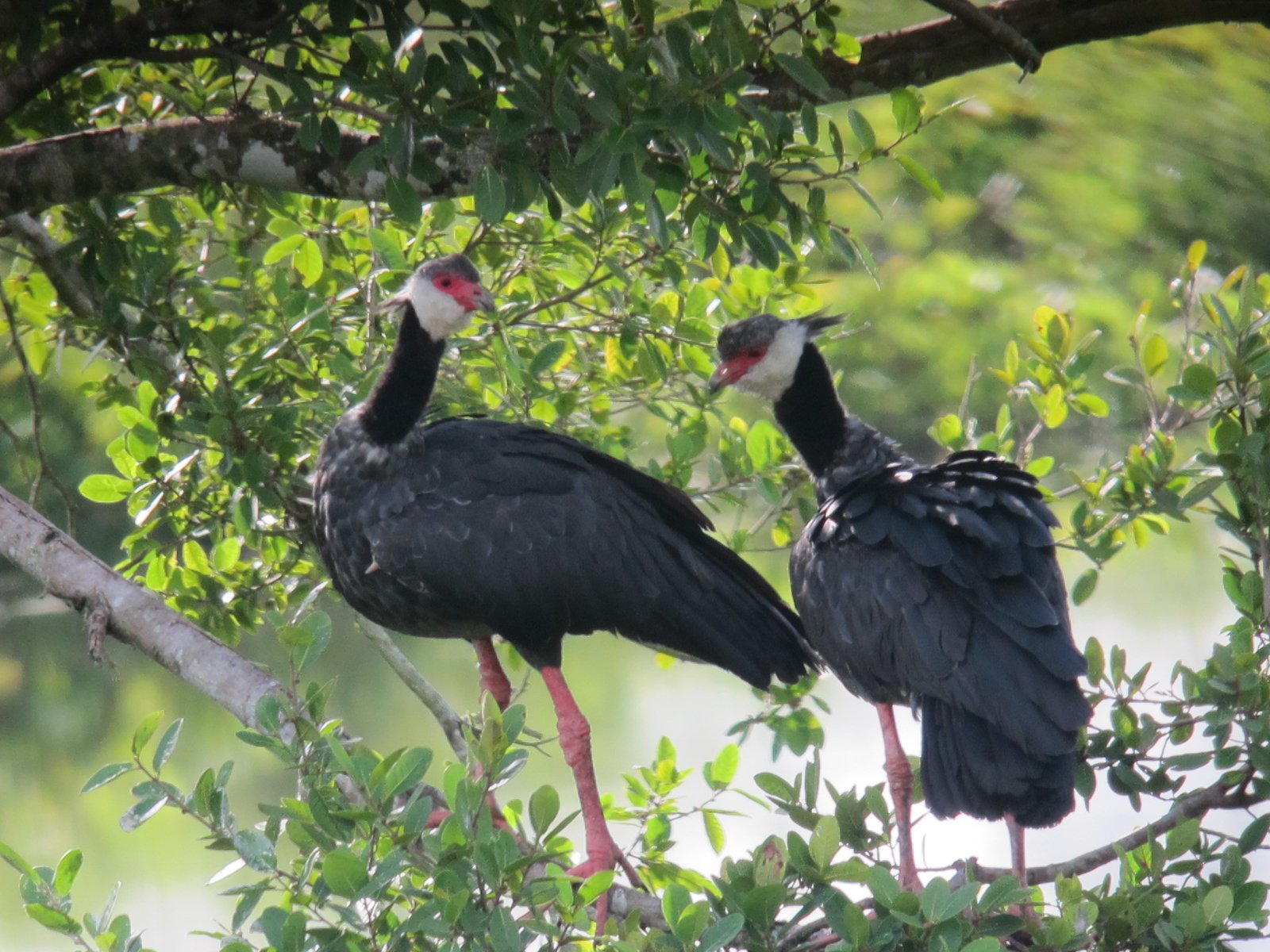
The Northern Screamer is a large, dark grey, goose-like bird with a conspicuous white face that lives only in the marshes and ciénagas of northern Colombia and north-western Venezuela. In the guide area it therefore occurs only in Colombia. Pairs call loudly in duet and sometimes soar high over the marshes.
Voice
A very loud, trumpeting, two-syllabled cha-ha, often given by the pair in duet, also in flight. Also lower, rumbling notes. It carries over long distances.
Recording: Oswaldo Cortes — CC BY-NC-SA 4.0 · xeno-canto
Identification
76–91 cm, heavily built, with a small head, a short, chicken-like bill and long, thick legs. The cheeks and throat are white, the crown grey with a short, blackish crest at the back of the head. The neck is black and forms a broad collar between the white head and the slate-grey body. Bare red skin surrounds the eye, and the legs are orange-red. Each bend of the wing carries two sharp spurs. In flight the wings are broad and rounded, with white underwing coverts. The sexes are alike.
Confusion species
Horned Screamer Anhima cornuta is blackish with a white belly and a long horn on the forehead, lacks the white face and lives east of the Andes. Southern Screamer Chauna torquata is greyer, with a grey head and a narrow white and black neck ring, and in the guide area occurs only in Bolivia and south-eastern Peru.
Habitat
Marshes, ciénagas, the shores of shallow lagoons and slow rivers with floating vegetation, and flooded pastures in the lowlands, mostly below 300 m. It grazes on land and in shallow water on leaves and shoots of aquatic plants. It often rests in trees or bushes near water. The nest is a large heap of plant material in shallow water or in dense marsh vegetation.
Where the bird is most at home, classified by the vegetation units of the Andes and the west coast.


Range and movements
In Colombia in the Caribbean lowlands of the north, especially in the ciénagas of the lower Magdalena, Cauca and Sinú, and in the Catatumbo region. Absent from Ecuador, Peru, Bolivia and the Galápagos. Outside the guide area only in the Lake Maracaibo basin of north-western Venezuela.
- Resident
- dark = core range, pale = thinly spread
How and when to look
Search the ciénagas of the Magdalena lowlands, for example around Mompox, along shores and in wet pastures. The birds often sit in the open in a tree or graze at the water's edge; they call mainly in the morning.
Conservation status
Least Concern, but with a small range. Drainage of marshes for cattle ranching and agriculture and local hunting have reduced numbers in many places.
Scientific name
Chauna chavaria | (Linnaeus, 1766)
Linnaeus described the species in 1766 as Parra Chavaria; because it was later moved to another genus, the author and year stand in brackets. The genus Chauna was introduced in 1811 by Illiger. The genus name comes from Greek khaunos, 'spongy, porous', for the air cells beneath the skin. Illiger (1811) chose the name for the crackling of the skin when touched. The species name goes back to Chavaria, the name Jacquin recorded in 1763 as the Spanish and indigenous name for this screamer at Cartagena (Colombia). The specimen the first description was based on came from Río Sinú, south of Cartagena, Colombia.