All species › Waterfowl › Screamers › Horned Screamer
Horned Screamer | Anhima cornuta
Hoornhoenderkoet | Gritador unicornio | Anhuma
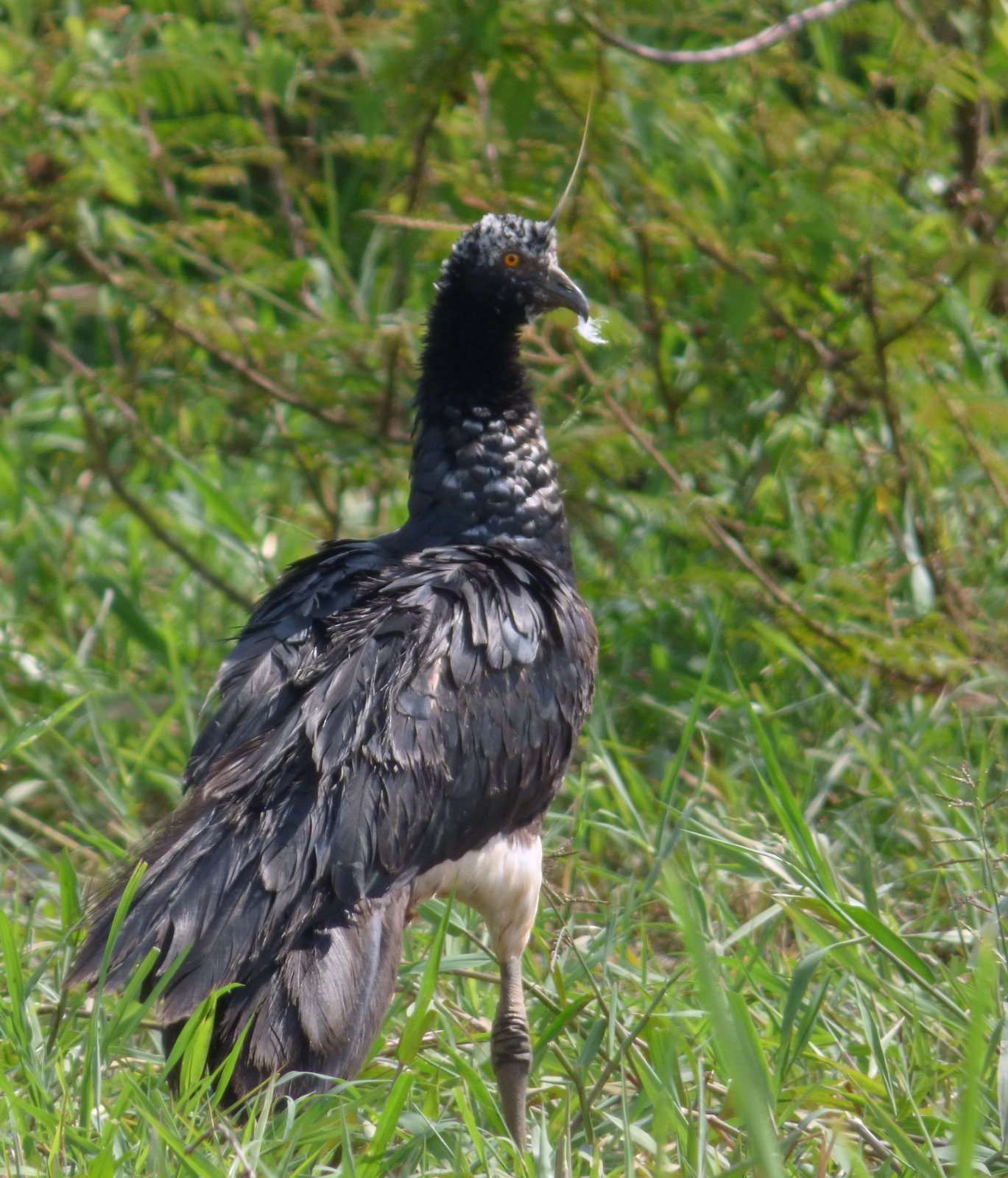
The Horned Screamer is a large, blackish, goose-like bird of marshes and lake shores in the lowlands east of the Andes. On the forehead it carries a long, thin, forward-curving ‘horn’ that is unique among birds. Pairs often perch high in a tree or on floating vegetation and give their loud calls over long distances.
Voice
Very loud, resonant, honking calls in short series, often given by the pair in duet, also in flight. Also deep, muffled, rumbling notes. It carries far.
Recording: Jacob Wijpkema — CC BY-NC-SA 4.0 · xeno-canto
Identification
84–94 cm, heavily built, with a small head, a short, chicken-like bill and long, thick legs. A long, thin, whitish horn of up to about 15 cm rises from the forehead. The head, neck and upperparts are blackish with a green gloss; the crown and neck are scaled white. The belly is white. Each bend of the wing carries two sharp spurs. In flight a white patch on the upperwing stands out, and the wings are broad and rounded. The legs are grey. The sexes are alike.
Confusion species
Southern Screamer Chauna torquata is grey, without a horn, with a white and a black neck ring and pink to red legs; it overlaps only in the lowlands of Bolivia and the extreme south-east of Peru. Northern Screamer Chauna chavaria has white cheeks and throat, no horn, and lives only west of the Andes in northern Colombia.
Habitat
Marshes, the shores of oxbow lakes and slow rivers with floating vegetation, flooded grassland and open areas in várzea in the lowlands, mostly below 500 m. It grazes on land and in shallow water on leaves and shoots of aquatic plants. It often rests high in bare trees near water. The nest is a large heap of plant material in shallow water or in dense marsh vegetation.
Where the bird is most at home, classified by the vegetation units of the Andes and the west coast.


Range and movements
In Colombia in the lowlands east of the Andes, in the Llanos and the Amazon basin. In Ecuador in the Amazonian lowlands. In Peru in the Amazonian lowlands. In Bolivia in the lowlands of the north and east, including the savannas of the Beni. Absent from the Galápagos. Outside the guide area in Venezuela, the Guianas and much of Brazil.
- Resident
- dark = core range, pale = thinly spread
How and when to look
Search the shores of oxbow lakes and slow rivers on a boat trip, for example around Manu and Tambopata in Peru or in the Llanos of Colombia. The birds often sit in the open on a treetop or on floating vegetation and call mainly in the morning.
Conservation status
Least Concern. Widespread in the Amazon and Orinoco lowlands; hunted locally and gone where marshes have been drained.
Scientific name
Anhima cornuta | (Linnaeus, 1766)
Linnaeus described the species in 1766 as Palamedea cornuta; because it was later moved to another genus, the author and year stand in brackets. The genus Anhima was introduced in 1760 by Brisson. The genus name comes from the name for this bird in Tupi, an indigenous language of Brazil. Georg Marcgrave already used Anhima in 1648. The species name cornuta is Latin for 'horned', after the horn-like quill on the head. The specimen the first description was based on came from Brazil.