All species › Woodpeckers and allies › Woodpeckers › Cinnamon Woodpecker
Cinnamon Woodpecker | Celeus loricatus
Roodkeelspecht | Carpintero canelo | Pica-pau-canela
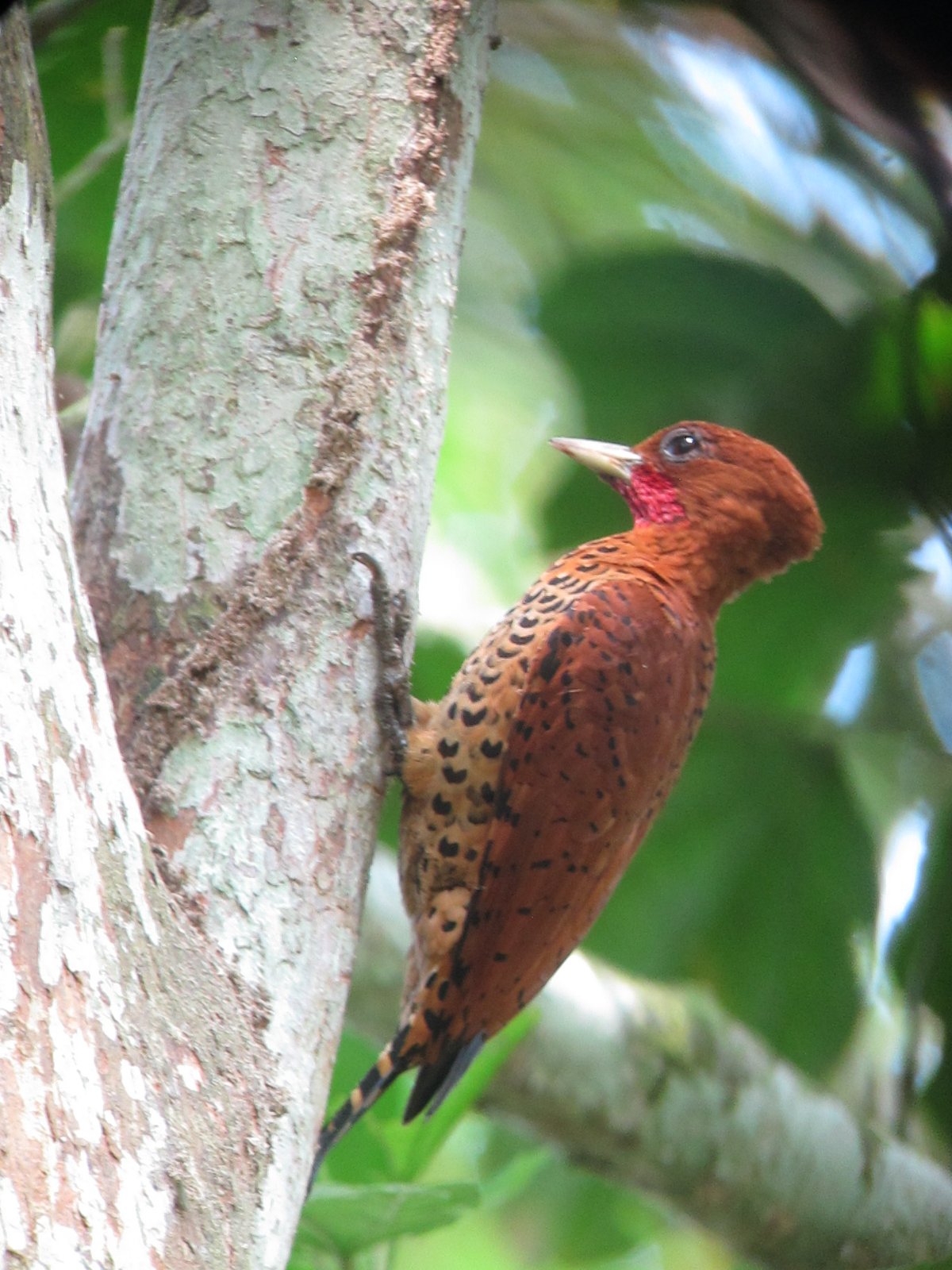
The Cinnamon Woodpecker is a medium-sized, cinnamon-rufous woodpecker with a short crest, found in humid lowland forest west of the Andes. In the guide area it is the only Celeus woodpecker of the Chocó and northern Colombia. The male has a red throat, from which the Dutch name is derived.
Voice
A clear, whistled series of three to five notes falling in pitch, and a short, sharp call. It rarely drums.
Recording: Juan Freile — CC BY-NC-SA 4.0 · xeno-canto
Identification
20–22 cm, with a short, shaggy crest and a straight, yellowish bill. The plumage is warm cinnamon-rufous. The upperparts have fine black bars, stronger or weaker depending on subspecies. The underparts are paler, buff to creamy, with bold black, heart-shaped scales on the breast and belly. The tail is rufous with black bars. The male has red on the chin, throat and malar area; the female lacks the red.
Confusion species
In the guide area no other Celeus woodpeckers live west of the Andes. Chestnut Woodpecker Celeus elegans and Variable Woodpecker Celeus undatus live east of the Andes. Golden-olive Woodpecker Colaptes rubiginosus has a greenish back, a grey crown and barred, yellow-green underparts.
Habitat
Humid lowland forest, tall secondary forest and forest edges, mainly in the canopy and middle levels, from sea level to about 800 m, locally higher. It eats ants and termites, which it takes from nests in trees, and also fruit. It nests in a self-excavated cavity in a tree.
Where the bird is most at home, classified by the vegetation units of the Andes and the west coast.


Range and movements
In Colombia in the Pacific lowlands of the Chocó and in the humid lowlands of the north, east to the middle Magdalena valley. In Ecuador in the north-western lowlands. Absent from Peru, Bolivia and the Galápagos. Outside the guide area from Nicaragua to Panama.
- Resident
- dark = core range, pale = thinly spread
How and when to look
In the lowland forest of the Chocó and north-western Ecuador, listen for the falling whistled series and then search the crowns and forest edges. Birds sometimes join mixed canopy flocks.
Conservation status
Least Concern. The species depends on humid lowland forest, which is declining through logging in parts of its range.
Scientific name
Celeus loricatus | (Reichenbach, 1854)
Reichenbach described the species in 1854 as Meiglyptes loricatus; because it was later moved to another genus, the author and year stand in brackets. The genus Celeus was introduced in 1831 by Boie. The genus name comes from Greek keleos, the name for a green woodpecker. The species name comes from Latin loricatus, 'armoured', from lorica, 'cuirass', probably for the scaled pattern on the underparts. The specimen the first description was based on came from Peru.