All species › Woodpeckers and allies › Woodpeckers › Lineated Woodpecker
Lineated Woodpecker | Dryocopus lineatus
Gestreepte helmspecht | Carpintero lineado | Pica-pau-de-banda-branca
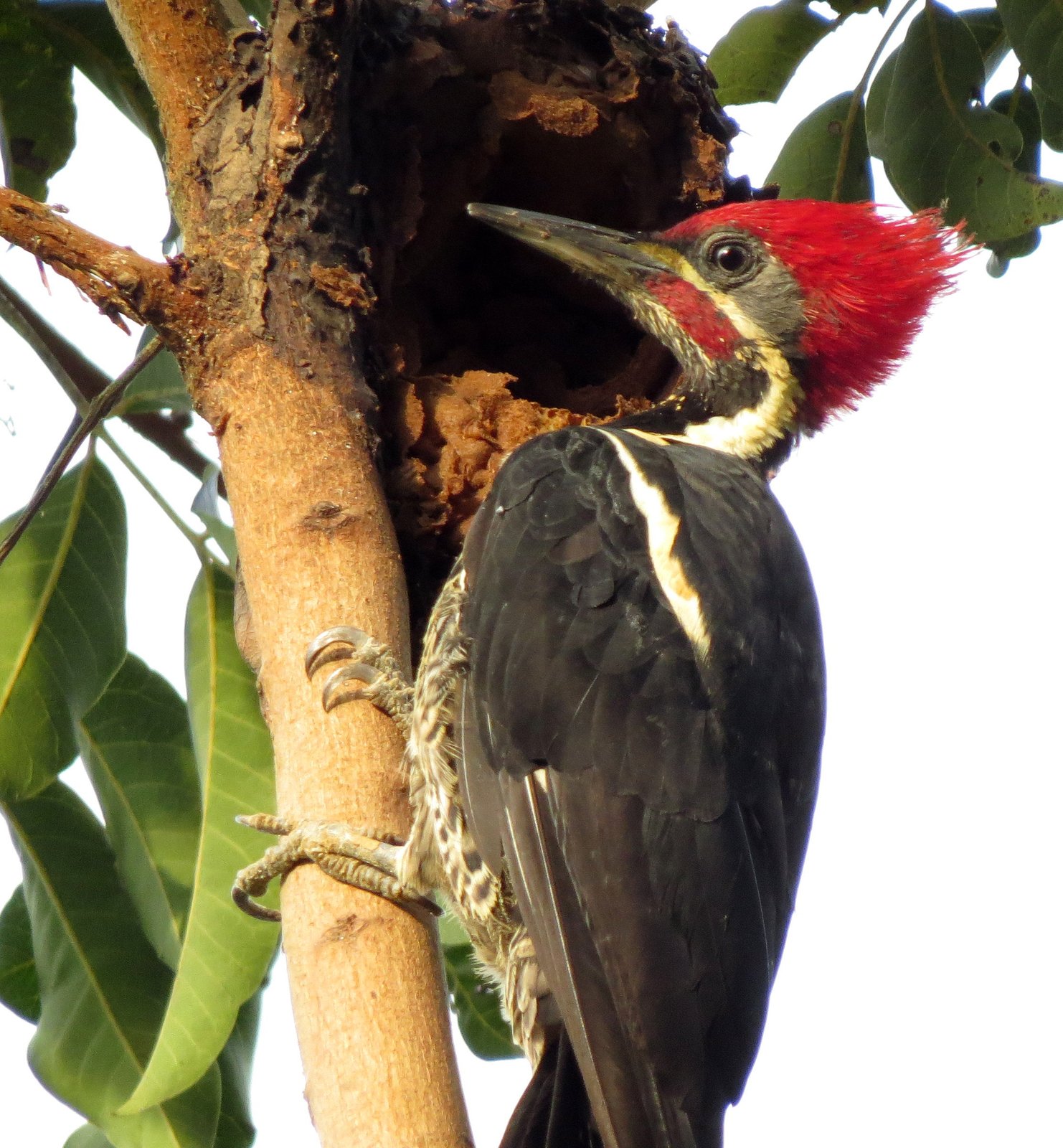
The Lineated Woodpecker is a large, black woodpecker with a red crest and white stripes on the head and back, found throughout almost all the lowlands of the guide area. It mainly lives in semi-open country with dead trees and forest edges, and so can also be found in areas heavily altered by people. Birds west of the Andes, in western Ecuador and north-western Peru, are duller and browner and are sometimes treated as a separate species.
Voice
A loud, laughing series wik-wik-wik-wik and a short, explosive call pik-krrr. It drums in a long, even roll.
Recording: JAYRSON ARAUJO DE OLIVEIRA — CC BY-NC-SA 4.0 · xeno-canto
Identification
31–35 cm, with a long, straight, pale grey bill and a pointed red crest. The upperparts are black. A narrow white stripe runs from the bill base across the cheek to the side of the neck, and two white scapular stripes on the back converge towards the rear without meeting. The throat is streaked black and white, the breast black and the belly buff with black barring. The male has a red forehead and a red malar stripe, the female a black forehead and a black malar stripe. In flight the underwings are white.
Confusion species
Crimson-crested Woodpecker Campephilus melanoleucos has white scapular stripes that form a closed V on the back, an almost entirely red head in the male, and in the female a white stripe that reaches the bill. Guayaquil Woodpecker Campephilus gayaquilensis west of the Andes resembles Crimson-crested. Both Campephilus species drum with a double knock. Black-bodied Woodpecker Dryocopus schulzii in the Bolivian Chaco is almost entirely black, without a barred belly.
Habitat
Forest edges, open woodland, secondary forest, gallery forest, clearings with dead trees, plantations and the edges of dry forest, from the lowlands to about 1500 m, locally higher. It searches trunks and large branches for ants, beetles and their larvae, and also eats fruit. It nests in a self-excavated cavity in a dead trunk.
Where the bird is most at home, classified by the vegetation units of the Andes and the west coast.


Range and movements
In Colombia widespread in the lowlands and on the lower slopes on both sides of the Andes. In Ecuador in the western and eastern lowlands and foothills. In Peru throughout the Amazonian lowlands and the lower eastern slope, and in the north-west. In Bolivia in the lowlands of the north and east. Absent from the Galápagos. Outside the guide area from Mexico to northern Argentina.
- Resident
- dark = core range, pale = thinly spread
How and when to look
Along forest edges, rivers and open ground with dead trees, listen for the loud, laughing calls and the long drum rolls. Birds often perch high and in the open on dead trunks and can then be seen from a great distance.
Conservation status
Not Evaluated in its current taxonomic treatment. In the older, broader treatment the species was listed as Least Concern. It has a very large range and tolerates forest edges, secondary forest and semi-open farmland.
Scientific name
Dryocopus lineatus | (Linnaeus, 1766)
Linnaeus described the species in 1766 as Picus lineatus; because it was later moved to another genus, the author and year stand in brackets. The genus Dryocopus was introduced in 1826 by Boie. The genus name comes from Greek drus, 'tree', and kopos, 'striking, hewing'. The species name comes from Latin lineatus, 'lined', for the white stripes on the head and back. The specimen the first description was based on came from Cayenne, French Guiana.