All species › Woodpeckers and allies › Woodpeckers › Black-bodied Woodpecker
Black-bodied Woodpecker | Dryocopus schulzii
Zwartbuikhelmspecht | Picamaderos chaqueño | Pica-pau-de-corpo-preto
The Black-bodied Woodpecker is a large, almost entirely black woodpecker with a red crest, restricted to the Chaco of southern South America. In the guide area it occurs only in the far south-east of Bolivia. Its habitat is declining due to clearance of Chaco forest.
Voice
Loud, rapidly repeated wik-wik-wik series and a short, harsh call. It drums in long, even rolls.
Recording: Niels Krabbe — CC BY-NC-SA 4.0 · xeno-canto
Identification
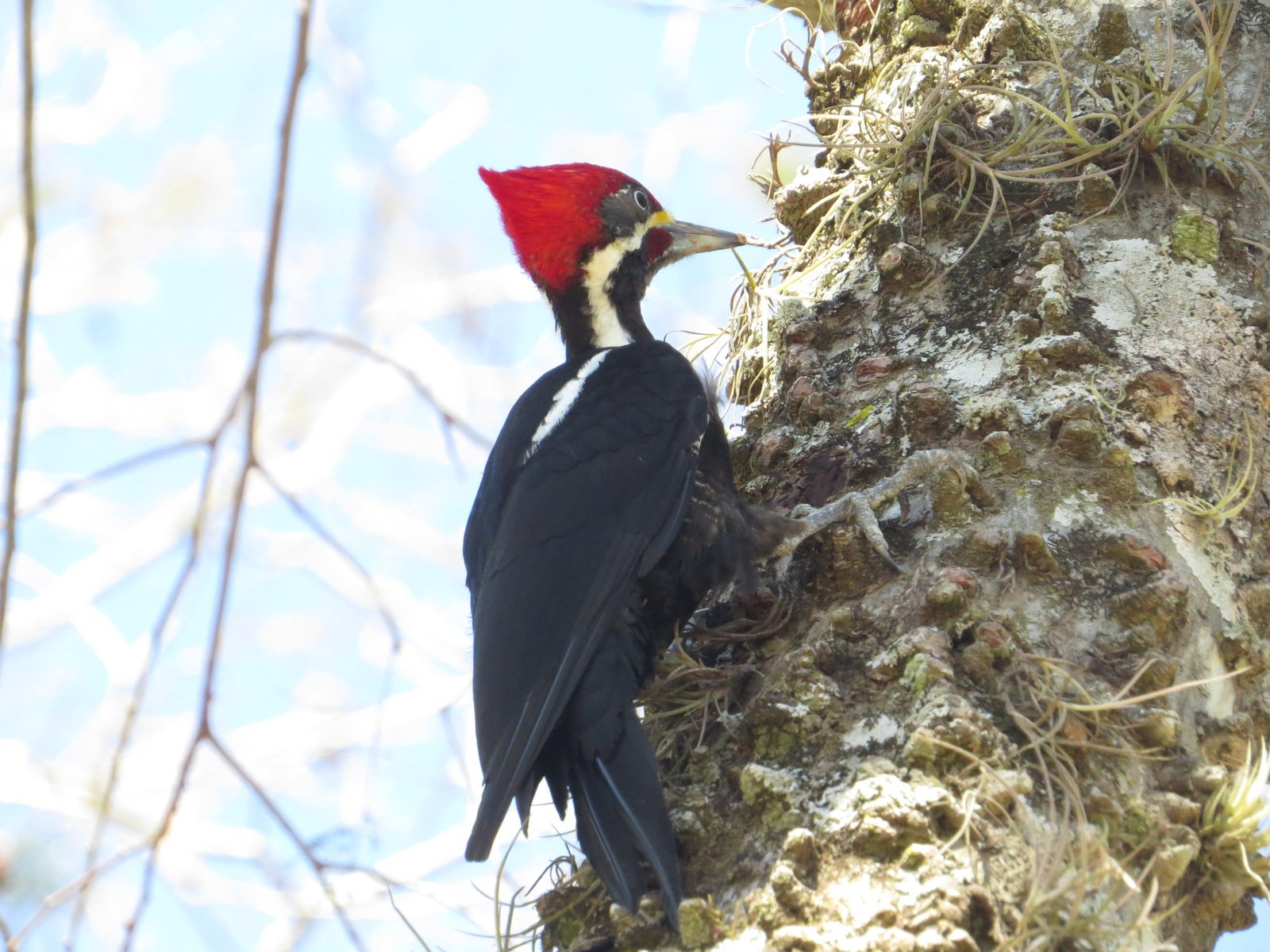
28–30 cm, with a strong, straight, pale bill and a pointed red crest. The body, back and wings are sooty black; white scapular stripes are absent or at most faint. A narrow white stripe runs from the bill base below the eye along the side of the neck. The male has a red malar stripe and a red forehead, the female a black forehead and a black malar stripe. In flight the white underwings stand out.
Confusion species
Lineated Woodpecker Dryocopus lineatus has white scapular stripes on the back and a barred, pale belly. Cream-backed Woodpecker Campephilus leucopogon, in the same Chaco forest, has a creamy back and, in the male, an all-red head. Crimson-crested Woodpecker Campephilus melanoleucos has a white V on the back, a barred belly and a pale patch at the bill.
Habitat
Dry Chaco forest with tall trees, gallery forest and transitions to semi-humid forest, in the guide area in the lowlands and low foothills up to about 1000 m. It searches trunks and large branches for ants and beetles and their larvae. It nests in a self-excavated cavity in a tree.
Where the bird is most at home, classified by the vegetation units of the Andes and the west coast.


Range and movements
In Bolivia only in the south-east, in the Chaco of Santa Cruz, Chuquisaca and Tarija. Absent from Colombia, Ecuador, Peru and the Galápagos. Outside the guide area in western Paraguay and northern Argentina.
- Resident
- dark = core range, pale = thinly spread
How and when to look
Search larger tracts of Chaco forest with old trees in south-eastern Bolivia and listen in the morning for the loud call series and drumming. Also watch for birds flying across open patches between woods.
Conservation status
Near Threatened. The population is small and fragmented and is declining because of large-scale clearance of Chaco forest for farming and cattle ranching.
Scientific name
Dryocopus schulzii | (Cabanis, 1882)
Cabanis described the species in 1882 as Phloeotomus Schulzi; because it was later moved to another genus, the author and year stand in brackets. The genus Dryocopus was introduced in 1826 by Boie. The genus name comes from Greek drus, 'tree', and kopos, 'striking, hewing'. The species name honours the German zoologist Friedrich W. Schulz (died 1933), who worked in Argentina from 1866 to 1933. The specimen the first description was based on came from Tucumán, Argentina.