All species › Woodpeckers and allies › Woodpeckers › Chestnut Piculet
Chestnut Piculet | Picumnus cinnamomeus
Rosse dwergspecht | Carpinterito castaño | Pica-pau-anão-castanho
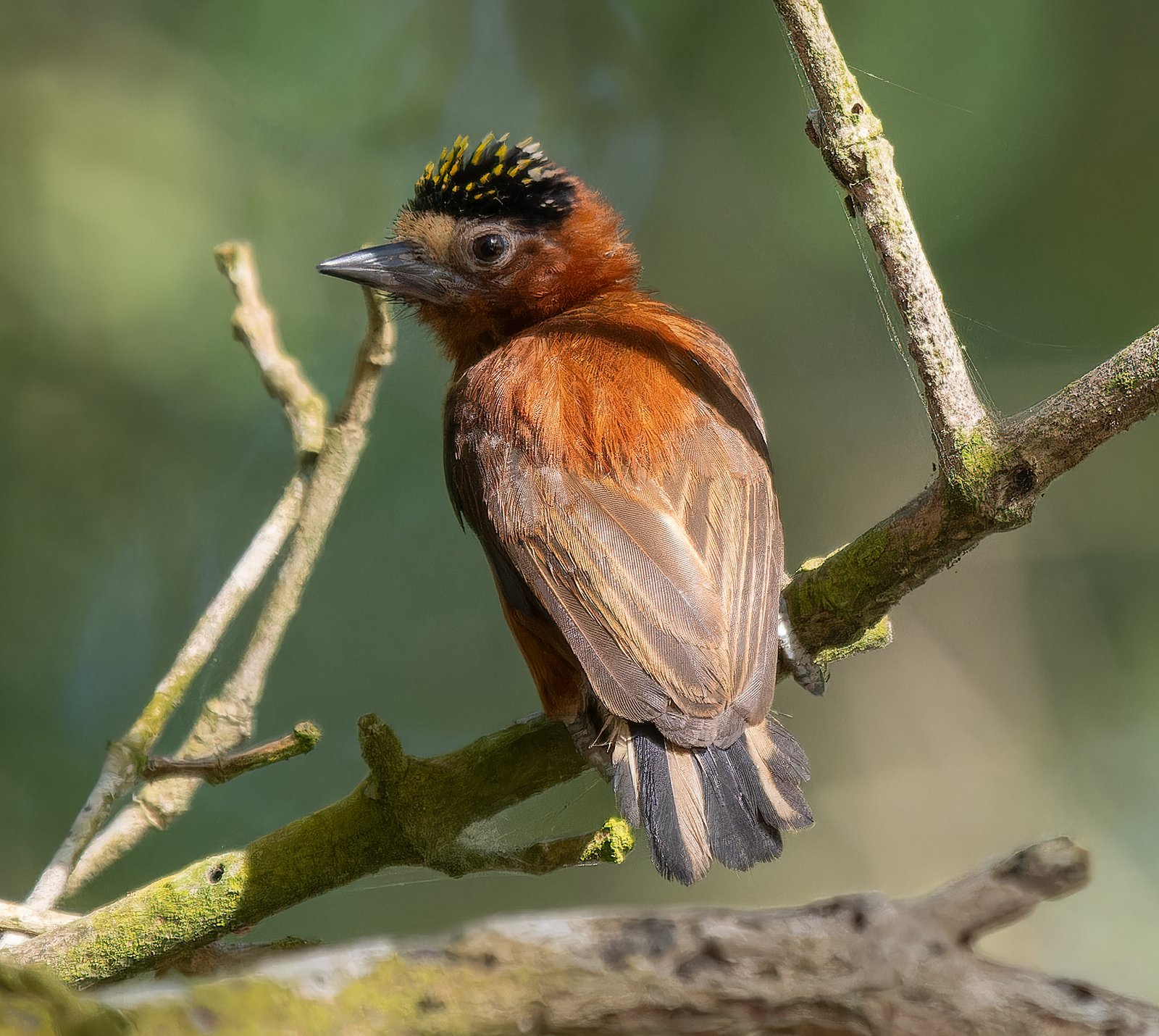
The Chestnut Piculet is a chestnut-brown piculet of the dry lowlands along the Caribbean coast of Colombia and adjacent Venezuela. Its almost entirely rufous-brown body sets it apart from all other piculets in the guide area. It lives in dry forest, scrub and mangrove.
Voice
A high, thin trill and sharp, short tsit calls. Also soft tapping on thin branches.
Recording: Oswaldo Cortes — CC BY-NC-SA 3.0 · xeno-canto
Identification
9–10 cm, with a short, straight, grey bill and a short tail. The head, upperparts and underparts are deep chestnut. The forehead is pale, buff to dirty white depending on subspecies. The crown is black; in the male with yellow dots, in the female with white dots. The wings are brownish, and the tail is black with pale stripes. The sexes differ only in the colour of the crown dots.
Confusion species
No other piculet in the guide area has an entirely chestnut body. Scaled Piculet Picumnus squamulatus, in the same part of Colombia, is pale above and below with dark scales. Olivaceous Piculet Picumnus olivaceus is olive-brown with a yellowish belly.
Habitat
Dry and semi-dry deciduous forest, thorn scrub, gallery forest, mangrove and forest edges in the lowlands, from sea level to about 300 m. It searches thin branches, vines and dry stems for ants, larvae and other small insects, often in pairs or mixed flocks. It excavates a nest cavity in a thin, dead branch.
Where the bird is most at home, classified by the vegetation units of the Andes and the west coast.


Range and movements
In Colombia in the Caribbean lowlands, from the area around Cartagena and the lower Magdalena east to La Guajira and Cesar. Absent from Ecuador, Peru, Bolivia and the Galápagos. Outside the guide area in north-western Venezuela, around Lake Maracaibo.
- Resident
- dark = core range, pale = thinly spread
How and when to look
Search dry forest and scrub in the Caribbean lowlands, for example around the Sierra Nevada de Santa Marta and in La Guajira, and the edges of mangroves. Listen for tapping on thin twigs and follow mixed flocks.
Conservation status
Least Concern. The range is limited and the dry forest of the Caribbean coast is highly fragmented, but the species tolerates scrub and secondary forest.
Scientific name
Picumnus cinnamomeus | Wagler, 1829
Wagler described the species in 1829 and placed it straight away in the genus where it still stands. The genus Picumnus was introduced in 1825 by Temminck. The genus name refers to Picumnus, a Roman god of fertility and agriculture, brother of Pilumnus, whose name is related to Latin picus, 'woodpecker'. The species name comes from Latin cinnamomeus, 'cinnamon-coloured', for the chestnut plumage. The specimen the first description was based on came from Cartagena, Colombia.