All species › Woodpeckers and allies › Woodpeckers › Greyish Piculet
Greyish Piculet | Picumnus granadensis
Grijze dwergspecht | Carpinterito colombiano | Pica-pau-anão-acinzentado
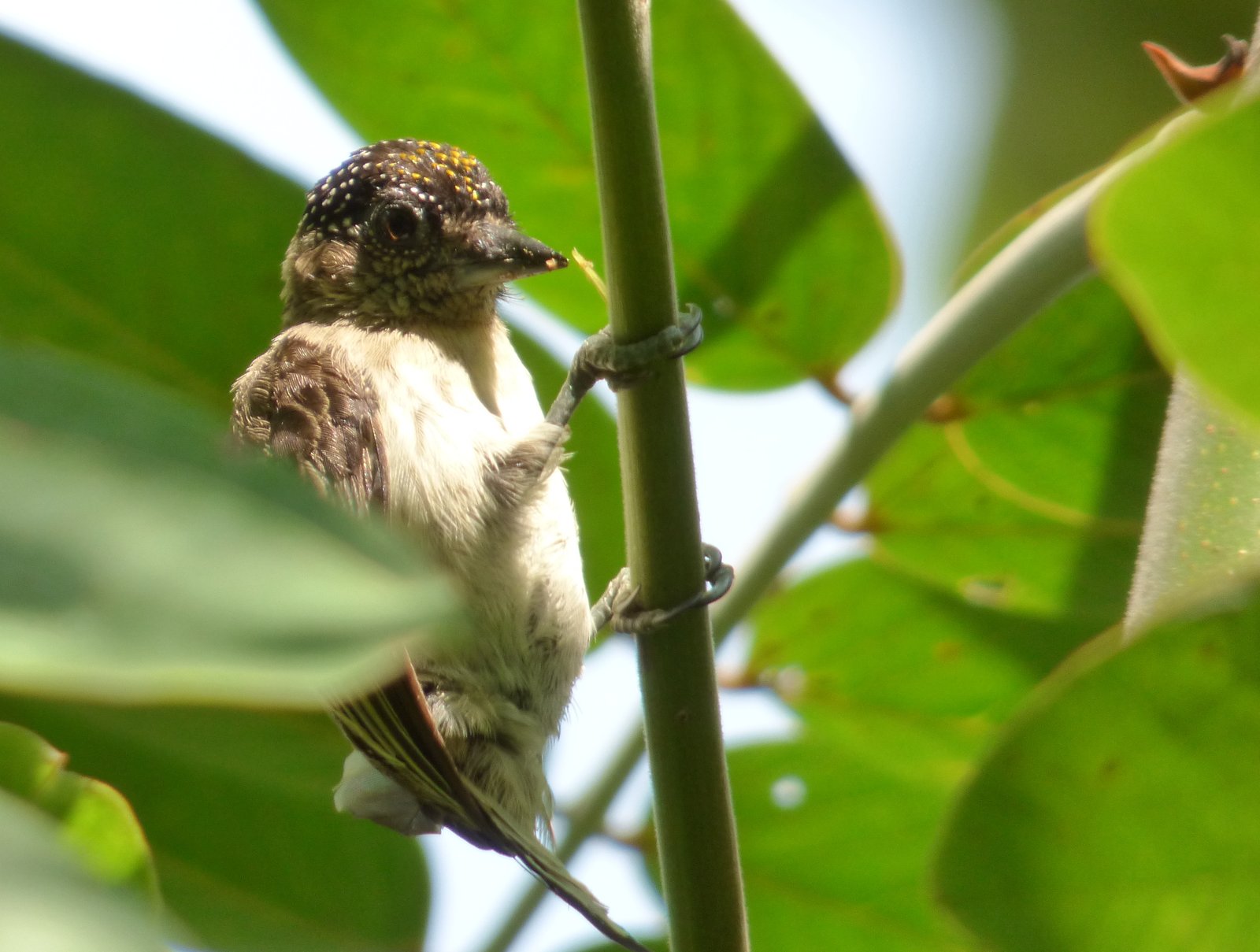
The Greyish Piculet is a piculet found only in Colombia, in the drier valleys between the Western and Central Andes. With its plain greyish-brown upperparts and dirty white underparts it is the most plainly coloured piculet of the guide area. It replaces the Olivaceous Piculet in the dry parts of the Cauca and Patía valleys.
Voice
A high, thin trill and short, sharp tsit calls. Also soft tapping on thin branches.
Recording: Jerome Fischer — CC BY-NC-SA 4.0 · xeno-canto
Identification
9–10 cm, with a short, straight, grey bill and a short tail. The crown is black; in the male with yellow-orange to red dots on the forehead and white dots behind, in the female with white dots only. The upperparts are plain pale greyish brown. The underparts are dirty white, with faint dark streaks on the breast and flanks, strongest in the north of the range. The tail is black with white stripes. Juveniles have a duller, barely dotted crown.
Confusion species
Olivaceous Piculet Picumnus olivaceus, in more humid places, is olive-brown with an olive breast and a yellowish belly; intermediates occur where the two meet. Scaled Piculet Picumnus squamulatus of northern Colombia is clearly scaled above and below.
Habitat
Dry and semi-humid forest, scrub, gallery forest, forest edges, young secondary growth and coffee plantations, roughly between 800 and 2200 m. It searches thin twigs and vines for ants, larvae and other small insects, alone, in pairs or in mixed flocks. It excavates a nest cavity in a thin, dead branch.
Where the bird is most at home, classified by the vegetation units of the Andes and the west coast.


Range and movements
In Colombia in the middle and upper Cauca valley, the Patía valley and the adjacent slopes of the Western and Central Andes, from Antioquia to Cauca and Nariño. Absent from Ecuador, Peru, Bolivia and the Galápagos. Only in Colombia; does not occur outside the guide area.
- Resident
- dark = core range, pale = thinly spread
How and when to look
Search thickets and scrub on the dry slopes of the Cauca and Patía valleys, preferably in the morning, and follow mixed flocks. The tapping on thin twigs and the high trill help to find it.
Conservation status
Least Concern. The range is small, but the species tolerates scrub, secondary forest and plantations.
Scientific name
Picumnus granadensis | de Lafresnaye, 1847
De Lafresnaye described the species in 1847 and placed it straight away in the genus where it still stands. The genus Picumnus was introduced in 1825 by Temminck. The genus name refers to Picumnus, a Roman god of fertility and agriculture, brother of Pilumnus, whose name is related to Latin picus, 'woodpecker'. The species name refers to New Granada, the former name of present-day Colombia. The specimen the first description was based on came from Cali, Colombia.