All species › Woodpeckers and allies › Woodpeckers › Olivaceous Piculet
Olivaceous Piculet | Picumnus olivaceus
Groenrugdwergspecht | Carpinterito oliváceo | Pica-pau-anão-oliváceo
The Olivaceous Piculet is a small, olive-brown piculet of forest edges and young woodland west and north of the Andes. Like other piculets it climbs thin twigs and vines rather than thick trunks, and does not use its tail as a prop. It is the most widespread piculet of western Colombia and western Ecuador.
Voice
A high, thin, slightly descending trill, sisisisi, and single sharp tsit calls. Also soft tapping on thin twigs.
Recording: José María Loaiza B. — CC BY-NC-SA 4.0 · xeno-canto
Identification
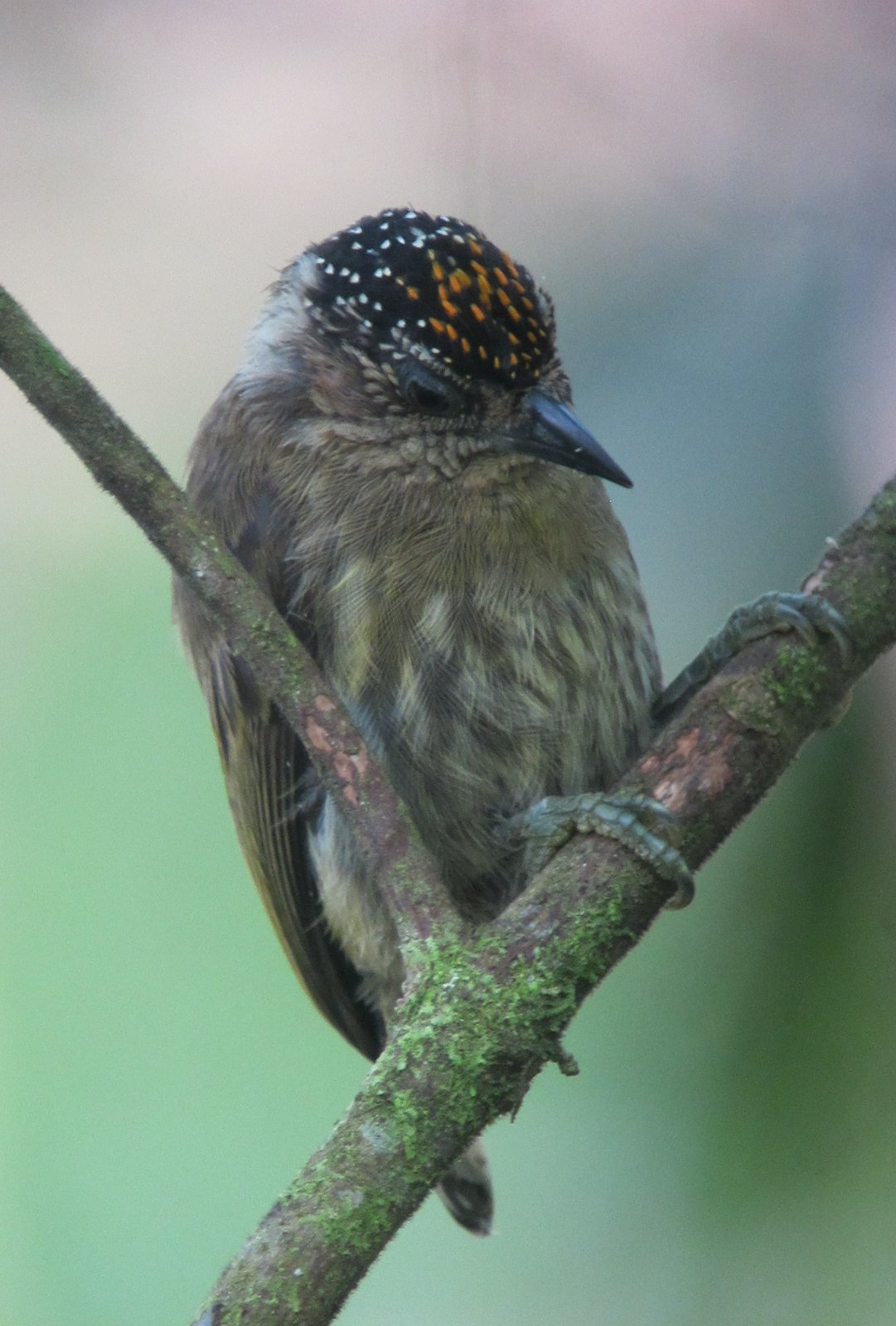
9–10 cm, with a short, straight, grey bill and a short, soft tail. The crown is black; in the male with orange-yellow streaks on the forehead and white dots on the hindcrown, in the female with white dots only. The upperparts are plain olive-brown. The throat is dirty white to buff, the breast olive-brown and the belly yellowish with faint olive streaks. The tail is black with white or yellowish stripes on the central and outer feathers. Juveniles have a crown with few or no dots.
Confusion species
Greyish Piculet Picumnus granadensis of the Cauca and Patía valleys is greyer brown, without olive and yellow tones, and has dirty white underparts; intermediates occur where the two meet. Ecuadorian Piculet Picumnus sclateri of dry south-western Ecuador and north-western Peru has black-and-white barred underparts. Scaled Piculet Picumnus squamulatus of northern Colombia is scaled above and below.
Habitat
Edges of humid and semi-humid forest, young secondary growth, scrub, gardens and coffee and cacao plantations, from sea level to about 2000 m, mostly below 1500 m. It searches thin twigs, vines and dry stems for ant larvae and other small insects, often in mixed flocks. It excavates a nest cavity in a thin, dead branch.
Where the bird is most at home, classified by the vegetation units of the Andes and the west coast.


Range and movements
In Colombia widespread in the lowlands and on the lower slopes west and north of the Eastern Andes, including the Cauca and Magdalena valleys and the Pacific coast, locally also in the north-east. In Ecuador in the western lowlands and foothills, south to El Oro and Loja. In Peru only in the far north-west. Absent from Bolivia and the Galápagos. Outside the guide area from Guatemala to north-western Venezuela.
- Resident
- dark = core range, pale = thinly spread
How and when to look
Follow mixed flocks along forest edges and through coffee plantations and look for a tiny bird clambering over thin twigs and vines. The soft tapping and the high trill often reveal it before it is seen.
Conservation status
Least Concern. The species has a large range and tolerates secondary forest, plantations and gardens.
Scientific name
Picumnus olivaceus | de Lafresnaye, 1845
De Lafresnaye described the species in 1845 and placed it straight away in the genus where it still stands. The genus Picumnus was introduced in 1825 by Temminck. The genus name refers to Picumnus, a Roman god of fertility and agriculture, brother of Pilumnus, whose name is related to Latin picus, 'woodpecker'. The species name comes from Latin olivaceus, 'olive-green', for the olive upperparts. The specimen the first description was based on came from Bogotá, Colombia.