All species › Woodpeckers and allies › Woodpeckers › Fine-barred Piculet
Fine-barred Piculet | Picumnus subtilis
Cuzcodwergspecht | Carpinterito de Cuzco | Pica-pau-anão-de-barras-finas
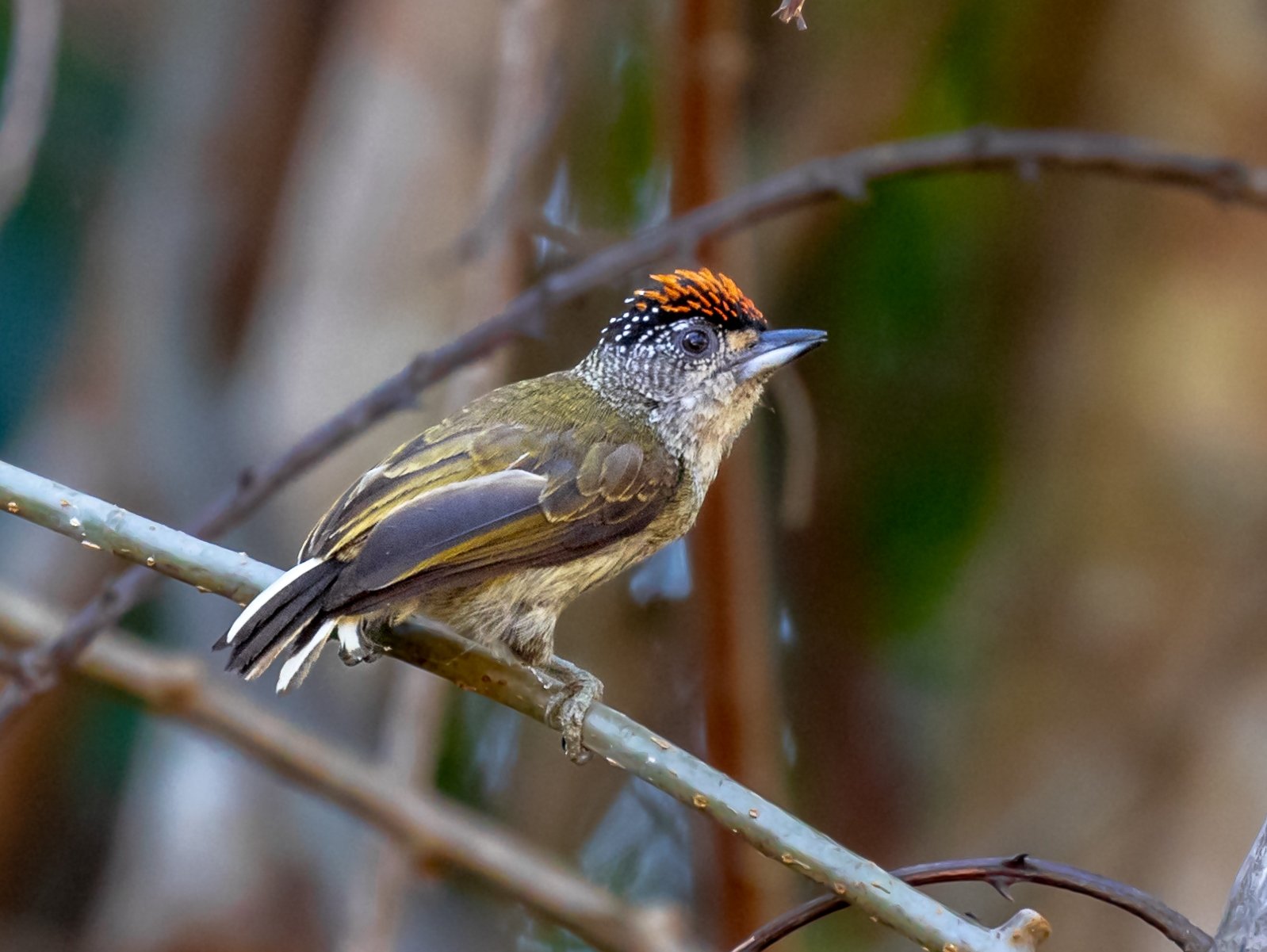
The Fine-barred Piculet is a piculet found only in central and southern Peru, in the Andean foothills at the edge of the Amazonian lowlands. It is finely barred below and resembles Lafresnaye's and Bar-breasted Piculets. It lives in forest edges and secondary forest and tolerates a landscape altered by people.
Voice
A high, rapid trill and thin tsit calls; soft tapping in thin branches.
Recording: GABRIEL LEITE — CC BY-NC-SA 4.0 · xeno-canto
Identification
10 cm, with a short, straight bill. The crown is black with white dots; the male has reddish feather tips on the forecrown. The upperparts are olive-brown with faint pale bars. The cheek has fine pale streaks. The underparts are yellowish white with fine, dense dark bars, fainter on the belly. The tail is black, with white inner webs to the central feathers. The female has no red on the head.
Confusion species
Bar-breasted Piculet Picumnus aurifrons is smaller, with a greener back and, in the male, a yellow forecrown, and lives in the lowlands. Ocellated Piculet Picumnus dorbignyanus lives higher and has scales and spots instead of fine bars. Rufous-breasted Piculet Picumnus rufiventris in the same area is larger and rufous below. Lafresnaye's Piculet Picumnus lafresnayi occurs further north and is greener, with coarser bars.
Habitat
Forest edges, secondary forest and open woodland with vines and scrub in the foothills and adjacent lowlands, roughly between 300 and 1100 m. It forages on thin branches, vines and bamboo stems in the lower and middle strata, often with mixed flocks. It eats small insects and larvae. It nests in a self-excavated cavity.
Where the bird is most at home, classified by the vegetation units of the Andes and the west coast.


Range and movements
Only in Peru: in the centre and south, along the eastern slope of the Andes and the adjacent lowlands, including the Ene drainage, Cusco and Madre de Dios. The northern limit of its range is uncertain. Absent from Colombia, Ecuador, Bolivia and the Galápagos. Endemic to the guide area.
- Resident
- dark = core range, pale = thinly spread
How and when to look
Search forest edges and clearings along the lower parts of the Manu road, around Pilcopata and Atalaya, often in mixed flocks in roadside vines.
Conservation status
Least Concern. The species tolerates forest edges and secondary forest; its range is limited but still largely forested.
Scientific name
Picumnus subtilis | Stager, 1968
Stager described the species in 1968 and placed it straight away in the genus where it still stands. The genus Picumnus was introduced in 1825 by Temminck. The genus name refers to Picumnus, a Roman god of fertility and agriculture, brother of Pilumnus, whose name is related to Latin picus, 'woodpecker'. The species name comes from Latin subtilis, 'fine, delicate', for the fine barring. The specimen the first description was based on came from Marcapata, Cusco, Peru.