All species › Woodpeckers and allies › Woodpeckers › Plain-breasted Piculet
Plain-breasted Piculet | Picumnus castelnau
Geelbuikdwergspecht | Carpinterito pechiblanco | Pica-pau-anão-de-peito-liso
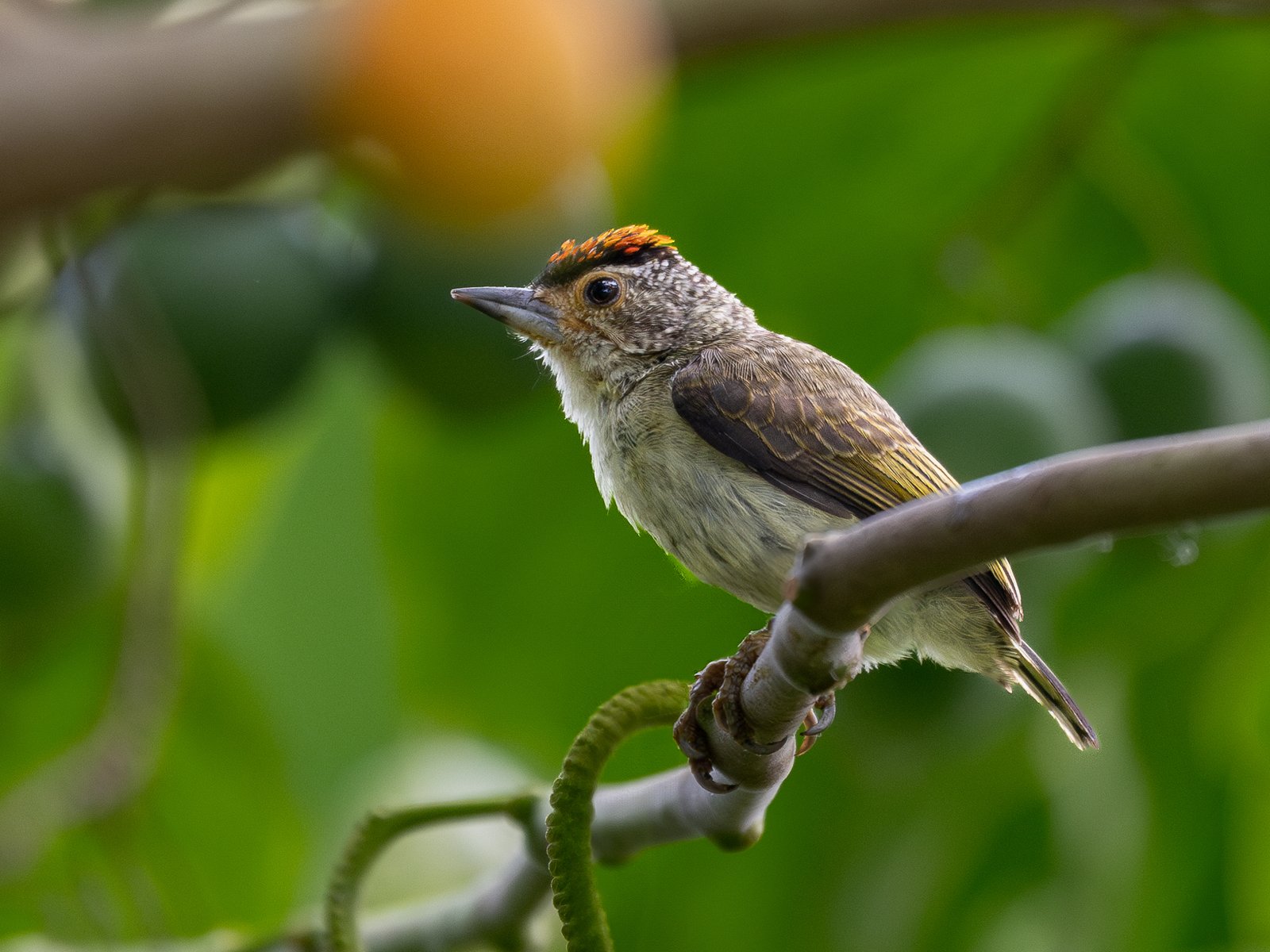
The Plain-breasted Piculet is a piculet of river islands and young riverside growth along the Amazon and its large tributaries in north-eastern Peru. It is the only piculet in the guide area with almost unmarked underparts. Its distribution closely follows the large rivers.
Voice
A high, rapid, descending trill and soft tapping while foraging.
Recording: Dan Lane — CC BY-NC-SA 3.0 · xeno-canto
Identification
9 cm, with a short, straight bill. The male has a black crown with red feather tips, the female an all-black crown. The nape and sides of the head are whitish with fine black streaks. The upperparts are greyish olive. The underparts are plain, dull yellowish white, without bars or spots. The tail is black, with white inner webs to the central feathers.
Confusion species
Bar-breasted Piculet Picumnus aurifrons has a greener back and is barred or streaked below; the male has a yellow forecrown. Lafresnaye's Piculet Picumnus lafresnayi is clearly barred black below and lives more in terra firme forest and the foothills. Rufous-breasted Piculet Picumnus rufiventris is larger and rufous below.
Habitat
Young forest and scrub on river islands and banks, with Cecropia, Tessaria and willow-like shrubs, adjacent secondary forest and sometimes the edges of pastures and gardens, mainly below 300 m. It often forages in the crowns of young Cecropia trees and on thin branches, in pairs or with mixed flocks. It eats small insects and larvae. It nests in a self-excavated cavity in a thin dead branch.
Where the bird is most at home, classified by the vegetation units of the Andes and the west coast.


Range and movements
In Peru in the north-east, along the Amazon, the lower Marañón, the Ucayali and the Napo. In Colombia only in the far south-east, along the Amazon near Leticia. Not confirmed with certainty in Ecuador. Absent from Bolivia and the Galápagos. Outside the guide area in far western Brazil.
- Resident
- dark = core range, pale = thinly spread
How and when to look
Search river islands near Iquitos, such as Padre Isla, or along the Amazon near Leticia, in young Cecropia and scrub. A boat trip to an island with young growth gives the best chance.
Conservation status
Least Concern. Its habitat is constantly renewed by the shifting rivers; the population is thought to be declining slightly.
Scientific name
Picumnus castelnau | Malherbe, 1862
Malherbe described the species in 1862 and placed it straight away in the genus where it still stands. The genus Picumnus was introduced in 1825 by Temminck. The genus name refers to Picumnus, a Roman god of fertility and agriculture, brother of Pilumnus, whose name is related to Latin picus, 'woodpecker'. The species name honours François Louis Nompar de Caumont de La Force, Comte de Castelnau (1810–1880), a French naturalist who led an expedition across South America from 1843 to 1847. The specimen the first description was based on came from Sarayacu, Ecuador.