All species › Woodpeckers and allies › Woodpeckers › Rufous-breasted Piculet
Rufous-breasted Piculet | Picumnus rufiventris
Roodbuikdwergspecht | Carpinterito ventrirrufo | Pica-pau-anão-vermelho
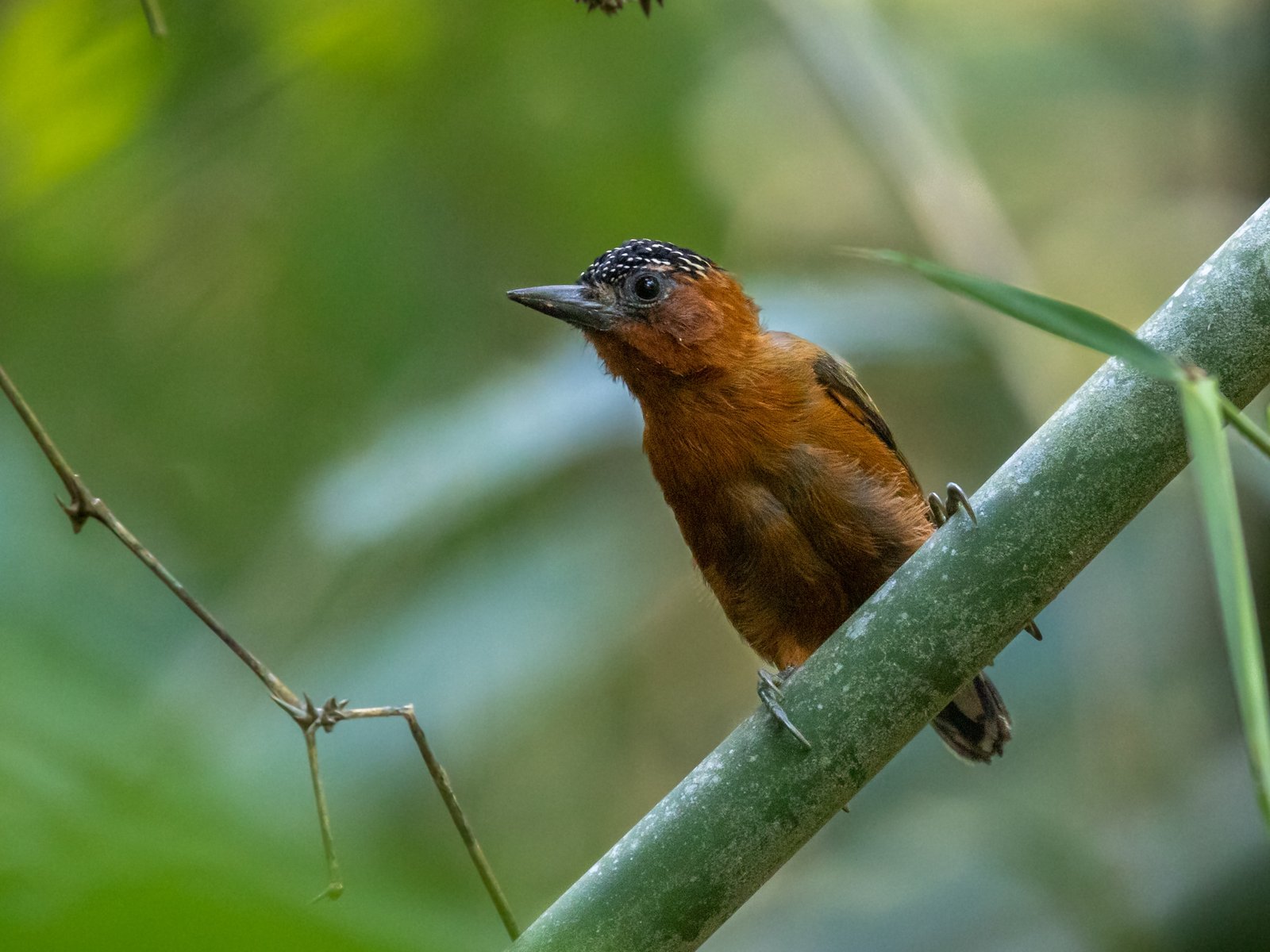
The Rufous-breasted Piculet is the largest piculet in the guide area and the only one in Amazonia with entirely rufous underparts. It lives in the western Amazon basin, often in bamboo and dense scrub, where it forages low among stems and vines.
Voice
A high, rapid series of tsit notes and a thin trill. It drums audibly on bamboo and dead stems.
Recording: Fernando Igor de Godoy — CC BY-NC-SA 4.0 · xeno-canto
Identification
10–11 cm, more robust than other piculets, with a short, straight bill. The crown is black; the male has red feather tips on the crown, the female lacks the red. The upperparts are olive-green. The head, neck and underparts are deep rufous to cinnamon, without markings. The tail is blackish.
Confusion species
Rusty-necked Piculet Picumnus fuscus in north-eastern Bolivia is smaller and paler, with ochre underparts and a brown back. Chestnut Piculet Picumnus cinnamomeus also has rufous underparts, but lives in northern Colombia, far outside the range of this species. Other piculets in the same area, such as Bar-breasted Piculet Picumnus aurifrons and Lafresnaye's Piculet Picumnus lafresnayi, are smaller and barred below.
Habitat
Bamboo (Guadua), dense scrub, riverside vegetation, forest edges and secondary forest in the lowlands and foothills, up to about 1200 m. It forages low, often within a few metres of the ground, in bamboo and vines, alone or in pairs and sometimes with mixed flocks. It eats ants, larvae and other small insects. It nests in a self-excavated cavity.
Where the bird is most at home, classified by the vegetation units of the Andes and the west coast.


Range and movements
In Colombia in the south-east, mainly at the foot of the Andes in Caquetá and Putumayo. In Ecuador in the eastern lowlands and foothills. In Peru throughout the Amazonian lowlands and on the lower eastern slope. In Bolivia only in the far north, with few records. Absent west of the Andes and from the Galápagos. Outside the guide area in western Brazil.
- Resident
- dark = core range, pale = thinly spread
How and when to look
Search bamboo along forest edges and riverside vegetation, for example in the Manu area and around Tambopata in Peru or along the Napo in Ecuador. Listen for tapping low in the stems.
Conservation status
Least Concern. The species has a large range and tolerates forest edges and secondary growth.
Scientific name
Picumnus rufiventris | (Bonaparte, 1838)
Bonaparte described the species in 1838 as Asthenurus rufiventris; because it was later moved to another genus, the author and year stand in brackets. The genus Picumnus was introduced in 1825 by Temminck. The genus name refers to Picumnus, a Roman god of fertility and agriculture, brother of Pilumnus, whose name is related to Latin picus, 'woodpecker'. The species name comes from Latin rufus, 'red', and venter, 'belly', for the rufous underparts. The specimen the first description was based on came from Western Brazil, near the border with Peru.