All species › Woodpeckers and allies › Woodpeckers › Rusty-necked Piculet
Rusty-necked Piculet | Picumnus fuscus
Roestnekdwergspecht | Carpinterito cuellirrufo | Pica-pau-anão-fusco
The Rusty-necked Piculet is a little-known piculet with a very small range along the Guaporé (Iténez) river, on the border between Bolivia and Brazil. It lives in seasonally flooded forest and has hardly been studied; its voice is almost undescribed.
Voice
Hardly described. Probably high trills and thin calls like other piculets; also soft tapping while foraging.
Recording: GABRIEL LEITE — CC BY-NC-SA 4.0 · xeno-canto
Identification
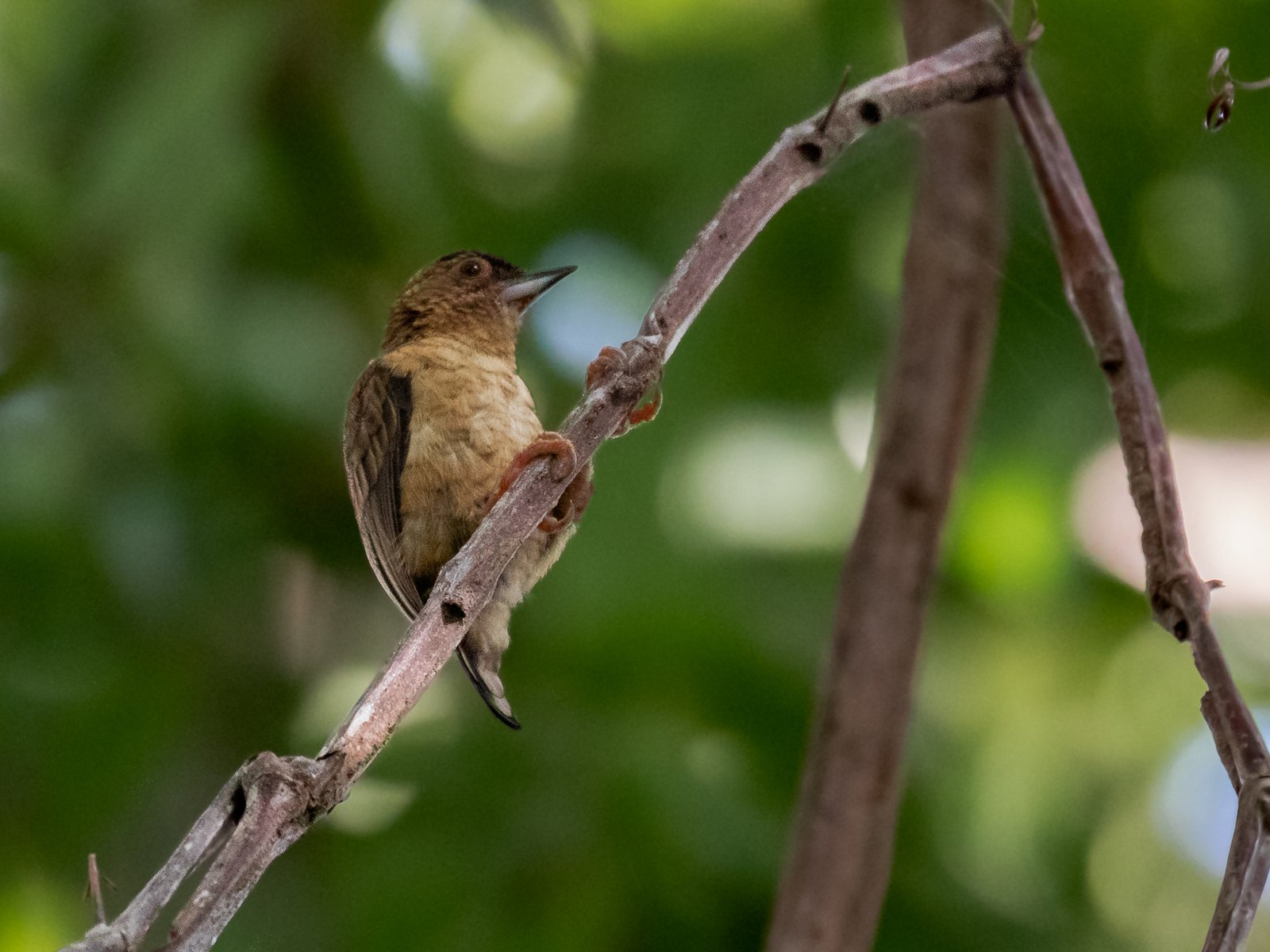
10 cm, with a short, straight bill. The male has a blackish crown with reddish-orange feather tips on the hindcrown, the female a plain black crown. The face is brownish, with a pale stripe behind the eye, and the neck sides are rusty to ochre-brown. The upperparts are brown to greenish brown. The underparts are pale ochre, with a cinnamon to rusty wash on the breast and flanks and at most faint barring.
Confusion species
White-wedged Piculet Picumnus albosquamatus, in drier forests nearby, is white below with black scales. Rufous-breasted Piculet Picumnus rufiventris is larger, with an olive-green back and a deep rufous head and underparts. White-barred Piculet Picumnus cirratus is densely barred black and white below.
Habitat
Seasonally flooded forest (várzea) and riverine forest along the large lowland rivers, below 300 m. It probably forages like other piculets on thin branches and vines in the lower and middle strata. Little is known about its food and nest.
Where the bird is most at home, classified by the vegetation units of the Andes and the west coast.


Range and movements
In Bolivia only in the north-east, in Beni along the Guaporé (Iténez) and the lower reaches of its tributaries. Absent from Colombia, Ecuador, Peru and the Galápagos. Outside the guide area only on the Brazilian side of the Guaporé, in Rondônia and western Mato Grosso.
- Resident
- dark = core range, pale = thinly spread
How and when to look
Records are scarce and come mainly from riverine forest along the Guaporé in north-eastern Beni, a remote region reached mostly by boat. Search mixed flocks in the riverside vegetation.
Conservation status
Least Concern under the current assessment, but the range is very small and the population is thought to be declining because of increasing settlement and clearance along the Guaporé. The species is poorly studied.
Scientific name
Picumnus fuscus | Pelzeln, 1870
Pelzeln described the species in 1870 and placed it straight away in the genus where it still stands. The genus Picumnus was introduced in 1825 by Temminck. The genus name refers to Picumnus, a Roman god of fertility and agriculture, brother of Pilumnus, whose name is related to Latin picus, 'woodpecker'. The species name comes from Latin fuscus, 'dusky, brown', for the brown plumage. The specimen the first description was based on came from Rio Guaporé, Mato Grosso, Brazil.