All species › Parrots › African and New World parrots › Cobalt-rumped Parrotlet
Cobalt-rumped Parrotlet | Forpus xanthopterygius
Spix' muspapegaai | Periquito aliazul | Tuim
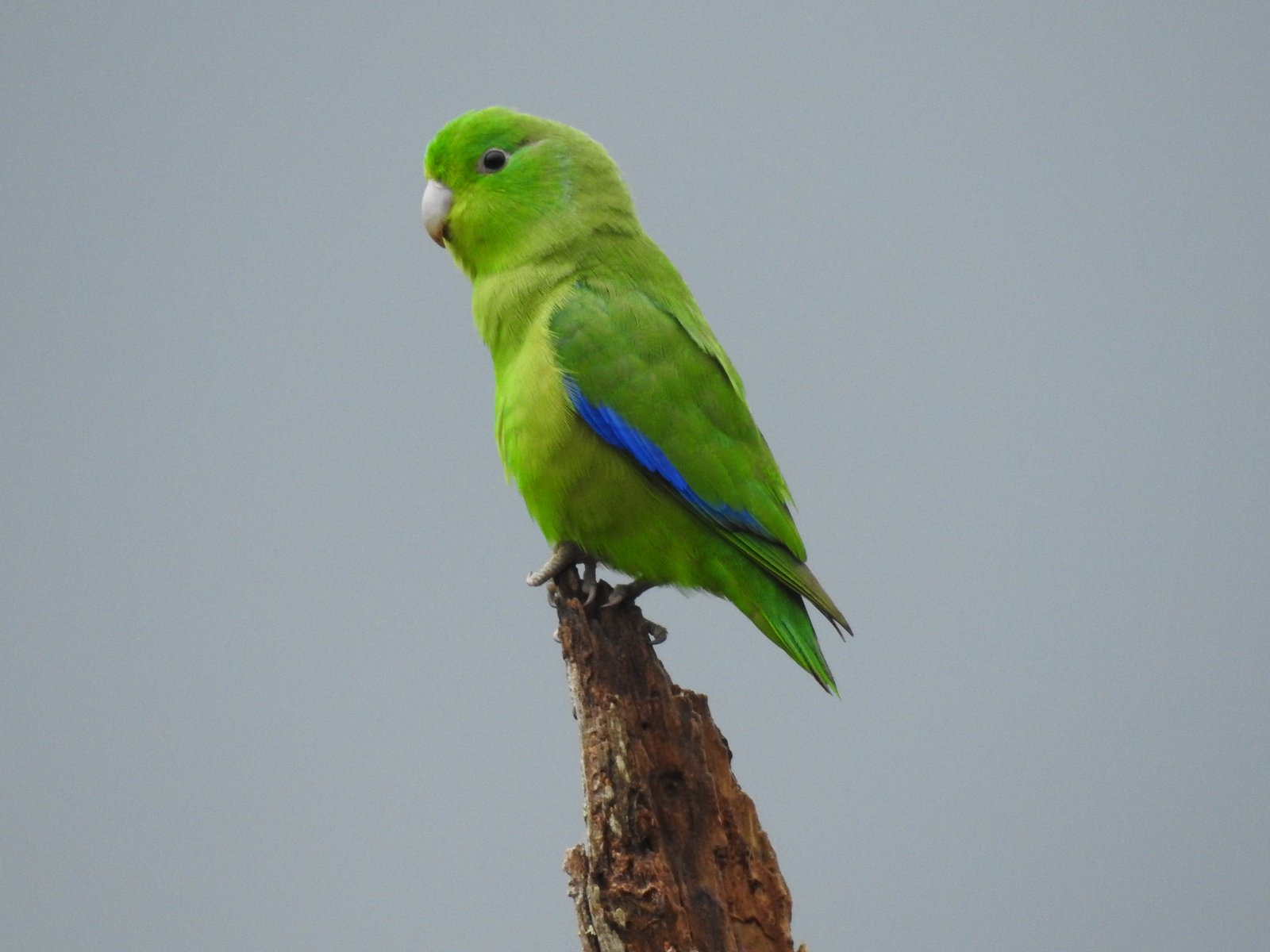
The Cobalt-rumped Parrotlet is a small, bright green parrotlet with a pale bill. In the Amazonian part of the guide area it lives mainly along the large rivers, on river islands and in riverside growth; an isolated form lives in northern Colombia. Outside the guide area it inhabits much of eastern South America.
Voice
A high, sharp tsit-tsit and rapid chattering, often from whole groups at once.
Recording: JAYRSON ARAUJO DE OLIVEIRA — CC BY-NC-SA 4.0 · xeno-canto
Identification
12–13 cm, with a short, wedge-shaped tail and a pale, horn-coloured to pinkish bill. The plumage is bright green, slightly more yellowish on the head. The male has a cobalt to violet-blue lower back and rump and blue wing coverts and secondaries; the underwing is also blue. The female lacks the blue and has a yellowish forehead. Birds of western Amazonia (crassirostris) have a heavier bill; those of northern Colombia (spengeli) are paler, turquoise blue on rump and wing. Juveniles resemble the female.
Confusion species
Dusky-billed Parrotlet Forpus modestus is darker green, with a dark upper mandible and deeper blue in the male, and lives in the forest canopy. In northern Colombia the male Green-rumped Parrotlet Forpus passerinus has a green rump, and the male Spectacled Parrotlet Forpus conspicillatus a blue eye-ring. Tui Parakeet Brotogeris sanctithomae is larger, with a longer, pointed tail, a yellow forehead and a brown bill.
Habitat
Riverside growth, scrub and young forest on river islands and sandbars, flooded forest and open woodland, also gardens and yards in villages; in Bolivia also savanna and open dry forest. In northern Colombia in dry scrub and open country. Mostly below 500 m. It eats seeds of grasses, herbs and trees, also fruit and flowers. It nests in a cavity in a tree, a post or a termite nest.
Where the bird is most at home, classified by the vegetation units of the Andes and the west coast.


Range and movements
In Colombia in the far south along the Amazon near Leticia, and a separate form in the Caribbean lowlands of the north. In Ecuador scarce in the far east, along the lower Napo. In Peru along the Amazon and the large tributaries in the north-east, and locally farther south in the eastern lowlands. In Bolivia in the northern and eastern lowlands. Absent from the Galápagos. Outside the guide area in much of Brazil, eastern Paraguay and north-eastern Argentina.
- Resident
- dark = core range, pale = thinly spread
How and when to look
Search the banks and river islands of the Amazon near Iquitos and Leticia. Small groups fly fast between the bushes with sharp chattering and also feed on grass seeds on sandbars.
Conservation status
Not Evaluated in this taxonomic treatment. Common over most of its range and without clear threats; the species locally benefits from open, human-made landscapes.
Scientific name
Forpus xanthopterygius | (Spix, 1824)
Spix described the species in 1824 as Psittaculus xanthopterygius; because it was later moved to another genus, the author and year stand in brackets. The genus Forpus was introduced in 1858 by Boie. The genus name, introduced by Boie in 1858, is probably arbitrary. It may come from Greek phoreō, 'to possess', and pous, 'foot', for the dexterous toes; according to Prestwich (1963) it is an anagram of Latin profus, 'spread out', for the short, wedge-shaped tail. The species name comes from Greek xanthos, 'yellow', and pterux, 'wing': 'yellow-winged'. The specimen the first description was based on came from Brazil.