All species › Parrots › African and New World parrots › Dusky-billed Parrotlet
Dusky-billed Parrotlet | Forpus modestus
Sclaters muspapegaai | Periquito piquioscuro | Tuim-de-bico-escuro
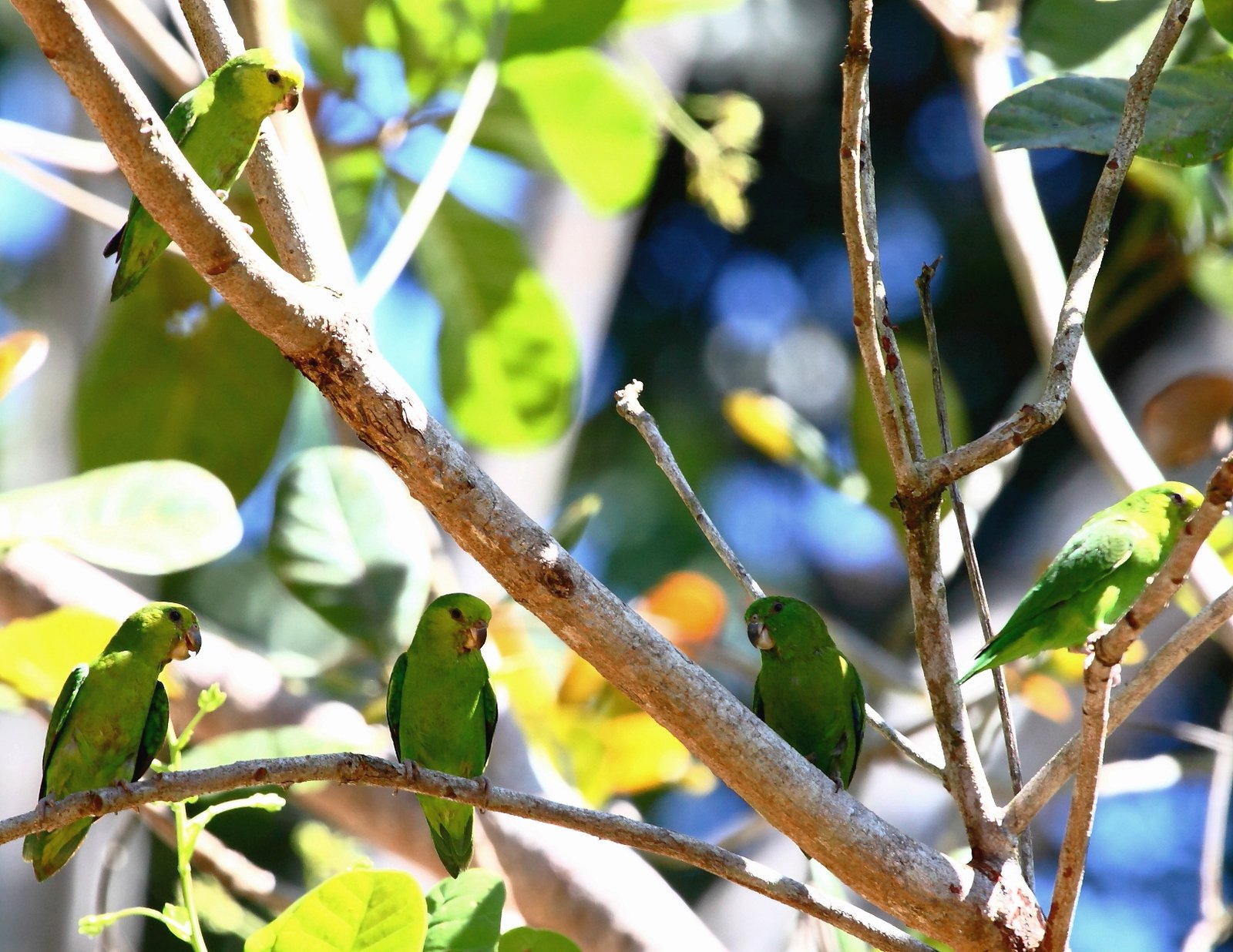
The Dusky-billed Parrotlet is one of the smallest parrots of the Amazonian lowlands, hardly larger than a sparrow. Small groups live in the canopy and at forest edges, moving from tree to tree in rapid flight with high-pitched chattering. It is the only parrotlet in the guide area with a dark upper mandible.
Voice
A high, sharp, finch-like tsit or tsee, often repeated in flight, and soft chattering from groups.
Recording: Richard E. Webster — CC BY-NC-SA 4.0 · xeno-canto
Identification
12–13 cm, with a short, wedge-shaped tail. The upper mandible is dark grey, the lower mandible paler. The plumage is dark, rather dull green, slightly brighter on the face. The male has a dark blue lower back and rump and dark blue wing coverts and secondaries. The female lacks the blue and has a yellowish-green forehead and face. Juveniles resemble the female.
Confusion species
Cobalt-rumped Parrotlet Forpus xanthopterygius is paler and brighter green, with an all-pale bill; the male has brighter cobalt blue on rump and wing. It lives mainly along the large rivers. Cobalt-winged Parakeet Brotogeris cyanoptera is larger, with a longer, pointed tail and an orange chin spot. Sapphire-rumped Parrotlet Touit purpuratus is larger, with a dark band across the back and a pale bill.
Habitat
Tall, humid lowland forest on terra firme, flooded forest and forest edges, also in the foothills, mostly below 1000 m. It eats seeds, fruit and flowers, usually high in the canopy, sometimes lower at the forest edge. It nests in a tree cavity.
Where the bird is most at home, classified by the vegetation units of the Andes and the west coast.


Range and movements
In Colombia in the eastern and south-eastern Amazonian lowlands. In Ecuador and Peru in the Amazonian lowlands east of the Andes, into the foothills. In Bolivia in the northern lowlands. Absent from the Galápagos. Outside the guide area in southern Venezuela, the Guianas and western and central Brazilian Amazonia.
- Resident
- dark = core range, pale = thinly spread
How and when to look
In the Amazonian lowlands watch for small, fast-flying groups with high-pitched chattering, for example from canopy towers or along clearings by rivers.
Conservation status
Least Concern. The species has a very large range, but occurs at low densities in most areas.
Scientific name
Forpus modestus | (Cabanis, 1849)
Cabanis described the species in 1849 as Psittacula modesta; because it was later moved to another genus, the author and year stand in brackets. The genus Forpus was introduced in 1858 by Boie. The genus name, introduced by Boie in 1858, is probably arbitrary. It may come from Greek phoreō, 'to possess', and pous, 'foot', for the dexterous toes; according to Prestwich (1963) it is an anagram of Latin profus, 'spread out', for the short, wedge-shaped tail. The species name is Latin modestus, 'modest, plain', for the unremarkable plumage. The specimen the first description was based on came from Guyana.