All species › Parrots › African and New World parrots › Red-fan Parrot
Red-fan Parrot | Deroptyus accipitrinus
Kraagpapegaai | Loro de abanico | Anacã
The Red-fan Parrot is the only species of the genus Deroptyus. It has a ruff of long, red-and-blue nape feathers that it raises like a fan around the head when excited. With its long, rounded tail and its flight of short wingbeats alternating with glides, it recalls a small raptor in the air more than a parrot.
Voice
Varied: high, shrill calls such as kee-kee, nasal and hoarse notes and softer whistles. Pairs often call from a prominent branch.
Recording: JAYRSON ARAUJO DE OLIVEIRA — CC BY-NC-SA 4.0 · xeno-canto
Identification
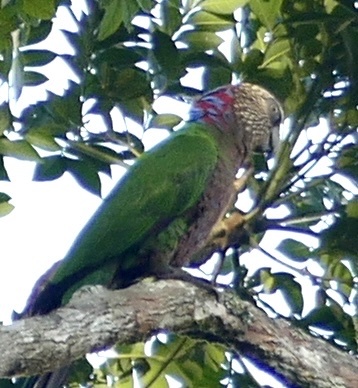
35 cm, with a long, rounded tail. The upperparts and wings are green, the flight feathers blackish. The head is brownish with pale streaks; the forehead and forecrown are paler, almost whitish, in birds from north of the Amazon. The long nape feathers are dark red edged blue and form a fan when raised. The breast and belly show the same red-and-blue pattern. The eye is yellow, the bill dark. The sexes are alike; juveniles are duller.
Confusion species
Amazons such as Mealy Amazon Amazona farinosa and Yellow-crowned Amazon Amazona ochrocephala are largely green, with a short tail and no red-and-blue ruff. Blue-headed Parrot Pionus menstruus has a blue head and red undertail coverts and flies with deep wingbeats. In flight the Red-fan Parrot stands out by its long tail, rounded wings and glides.
Habitat
Undisturbed lowland terra firme rainforest, especially on poor, sandy soils, and its edges; also near palm swamps. Mostly below 400 m. It eats fruit, seeds and flowers, often of palms. It lives in pairs and small groups. The nest is in a tree cavity or a hollow stump.
Where the bird is most at home, classified by the vegetation units of the Andes and the west coast.


Range and movements
In Colombia in the lowlands east of the Andes, mainly in the east (Guainía, Vaupés, Amazonas). In Ecuador very scarce and local in the north-east, with few records. In Peru only in the north-east, in Loreto north of the Amazon. No confirmed records are known from Bolivia. Absent from the Galápagos. Outside the guide area in southern Venezuela, the Guianas and Brazilian Amazonia.
- Resident
- dark = core range, pale = thinly spread
How and when to look
Search in forest on sandy soil around Iquitos and in eastern Colombia; in the morning pairs often perch on a bare branch above the canopy. Listen for the shrill calls and watch for the long-tailed flight silhouette.
Conservation status
Least Concern. The species depends on undisturbed forest; deforestation and capture for the cage-bird trade are local threats.
Scientific name
Deroptyus accipitrinus | (Linnaeus, 1758)
Linnaeus described the species in 1758 as Psittacus accipitrinus; because it was later moved to another genus, the author and year stand in brackets. The genus Deroptyus was introduced in 1832 by Wagler. The genus name comes from Greek derē, 'neck', and ptuon, 'fan', for the nape feathers that can be raised into a fan. The species name is Latin accipitrinus, 'hawk-like', for the head with its erectile ruff that recalls a bird of prey. The specimen the first description was based on came from Cayenne, French Guiana.