All species › Parrots › African and New World parrots › Manu Parrotlet
Manu Parrotlet | Nannopsittaca dachilleae
Amazoneparkiet | Cotorrita amazónica | Periquito-da-amazônia
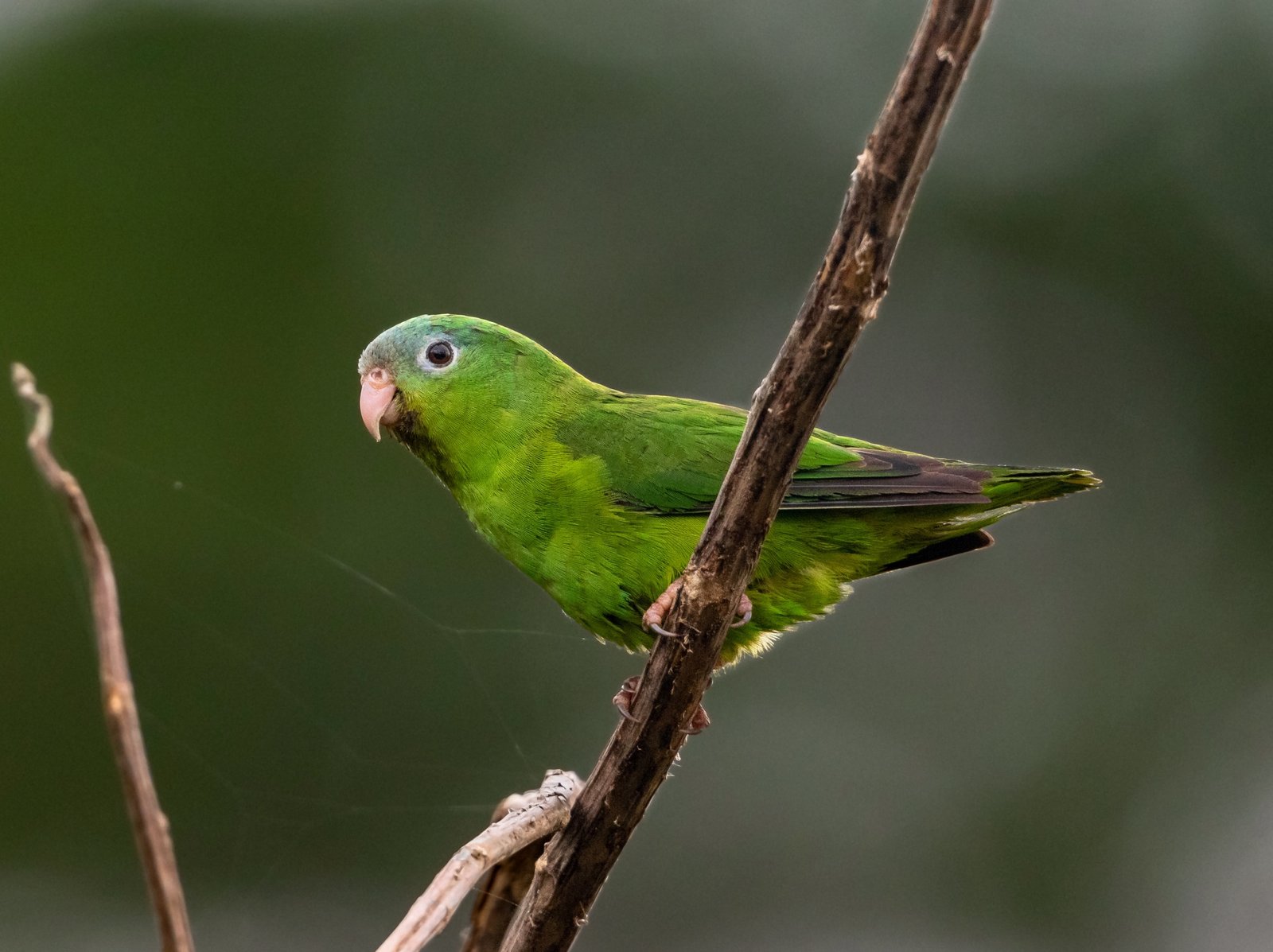
The Manu Parrotlet is a small, short-tailed green parrot of the lowlands of the south-western Amazon basin. It was described only in 1991, from the Manu area in south-eastern Peru, and is the only member of the genus Nannopsittaca in the guide area. Flocks fly fast and high over the forest and are found mainly along rivers with bamboo and young riverine forest.
Voice
High, thin, squeaky calls such as zee, mainly in flight and in rapid series; softer and thinner than the calls of the Brotogeris parakeets.
Recording: GABRIEL LEITE — CC BY-NC-SA 4.0 · xeno-canto
Identification
14 cm, with a short, fairly square tail and a small, pinkish-horn bill. The plumage is green, yellowish green below. The forehead and forecrown are pale blue. The flight feathers are dark green, without blue or yellow. The legs are pinkish grey. The sexes are alike. Juveniles show less blue on the head.
Confusion species
Dusky-billed Parrotlet Forpus modestus has a dark upper mandible, and the male has a blue rump and blue in the wing. Cobalt-winged Parakeet Brotogeris cyanoptera is larger, with a longer, pointed tail, blue flight feathers and an orange chin spot. Tui Parakeet Brotogeris sanctithomae is larger, with a yellow forehead and a longer tail. Scarlet-shouldered Parrotlet Touit huetii has red under the wing and a dark forehead.
Habitat
Forest along rivers with bamboo (Guadua), young riverine forest with Cecropia, cane-like vegetation on river islands and the edges of terra firme forest, in the lowlands and low foothills. It feeds on seeds, including bamboo seeds, and fruit. Little is known about its breeding biology.
Where the bird is most at home, classified by the vegetation units of the Andes and the west coast.


Range and movements
In Peru in the Amazonian lowlands of the south-east, mainly in Madre de Dios and adjacent Cusco and Puno, locally further north. In Bolivia in the north-western lowlands. Absent from Colombia, Ecuador and the Galápagos. Outside the guide area in western Brazil (Acre).
- Resident
- dark = core range, pale = thinly spread
How and when to look
Along the rivers of the Manu and Tambopata area, where flocks pass over the forest and along the riverbanks. Listen for the high, thin calls; perched birds are inconspicuous in the green canopy.
Conservation status
Least Concern. The species has a fairly small range, but much of it consists of undisturbed forest; locally riverine forest is lost to clearance and gold mining.
Scientific name
Nannopsittaca dachilleae | O'Neill, Munn & Franke, 1991
O'Neill, Munn & Franke described the species in 1991 and placed it straight away in the genus where it still stands. The genus Nannopsittaca was introduced in 1912 by Ridgway. The genus name comes from Greek nannos, 'dwarf', and psittakē, 'parrot'. The species name honours Barbara D'Achille (died 1989), Peruvian journalist and conservationist who was murdered by the Shining Path in 1989. The specimen the first description was based on came from Madre de Dios, Peru.