All species › Parrots › African and New World parrots › Andean Parakeet
Andean Parakeet | Bolborhynchus orbygnesius
Andesparkiet | Catita andina | Periquito-andino
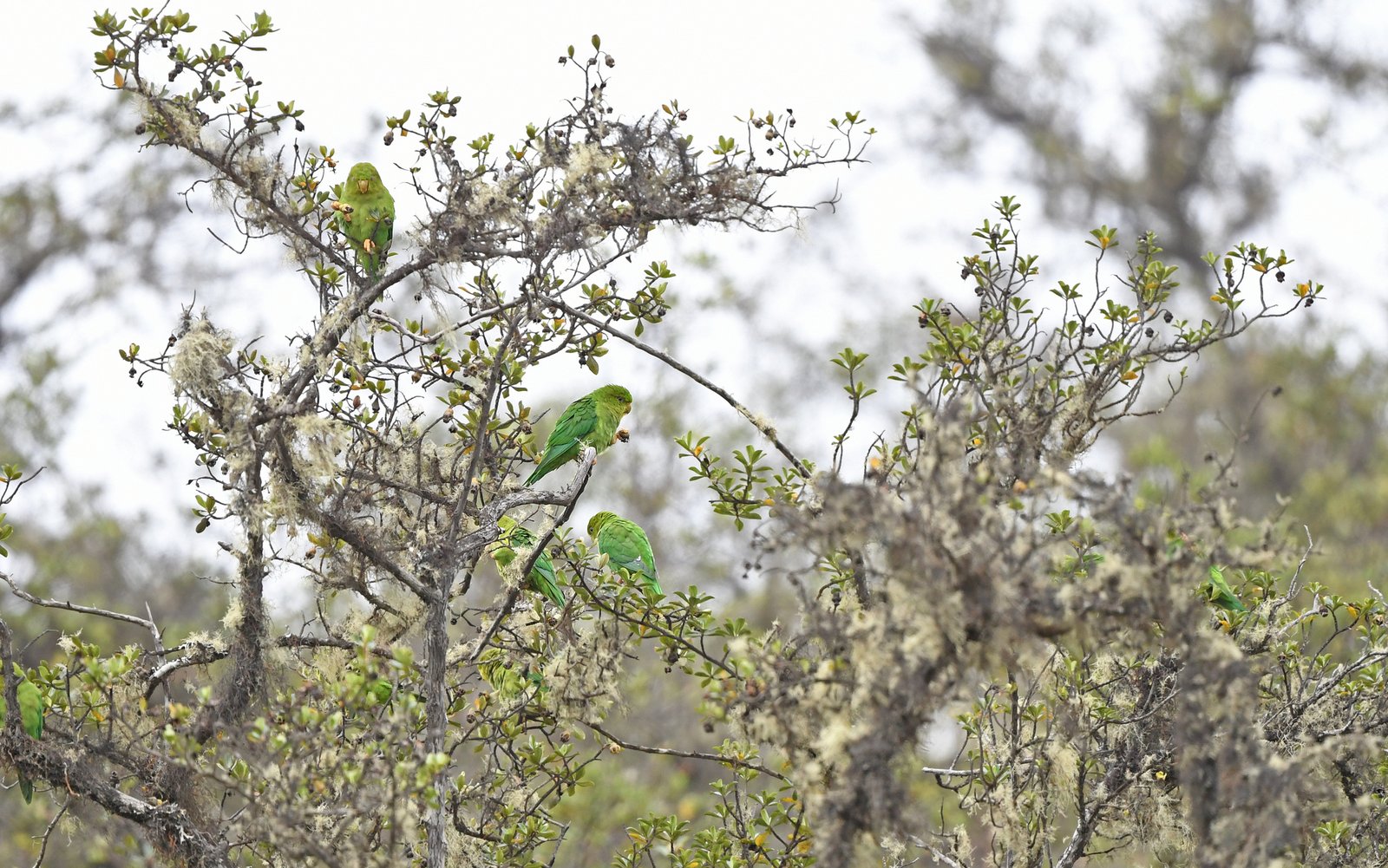
The Andean Parakeet is a small, stocky, plain green parakeet with a short, pointed tail, found in upper montane scrub and forest edges of the Andes of Peru and Bolivia. Flocks often forage inconspicuously in shrubs or on the ground and fly fast and low over the slopes. In the cold season it locally descends to lower valleys.
Voice
A soft, rolling chirp and short, high chattering calls, mainly in flight; perched flocks make soft, babbling sounds.
Recording: Ross Gallardy — CC BY-NC-SA 4.0 · xeno-canto
Identification
16–17 cm, with a short, pointed tail and a small, pale, horn-coloured bill. The plumage is plain green, slightly paler and yellower below, with bluish-green flight feathers. There is no barring and no colour on the head or wing. The sexes are alike. Juveniles are duller green.
Confusion species
Barred Parakeet Bolborhynchus lineola is barred with black, with black shoulders, and lives in cloud forest with bamboo. Mountain Parakeet Psilopsiagon aurifrons is slimmer and paler green, with a longer, more pointed tail; the male has a yellow face. Grey-hooded Parakeet Psilopsiagon aymara has a grey-brown hood and a long tail.
Habitat
Semi-humid montane scrub, Polylepis and alder groves, the edges of upper cloud forest, and dry valleys with shrubs and fields, mostly between 2000 and 4000 m. It feeds on seeds, buds and fruit of shrubs, herbs and grasses, often on or near the ground. It nests in cavities in rocks or trees.
Where the bird is most at home, classified by the vegetation units of the Andes and the west coast.


Range and movements
In Peru in the Andes from north to south, mainly along the eastern slope and in the higher inter-Andean valleys. In Bolivia in the Andes of La Paz and Cochabamba, south into Chuquisaca. Absent from Colombia, Ecuador and the Galápagos. The species does not occur outside the guide area.
- Resident
- dark = core range, pale = thinly spread
How and when to look
In the higher valleys and shrubby slopes around Cusco, such as the Urubamba valley, and in Polylepis groves, where flocks forage among shrubs and on the ground. Watch for small, chirping flocks flying low overhead.
Conservation status
Least Concern. The species tolerates a mixed landscape of scrub and fields, but the clearing of Polylepis and scrub locally reduces its habitat.
Scientific name
Bolborhynchus orbygnesius | (de Souancé, 1856)
De Souancé described the species in 1856 as Myiopsitta Orbygnesia; because it was later moved to another genus, the author and year stand in brackets. The genus Bolborhynchus was introduced in 1857 by Bonaparte. The genus name comes from Greek bolbos, 'bulb', and rhunkhos, 'bill', for the thick, swollen bill. The species name honours Alcide d'Orbigny (1802-1857), a French naturalist who travelled in South America from 1826 to 1834. The specimen the first description was based on came from Yungas, Bolivia.