All species › Parrots › African and New World parrots › Rufous-fronted Parakeet
Rufous-fronted Parakeet | Bolborhynchus ferrugineifrons
Tolimaparkiet | Periquito de Los Nevados | Periquito-de-testa-ruiva
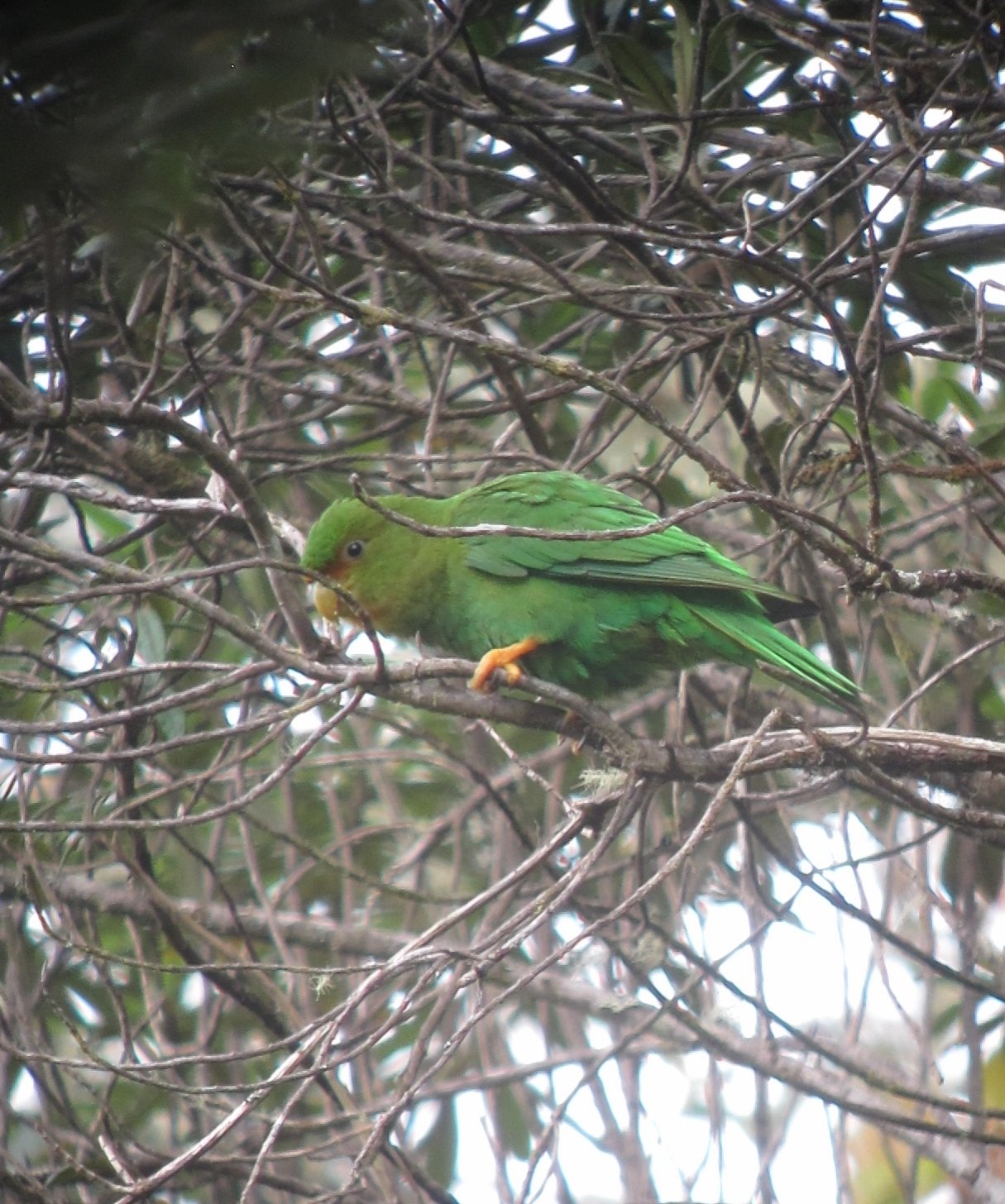
The Rufous-fronted Parakeet is a stocky, green parakeet with a short tail, found only in the páramo and at the treeline of the Central Andes of Colombia, around the volcanoes of the Los Nevados massif. It lives higher than almost all other Andean parrots and finds much of its food on the ground among grasses and frailejones. The species has a small range and a small population.
Voice
A soft, chattering babble and short, high trills, mainly in flight; flocks on the ground are often silent.
Recording: Jaime Suárez — CC BY-NC-SA 4.0 · xeno-canto
Identification
18 cm, with a short, pointed tail and a pale, horn-coloured bill. The plumage is plain dark green, slightly paler and yellower below. A narrow rufous band runs across the forehead and around the base of the bill. The flight feathers are bluish green. The sexes are alike. Juveniles show less or no rufous on the forehead.
Confusion species
Barred Parakeet Bolborhynchus lineola is barred with black, lacks the rufous forehead and lives lower, in cloud forest. Golden-plumed Parakeet Leptosittaca branickii is much larger, with a long tail, an orange stripe in front of the eye and yellow plumes behind the eye. Flame-winged Parakeet Pyrrhura calliptera is larger, with a long, maroon tail and a brown breast, and lives in the Eastern Andes.
Habitat
Páramo with grasses and frailejones (Espeletia), shrubby páramo and the elfin woodland at the upper treeline, roughly between 3000 and 4000 m, sometimes higher. Small flocks search for seeds of grasses, herbs and shrubs, mainly on the ground. It nests in cavities; its breeding biology has only recently become known.
Where the bird is most at home, classified by the vegetation units of the Andes and the west coast.


Range and movements
Only in Colombia, in the Central Andes, mainly in the Los Nevados massif on the border of Caldas, Risaralda, Quindío and Tolima, with scattered records further south into Cauca. Absent from Ecuador, Peru, Bolivia and the Galápagos. Endemic to the guide area.
- Resident
- dark = core range, pale = thinly spread
How and when to look
In Los Nevados National Park, in the páramo and at the treeline on the flanks of the volcanoes, where small flocks forage among frailejones and grasses in the morning. On the ground the green birds are inconspicuous; watch for small chattering flocks taking off.
Conservation status
Vulnerable. The species has a small range and a small population; the páramo is threatened by conversion to pasture and potato fields, by fires and by the loss of forest at the treeline.
Scientific name
Bolborhynchus ferrugineifrons | (Lawrence, 1880)
Lawrence described the species in 1880 as Brotogerys ferrugineifrons; because it was later moved to another genus, the author and year stand in brackets. The genus Bolborhynchus was introduced in 1857 by Bonaparte. The genus name comes from Greek bolbos, 'bulb', and rhunkhos, 'bill', for the thick, swollen bill. The species name comes from Latin ferrugineus, 'rust-coloured', and frons, 'forehead', for the rufous forehead. The specimen the first description was based on came from Bogotá, Colombia.