All species › Parrots › African and New World parrots › Barred Parakeet
Barred Parakeet | Bolborhynchus lineola
Catharinaparkiet | Perico barrado | Periquito-barrado
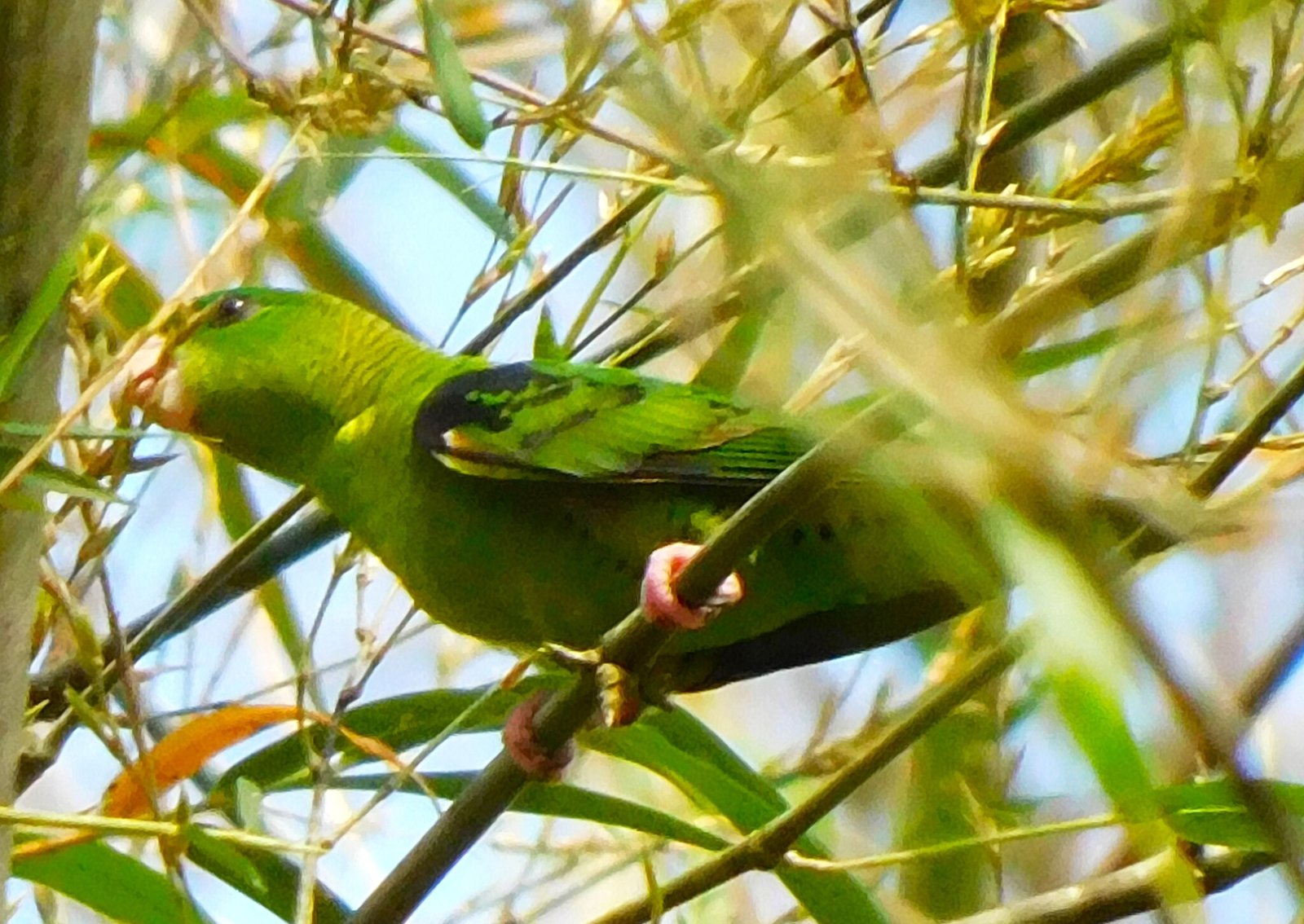
The Barred Parakeet is a small, stocky, green parakeet with a short, pointed tail and fine black barring, found in cloud forest from Mexico to Bolivia. It wanders over large distances and appears locally in large numbers where mountain bamboo is seeding, then may be absent again for years. Flocks often fly high and fast, also at dusk.
Voice
A soft, musical, rolling chirp such as chrreet, repeated constantly by flocks in flight; perched birds are often silent.
Recording: José — CC BY-NC-SA 4.0 · xeno-canto
Identification
16–17 cm, with a short, pointed, wedge-shaped tail and a small, pale, horn-coloured bill. The plumage is green, with black edges to the feathers of the upperparts and flanks, giving a finely barred pattern. The lesser coverts along the leading edge of the wing are black. The underparts are slightly yellower green and less barred. The sexes are alike; the female is sometimes less heavily barred. Juveniles are more faintly barred.
Confusion species
Andean Parakeet Bolborhynchus orbygnesius is plain green, without barring, and in Peru and Bolivia usually lives higher, in scrub. Rufous-fronted Parakeet Bolborhynchus ferrugineifrons is plain green with a rufous band on the forehead and lives only in the páramo of the Central Andes of Colombia. Parakeets of the genus Pyrrhura are larger, with a long, maroon tail.
Habitat
Cloud forest and upper montane forest, especially with mountain bamboo (Chusquea), and its edges and clearings, locally also semi-open country, mostly between 1600 and 3400 m, sometimes lower. It feeds mainly on bamboo seeds, and also on other seeds, buds and fruit. It nests in tree cavities.
Where the bird is most at home, classified by the vegetation units of the Andes and the west coast.


Range and movements
In Colombia very locally in all three Andean ranges and in the mountains of the north. In Ecuador mainly on the eastern slope, more rarely on the western slope. In Peru along the eastern slope of the Andes. In Bolivia in the Yungas of La Paz and Cochabamba. Absent from the Galápagos. Outside the guide area in Venezuela and from southern Mexico to Panama.
- Resident
- dark = core range, pale = thinly spread
How and when to look
Large flocks appear irregularly where mountain bamboo is seeding; in cloud forest watch especially for high-flying, chirping flocks in the early morning and towards evening. The species may then be absent from the same site for a long time.
Conservation status
Least Concern. Its nomadic behaviour makes population estimates uncertain; cloud forest is lost locally to clearance.
Scientific name
Bolborhynchus lineola | (Cassin, 1853)
Cassin described the species in 1853 as Psittacula lineola; because it was later moved to another genus, the author and year stand in brackets. The genus Bolborhynchus was introduced in 1857 by Bonaparte. The genus name comes from Greek bolbos, 'bulb', and rhunkhos, 'bill', for the thick, swollen bill. The species name is Latin lineola, 'little line', for the fine black barring of the plumage. The specimen the first description was based on came from Puente Nacional, Veracruz, Mexico.