All species › Parrots › African and New World parrots › Yellow-eared Parrot
Yellow-eared Parrot | Ognorhynchus icterotis
Geeloorparkiet | Loro orejiamarillo | Papagaio-de-orelha-amarela
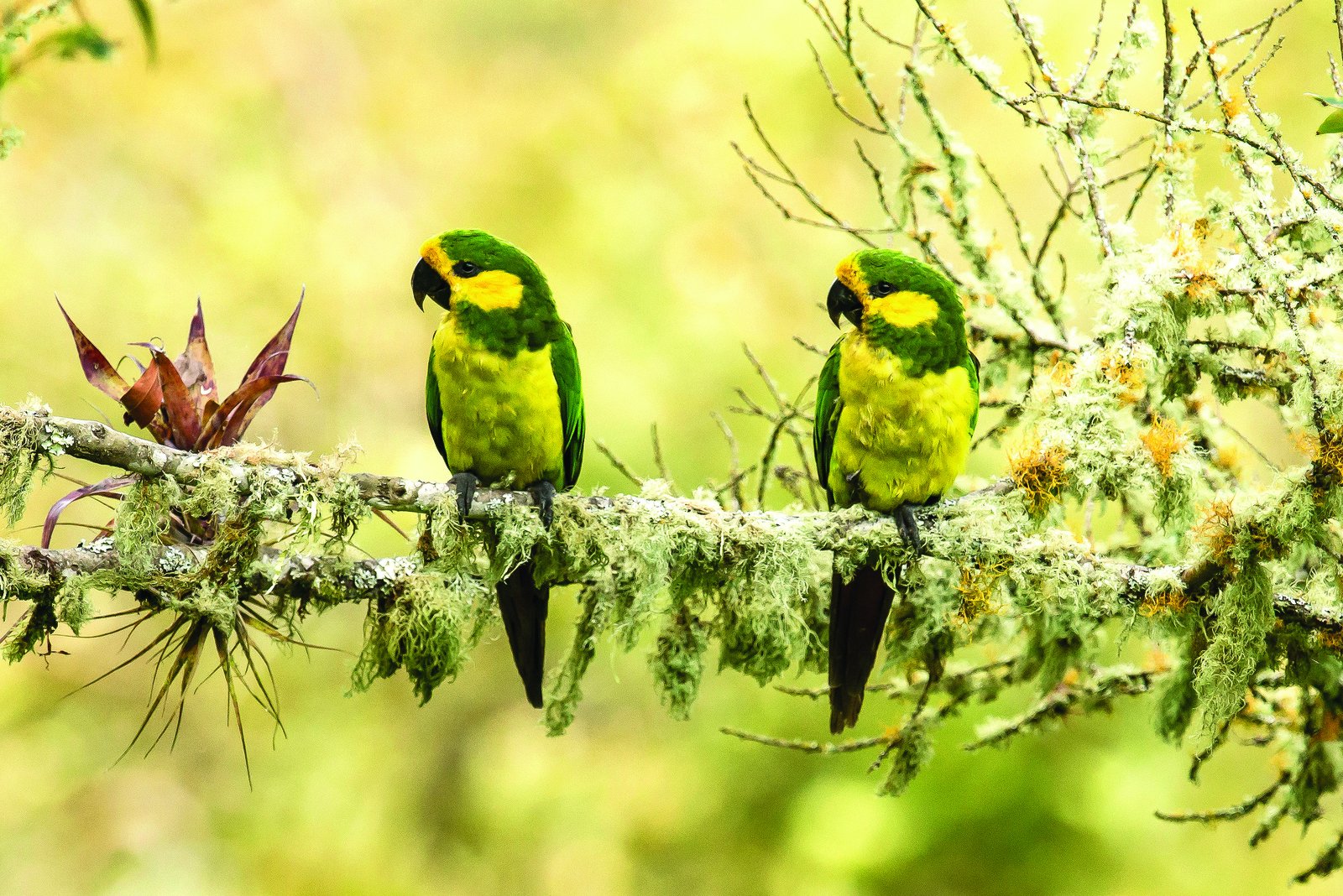
The Yellow-eared Parrot is a large green parrot of the cloud forest of the Colombian Andes, with a striking yellow face. It depends heavily on wax palms, Ceroxylon, for roosting and nesting. After a steep decline to a few dozen birds around 1999, the population has grown again thanks to conservation to several thousand.
Voice
Loud, nasal, somewhat goose-like calls, often in chorus from flocks in flight.
Recording: Carlos Delgado JUMABITA — CC BY-NC-SA 4.0 · xeno-canto
Identification
42 cm, with a fairly long, pointed tail and a heavy, black bill. The plumage is dark green. The forehead, lores and a broad patch across the cheeks and ear coverts are bright yellow. The underparts are slightly paler, yellowish green. The underside of the tail is dull red. There is a narrow, bare, grey ring around the eye. The sexes are alike.
Confusion species
Scaly-naped Amazon Amazona mercenarius lacks the yellow face and has a dark-scaled nape, a red patch in the wing and a shorter tail. Speckle-faced Parrot Pionus tumultuosus is smaller, with a dark, speckled head and a short tail. Golden-plumed Parakeet Leptosittaca branickii is smaller and slimmer, with a narrow yellow plume behind the eye and a pale bill.
Habitat
Cloud forest and upper montane forest with wax palms, and pastures with scattered wax palms, roughly between 1800 and 3000 m. It eats fruit and seeds, especially of wax palms and other trees. It roosts communally in wax palms and nests in cavities in the trunks of dead wax palms.
Where the bird is most at home, classified by the vegetation units of the Andes and the west coast.


Range and movements
In Colombia very locally in the Central and Western Andes, including Antioquia, Caldas, Risaralda, Quindío and Tolima. In Ecuador formerly in the north-west; there have been no confirmed records there since the late 1990s, and the species is presumably extirpated. Absent from Peru, Bolivia and the Galápagos. Does not occur outside the guide area.
- Resident
- dark = core range, pale = thinly spread
How and when to look
In the protected areas with wax palms near Jardín in Antioquia and near Roncesvalles in Tolima, mainly early in the morning, when flocks leave the roosts calling loudly.
Conservation status
Vulnerable. The species was nearly extinct through the felling of wax palms (among other things for fronds on Palm Sunday), forest loss and hunting. Thanks to nest boxes, protection of wax palms and education, the population is increasing again.
Scientific name
Ognorhynchus icterotis | (Massena & de Souancé, 1854)
Massena & de Souancé described the species in 1854 as Conurus icterotis; because it was later moved to another genus, the author and year stand in brackets. The genus Ognorhynchus was introduced in 1857 by Bonaparte. The genus name comes from Greek onkos, 'bulk, weight', and rhunkhos, 'bill', for the heavy bill. The species name comes from Greek ikteros, 'jaundice, yellow', and ous, ōtos, 'ear', for the yellow ear patch. The specimen the first description was based on came from Ocaña, Colombia.