All species › Falcons › Falcons and caracaras › Lined Forest Falcon
Lined Forest Falcon | Micrastur gilvicollis
Gebandeerde bosvalk | Halcón montés lineado | Falcão-mateiro
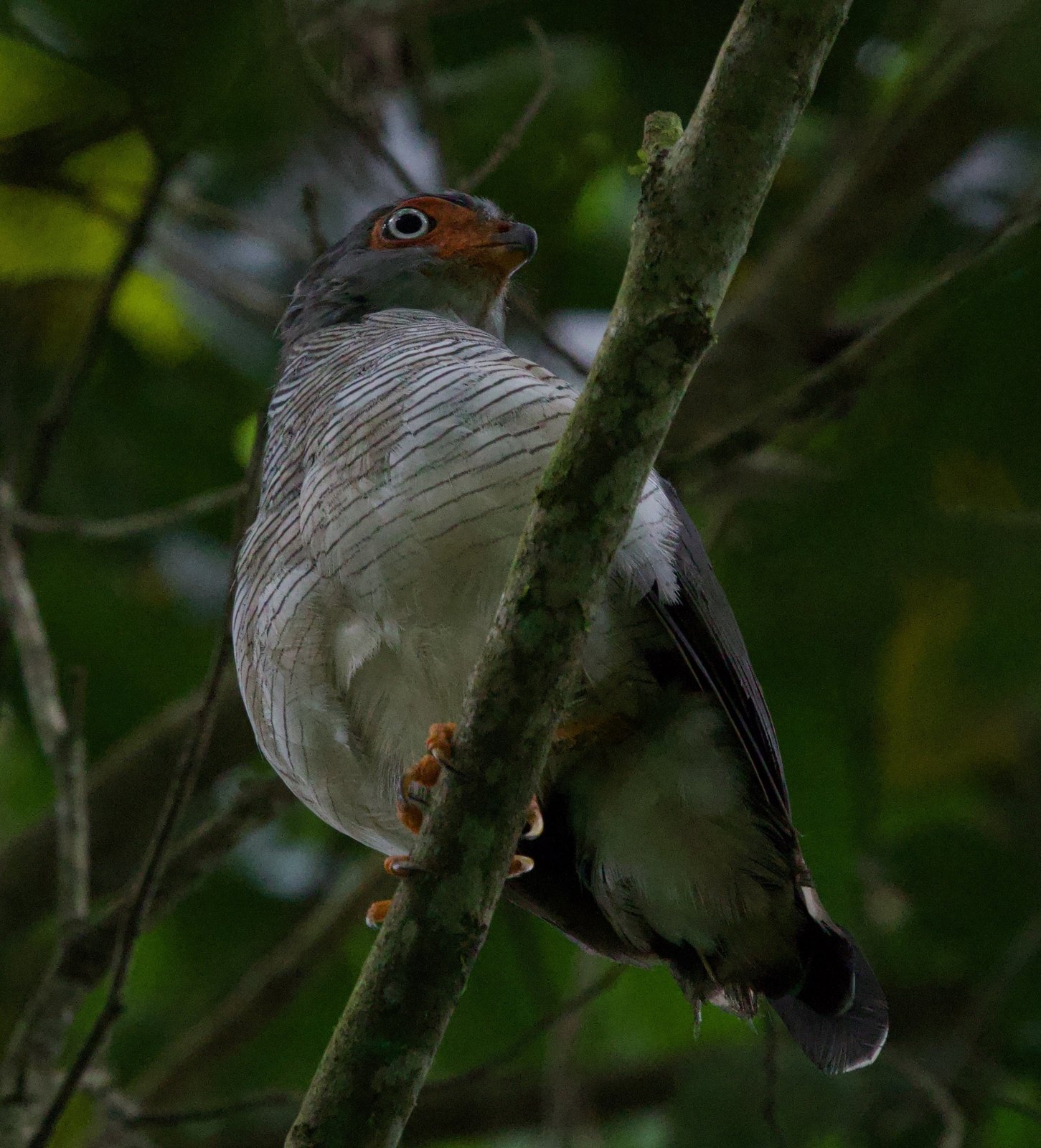
The Lined Forest Falcon is a small forest falcon of the Amazonian lowlands that almost always stays inside the forest. It hunts small birds and lizards from a hidden perch in the lower and middle levels of the forest. Its call at dusk is often the only sign of its presence.
Voice
A repeated series of usually two nasal, barking notes, kow-kow, sometimes extended into a longer series. Heard mainly in the early morning and at dusk.
Recording: Yannick Wiegers — CC BY-NC-SA 4.0 · xeno-canto
Identification
30–36 cm, with short, rounded wings, a long tail and long legs. The adult is slate-grey above, with a grey head and a pale, whitish iris. The underparts are white with narrow grey bars on the breast and flanks; the belly is often almost unbarred. The tail is black with two or three narrow white bands. Cere, bare skin around the eye and legs are orange-yellow. The sexes are alike. Juveniles are browner above and white to buff below with coarser dark bars, and have a darker iris.
Confusion species
Barred Forest Falcon Micrastur ruficollis is very similar, but has a darker iris and denser grey barring that extends onto the belly; iris colour and voice are the best features. Cryptic Forest Falcon Micrastur mintoni is almost identical in appearance and is told mainly by voice; in the guide area it is known only from eastern Bolivia. Plumbeous Forest Falcon Micrastur plumbeus lives west of the Andes and has a single white tail band. Buckley's Forest Falcon Micrastur buckleyi and Slaty-backed Forest Falcon Micrastur mirandollei are larger and have unbarred underparts.
Habitat
Humid terra firme lowland forest, also várzea and old secondary forest, mostly below 800 m and locally up to about 1000 m in the foothills. It sits still on a branch in the lower and middle forest levels and hunts small birds, lizards and large insects with short sallies; sometimes follows army-ant swarms. The nest is probably in a tree cavity; little is known about its breeding biology.
Where the bird is most at home, classified by the vegetation units of the Andes and the west coast.


Range and movements
In Colombia in the Amazonian lowlands east of the Andes. In Ecuador in the eastern lowlands. In Peru in the Amazonian lowlands throughout the east of the country. In Bolivia in the lowlands of the north and centre. Absent west of the Andes and from the Galápagos. Outside the guide area in the Amazon basin of Venezuela, the Guianas and Brazil.
- Resident
- dark = core range, pale = thinly spread
How and when to look
Listen for the barking call in terra firme forest in the early morning, then search the lower forest levels. At army-ant swarms it sometimes sits on low branches during the day as well.
Conservation status
Least Concern. The species depends on continuous forest and is declining locally through deforestation.
Scientific name
Micrastur gilvicollis | (Vieillot, 1817)
Vieillot described the species in 1817 as Sparvius gilvicollis; because it was later moved to another genus, the author and year stand in brackets. The genus Micrastur was introduced in 1841 by Gray. The genus name combines Greek mikros, 'small', with Astur, a genus name for goshawks. The species name comes from Latin gilvus, 'pale yellow', and collum, 'neck'. The specimen the first description was based on came from Cayenne, French Guiana.