All species › Falcons › Falcons and caracaras › Collared Forest Falcon
Collared Forest Falcon | Micrastur semitorquatus
Grote bosvalk | Halcón montés collarejo | Falcão-relógio
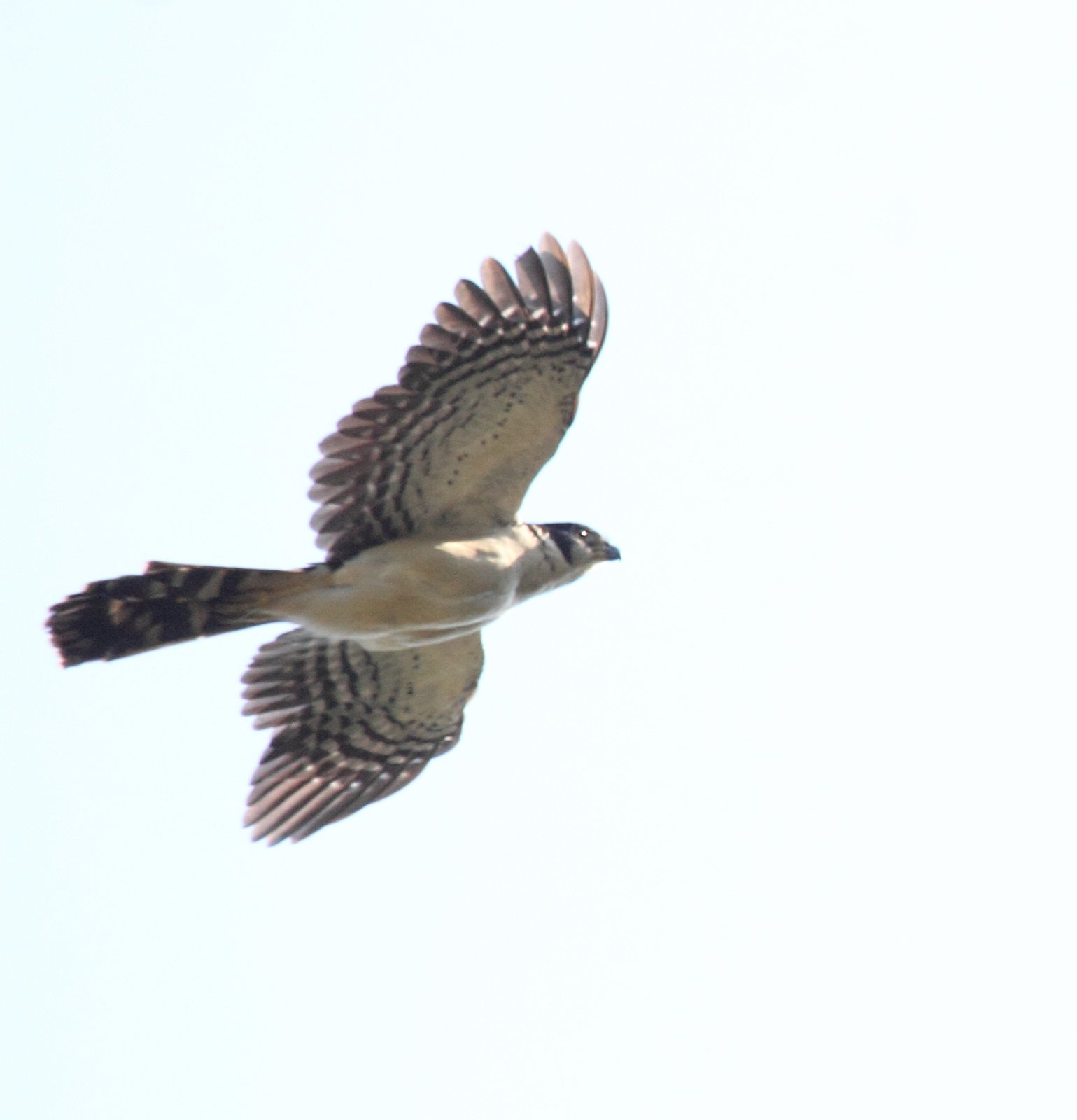
Collared Forest Falcon is the largest forest falcon: a slim, long-tailed and long-legged raptor of the forest interior. It hunts hidden in the understorey and midstorey, often chasing birds and mammals on the ground or through the branches. It is heard far more often than seen; its mournful call carries mainly at dusk and dawn.
Voice
A loud, mournful call, aaow, slowly repeated, sometimes as a series that speeds up and rises; mainly at sunrise and sunset, often from a hidden perch. Also a laughing series ow-ow-ow when excited.
Recording: JAYRSON ARAUJO DE OLIVEIRA — CC BY-NC-SA 4.0 · xeno-canto
Identification
51–58 cm, with short, rounded wings, a long, graduated tail and long legs; the female is clearly larger. The pale morph has a black crown and back, a white or creamy collar around the neck, white to buff underparts and a narrow black crescent running down from behind the eye across the cheek. There is also a buff morph and a rare dark morph, which is entirely blackish. The tail is black with three to five narrow white bands and a white tip. The bare skin around the eye and the lores is greenish. Juveniles are browner above and have buff underparts with coarse dark scaling or barring.
Confusion species
Buckley's Forest Falcon Micrastur buckleyi is smaller, with white spots on the secondaries visible on the closed wing, fewer and broader white tail bands and a different call; it occurs only in western Amazonia. Laughing Falcon Herpetotheres cachinnans has a broad black mask instead of a cheek crescent, shorter legs and perches in the open at forest edges. Juveniles can resemble a young Bicolored Hawk Astur bicolor, which is smaller and has a shorter, not graduated tail.
Habitat
Humid and dry forest, gallery forest, tall secondary forest and forest edges, from the lowlands to about 1500 m, locally higher. It hunts from a hidden perch and pursues prey by running and hopping through the undergrowth; it takes medium-sized birds such as guans and chachalacas, as well as mammals and reptiles. The nest is in a large tree hollow.
Where the bird is most at home, classified by the vegetation units of the Andes and the west coast.


Range and movements
In Colombia in almost all forested lowlands and foothills. In Ecuador in the west, including the dry south-west, and in the Amazon basin. In Peru in the Amazon basin and in the north-west. In Bolivia in the northern and eastern lowlands, including the Chiquitano dry forest. Absent from the Galápagos. Outside the guide area from Mexico to northern Argentina.
- Resident
- dark = core range, pale = thinly spread
How and when to look
Listen at dusk for the mournful call from inside the forest, then search low, sheltered branches. It sometimes approaches in response to sound and then perches briefly in the open in the understorey.
Conservation status
Least Concern. Widespread, but dependent on forest and therefore locally declining through deforestation.
Scientific name
Micrastur semitorquatus | (Vieillot, 1817)
Vieillot described the species in 1817 as Sparvius semi-torquatus; because it was later moved to another genus, the author and year stand in brackets. The genus Micrastur was introduced in 1841 by Gray. The genus name combines Greek mikros, 'small', with Astur, a genus name for goshawks. The species name comes from Latin semi, 'half', and torquatus, 'collared'. The specimen the first description was based on came from Paraguay.