All species › Falcons › Falcons and caracaras › Slaty-backed Forest Falcon
Slaty-backed Forest Falcon | Micrastur mirandollei
Mirandolles bosvalk | Halcón montés dorsigrís | Tanatau
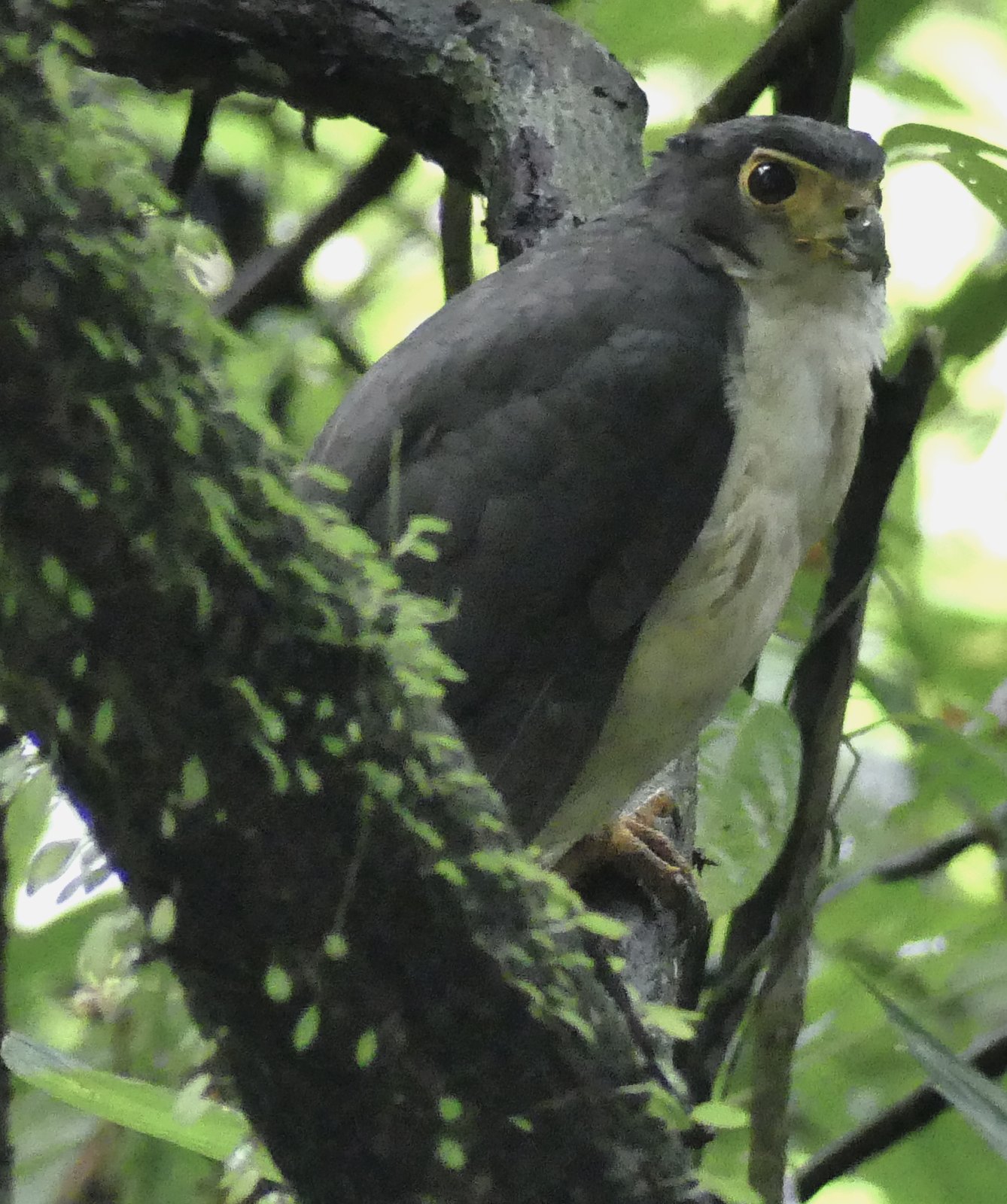
Slaty-backed Forest Falcon is a grey-and-white forest falcon of the interior of humid lowland forest. With its plain slate-grey upperparts and unmarked white underparts it looks more like a hawk than a falcon. It lives hidden and is mainly detected by its long, nasal calling series.
Voice
A long series of nasal notes, ah, ah, ah, that starts slowly, speeds up and falls away again, often kept up for a long time; mainly at dusk and dawn. Also a repeated, mournful kaaow.
Recording: JAYRSON ARAUJO DE OLIVEIRA — CC BY-NC-SA 4.0 · xeno-canto
Identification
41–46 cm, with short, rounded wings, a fairly long tail and long yellow legs. The head and upperparts are plain dark slate-grey, the underparts white to pale greyish, without barring. The bare skin around the eye, the lores and the cere are yellow to yellow-orange; the eye is dark. The tail is blackish with three narrow greyish-white bands and a white tip. The sexes are alike; the female is larger. Juveniles are browner grey above and have creamy underparts with fine dark scaling or streaks.
Confusion species
Semiplumbeous Hawk Leucopternis semiplumbeus is smaller, with a shorter tail with one white band, an orange cere and orange legs. Plumbeous Hawk Cryptoleucopteryx plumbea is grey below as well. Collared Forest Falcon Micrastur semitorquatus has black upperparts, a pale collar and a dark cheek crescent. Barred Forest Falcon Micrastur ruficollis is much smaller and densely barred below.
Habitat
Tall humid lowland forest on terra firme and in várzea, also swamp forest and tall secondary forest, mostly below 500 m, locally higher. It hunts in the midstorey and understorey from a hidden perch, taking birds, small mammals and reptiles. Little is known about the nest.
Where the bird is most at home, classified by the vegetation units of the Andes and the west coast.


Range and movements
In Colombia mainly in Amazonia and the Orinoco lowlands, with scattered records in the north and in the Pacific lowlands. In Ecuador in the Amazon basin. In Peru in the Amazon basin. In Bolivia in the northern lowlands. Outside the guide area from Costa Rica to the Guianas and Amazonian Brazil.
- Resident
- dark = core range, pale = thinly spread
How and when to look
At sunrise in large, undisturbed lowland forest listen for the long nasal series. From a canopy tower or high point you may sometimes see it perched just below the canopy.
Conservation status
Least Concern. Tied to large, continuous forests and therefore sensitive to deforestation; scarce throughout.
Scientific name
Micrastur mirandollei | (Schlegel, 1862)
Schlegel described the species in 1862 as Astur mirandollei; because it was later moved to another genus, the author and year stand in brackets. The genus Micrastur was introduced in 1841 by Gray. The genus name combines Greek mikros, 'small', with Astur, a genus name for goshawks. The species name honours Charles Jean François Mirandolle (1827–1884), Dutch lawyer and politician, born in Suriname. The specimen the first description was based on came from Suriname.