All species › Falcons › Falcons and caracaras › Barred Forest Falcon
Barred Forest Falcon | Micrastur ruficollis
Gestreepte bosvalk | Halcón montés barreteado | Falcão-caburé
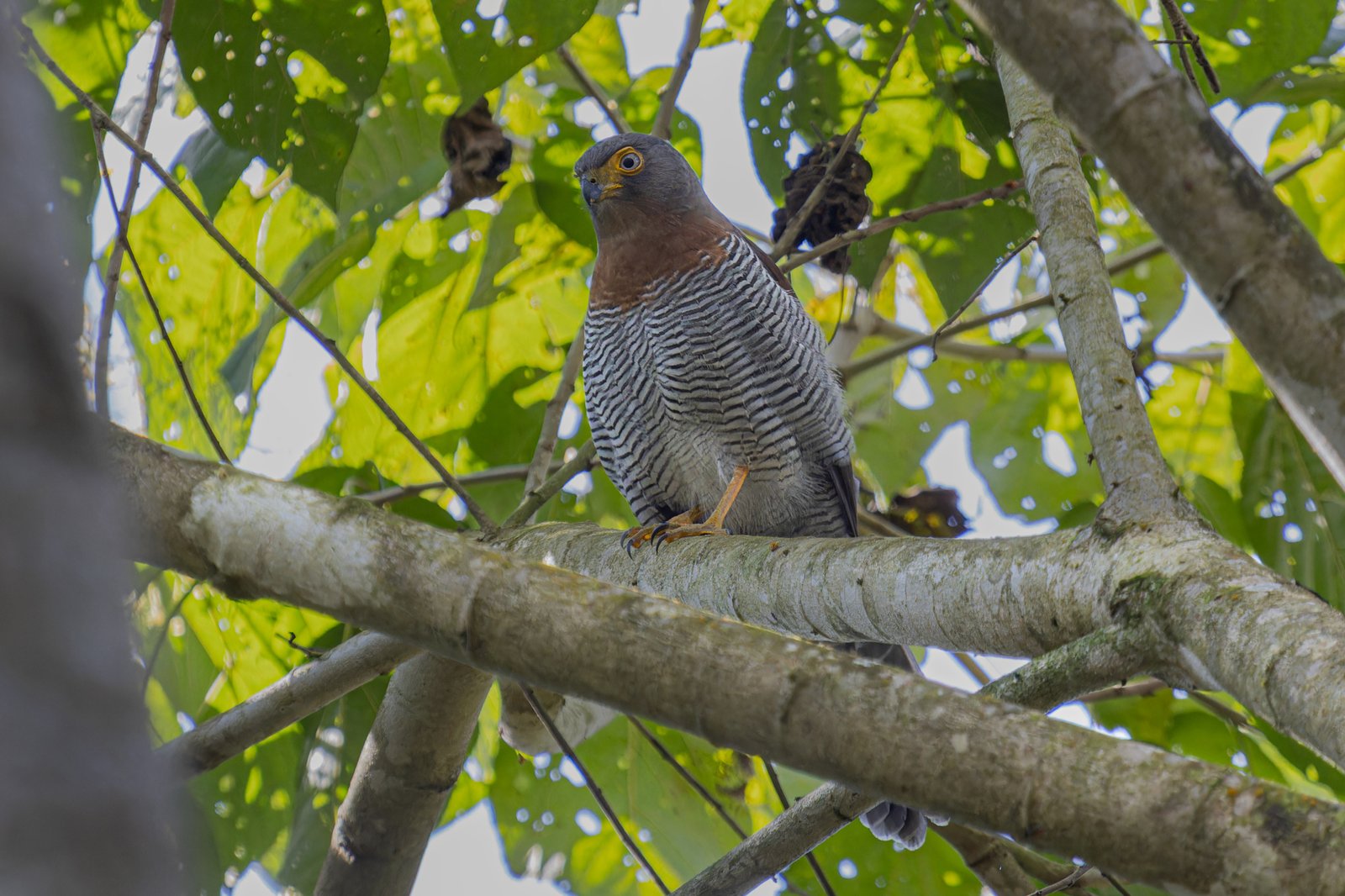
Barred Forest Falcon is a small, Accipiter-like forest falcon with a long tail and finely black-and-white barred underparts. Of all forest falcons it has the widest range and goes highest into the Andes. It lives hidden in the understorey and sometimes follows army-ant swarms to catch flushed prey.
Voice
A short, barking ahrk or kak, repeated at intervals, mainly at sunrise; sometimes an accelerating series of such notes.
Recording: Jacob Wijpkema — CC BY-NC-SA 4.0 · xeno-canto
Identification
33–38 cm, with short, rounded wings, a long tail and long yellow legs. The adult is dark slate-grey to brownish grey above, with a grey head and throat. The underparts are white, densely and finely barred black from breast to undertail coverts. The bare skin around the eye, the lores and the cere are yellow to orange; the eye is pale yellow to orange. The tail is blackish with three or four narrow white bands and a white tip. Juveniles are very variable: brown above, with white, creamy or buff underparts with coarse or sparse dark barring, often with a pale collar.
Confusion species
Lined Forest Falcon Micrastur gilvicollis in Amazonia has a white eye, sparser barring below and only one or two white tail bands. Plumbeous Forest Falcon Micrastur plumbeus in western Colombia and Ecuador has a single white tail band. Bicolored Hawk Astur bicolor is larger, with plain grey underparts and rufous thighs. Tiny Hawk Microspizias superciliosus is much smaller, with a shorter tail.
Habitat
Humid forest of the lowlands, foothills and mountain slopes, also cloud forest, tall secondary forest and forest edges; from sea level to about 2500 m, in the Andes mainly between 500 and 2000 m. It hunts from a low, hidden perch, taking small birds, lizards and large insects, and sometimes follows army-ant swarms. The nest is in a tree hollow.
Where the bird is most at home, classified by the vegetation units of the Andes and the west coast.


Range and movements
In Colombia in the lowlands and on the slopes of all Andean ranges. In Ecuador on both sides of the Andes, from the lowlands up into montane forest. In Peru on the eastern slope of the Andes and in the Amazon basin, and in the north-west. In Bolivia in the Yungas and the northern and eastern lowlands. Absent from the Galápagos. Outside the guide area from Mexico to north-eastern Argentina.
- Resident
- dark = core range, pale = thinly spread
How and when to look
In the early morning listen in montane and foothill forest for the barking ahrk. At army-ant swarms look for a small, long-tailed raptor perched low in the undergrowth.
Conservation status
Least Concern. Widespread and tolerant of some disturbance, but tied to forest.
Scientific name
Micrastur ruficollis | (Vieillot, 1817)
Vieillot described the species in 1817 as Sparvius ruficollis; because it was later moved to another genus, the author and year stand in brackets. The genus Micrastur was introduced in 1841 by Gray. The genus name combines Greek mikros, 'small', with Astur, a genus name for goshawks. The species name comes from Latin rufus, 'red', and collum, 'neck'. The specimen the first description was based on came from Rio de Janeiro, Brazil.