All species › Falcons › Falcons and caracaras › Cryptic Forest Falcon
Cryptic Forest Falcon | Micrastur mintoni
Mintons bosvalk | Halcón montés críptico | Falcão-críptico
Cryptic Forest Falcon was described as a separate species only in 2002; before that it was included in Lined Forest Falcon, from which it is almost impossible to separate by appearance. The difference lies mainly in the call and the range. In the guide area it occurs only at the extreme eastern edge, and its status there is poorly known.
Voice
A series of nasal, barking notes, ah, ah, ah, ah, longer and more even than the short two-note call of Lined Forest Falcon; mainly at dusk and dawn.
Recording: Fernando Igor de Godoy — CC BY-NC-SA 4.0 · xeno-canto
Identification
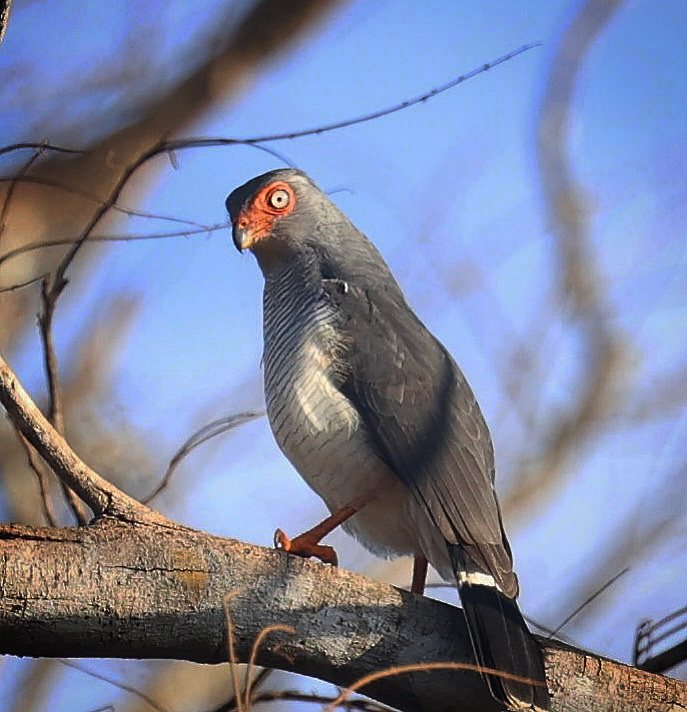
31–36 cm, with short, rounded wings, a long tail and long yellow legs. The adult is plain slate-grey above, with a paler grey throat and breast. The underparts are white with narrow, sparse black bars, mainly on the flanks. The bare skin around the eye, the lores and the cere are yellow-orange. The tail is blackish with one narrow white band and a white tip. Juveniles are browner above and have white to creamy underparts with little or no barring.
Confusion species
Lined Forest Falcon Micrastur gilvicollis is almost identical; it has a white eye and usually two white tail bands, but the call is the only reliable feature. Barred Forest Falcon Micrastur ruficollis is more densely and evenly barred below and has three or four white tail bands. Bicolored Hawk Astur bicolor has plain grey underparts and rufous thighs.
Habitat
Humid lowland forest, mainly terra firme, also semi-humid forest and transitional forest towards drier woodland. It hunts from a low, hidden perch in the understorey, taking small birds, lizards and large insects. Little is known about the nest.
Where the bird is most at home, classified by the vegetation units of the Andes and the west coast.


Range and movements
In Bolivia in the northern and eastern lowlands, including Santa Cruz; the exact limits are still poorly known. In Peru possibly in the extreme south-east, but not confirmed there. Absent from Colombia and Ecuador. The core of the range lies outside the guide area, in Amazonian Brazil south of the Amazon and in the Atlantic Forest of eastern Brazil.
- Resident
- dark = core range, pale = thinly spread
How and when to look
In the guide area to be expected only in the eastern lowland forests of Bolivia. Record the call of any forest falcon of this type; without a recording the species cannot be safely separated from Lined Forest Falcon.
Conservation status
Least Concern. The Atlantic Forest is highly fragmented, but in Amazonia the species lives in still large forest areas that are, however, affected by deforestation.
Scientific name
Micrastur mintoni | Whittaker, 2003
Whittaker described the species in 2003 and placed it straight away in the genus where it still stands. The genus Micrastur was introduced in 1841 by Gray. The genus name combines Greek mikros, 'small', with Astur, a genus name for goshawks. The species name honours Clive D. T. Minton (1934–2019), shorebird researcher and mentor of the describer Andrew Whittaker. The specimen the first description was based on came from (per the original description).