All species › Passerines › Gnatwrens and gnatcatchers › Collared Gnatwren
Collared Gnatwren | Microbates collaris
Zwartborstmuggensluiper | Soterillo acollarado | Bico-assovelado-de-coleira
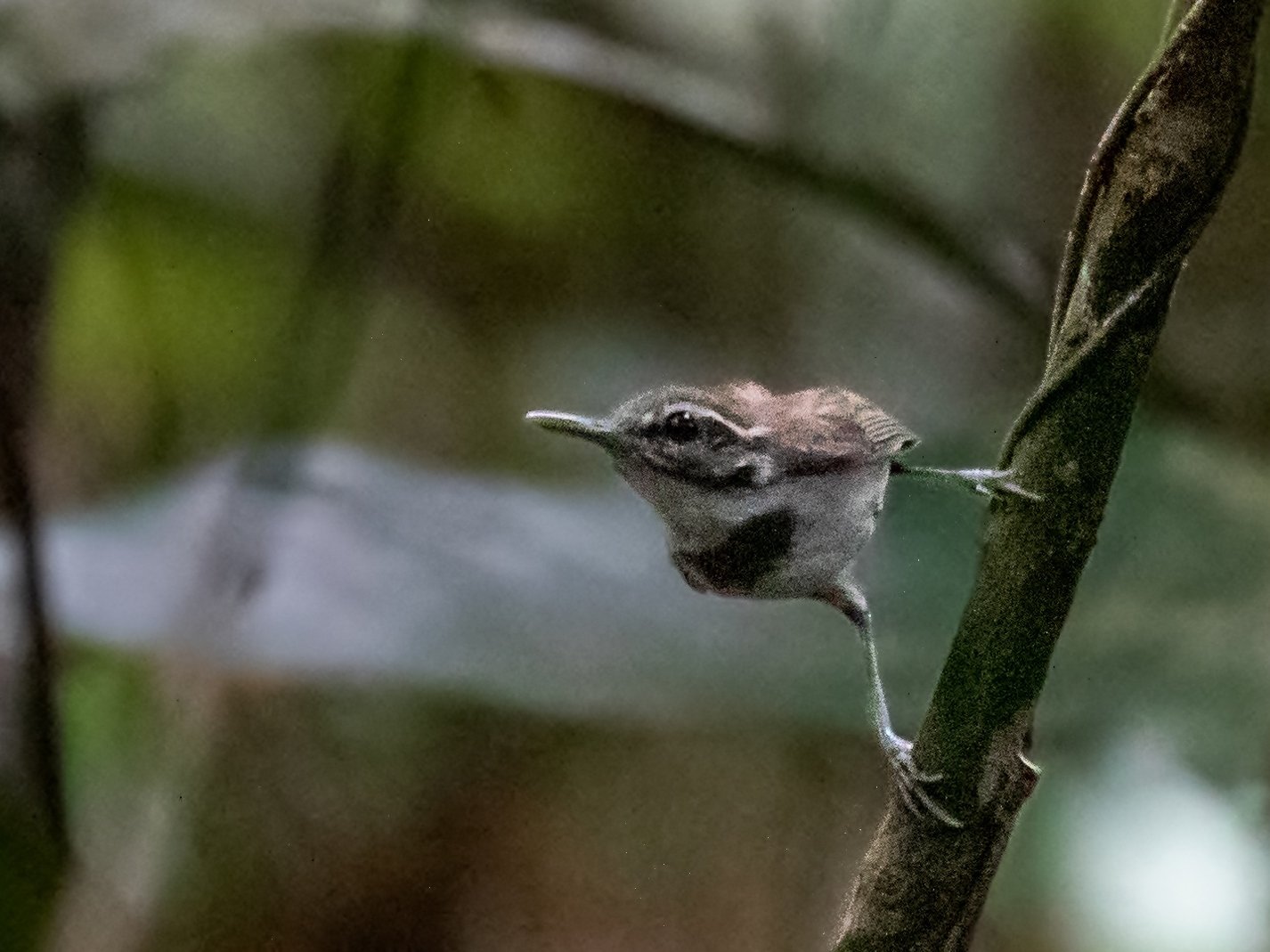
Collared Gnatwren is a small, short-tailed bird with a long, straight bill, a striped head and a black band across the white breast. It lives in the undergrowth of Amazonian forest and often travels with mixed understorey flocks of antwrens. In the guide area it occurs only in north-western Amazonia.
Voice
The song is a long, high, thin whistle, often slightly descending, peeeeuw, repeated at intervals. The call is a nasal, harsh chatter.
Recording: Alexandre GRAVE — CC BY-NC-SA 4.0 · xeno-canto
Identification
10–11 cm, with a long, thin, straight bill and a short tail that is often held cocked. The upperparts are warm brown. The face is white, with a narrow black eyestripe and a black malar stripe; the cheeks are bordered blackish. Throat and belly are white, with a broad black band across the breast; the flanks are grey. The legs are long and greyish pink. The sexes are alike; juveniles are duller, with a less sharply defined breast band.
Confusion species
Tawny-faced Gnatwren Microbates cinereiventris has a rufous face and grey underparts without a black breast band, and lives mainly at the foot of the Andes. Trilling Gnatwren Ramphocaenus melanurus has a much longer, narrow tail and a buffy head and underparts without a breast band. Wrens such as Coraya Wren Pheugopedius coraya have a shorter bill and barred wings or tail.
Habitat
Dense undergrowth of humid terra firme forest in the lowlands, especially in fairly open understorey on hilly ground, mostly below 500 m. It searches for insects and spiders low above the ground, in pairs, often with mixed understorey flocks of antwrens. The nest is an open cup low in the undergrowth.
Where the bird is most at home, classified by the vegetation units of the Andes and the west coast.


Range and movements
In Colombia in the Amazonian lowlands of the south-east. In Ecuador in the eastern lowlands. In Peru in the north-east (Loreto), mainly north of the Amazon. Absent from Bolivia and the Galápagos. Outside the guide area in southern Venezuela, the Guianas and northern Brazil.
- Resident
- dark = core range, pale = thinly spread
How and when to look
Walk slowly along trails through undisturbed terra firme forest and watch for mixed flocks in the undergrowth. The high, thin whistle often gives the bird away before it is seen; it moves low and flicks its tail.
Conservation status
Least Concern. The species depends on undisturbed lowland forest and disappears where forest is cleared or heavily fragmented.
Scientific name
Microbates collaris | (Pelzeln, 1868)
Pelzeln described the species in 1868 as Rhamphocaenus collaris; because it was later moved to another genus, the author and year stand in brackets. The genus Microbates was introduced in 1873 by Sclater & Salvin. The genus name comes from Greek mikros, 'small', and batēs, 'walker', from bainō, 'to tread'. The species name is Latin collaris, 'of the neck, collared', after the black breast band. The specimen the first description was based on came from Manaus (Barra do Rio Negro), Amazonas, Brazil.