All species › Passerines › Waxwings › Cedar Waxwing
Cedar Waxwing | Bombycilla cedrorum
Cederpestvogel | Ampelis americano | Tagarela-dos-cedros
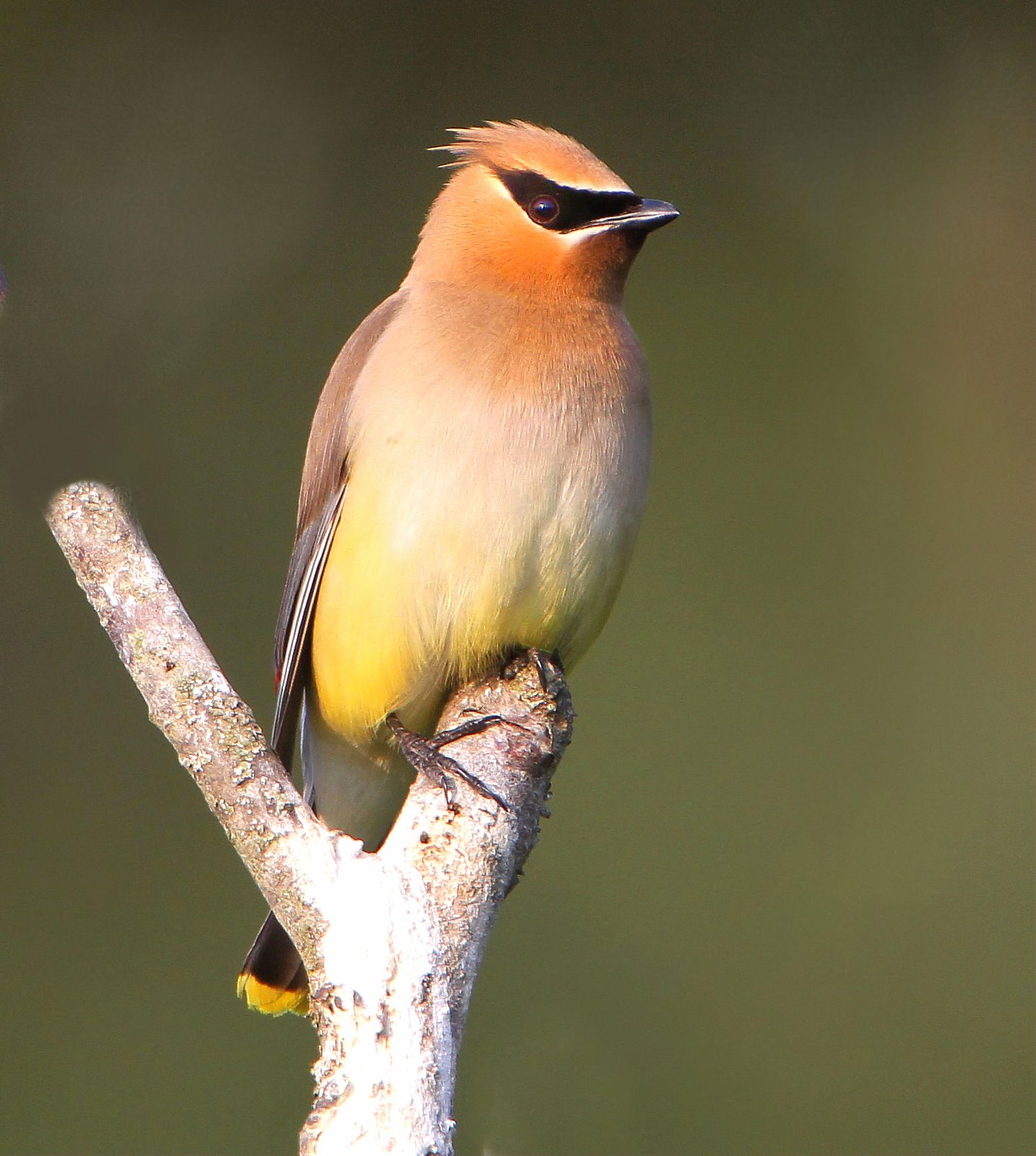
Cedar Waxwing is a crested, soft brown fruit-eater from North America that wanders in flocks during the northern winter. The guide area lies at the southern edge of its winter range: it reaches mainly Colombia, and not in the same numbers every year. The red, waxy tips on the secondaries gave the family its name.
Voice
No real song. The call is a very high, thin, slightly trilled whistle, sreee, given constantly by flocks, also in flight.
Recording: Rory Nefdt — CC BY-NC-SA 4.0 · xeno-canto
Identification
16–18 cm, compact, with a pointed crest, a short, broad bill and a fairly short tail. The head, breast and back are warm greyish brown, the belly is pale yellow and the undertail coverts are white. A black mask runs from the bill through the eye and is thinly edged white above; the chin is black. The rump and tail are grey, the tail with a yellow terminal band. Adults have red, waxy tips to the secondaries. The sexes are very similar; the male has a slightly larger black chin. Juveniles are greyer, with faint streaks on the underparts and a smaller mask.
Confusion species
No other waxwing occurs in the guide area. Bohemian Waxwing Bombycilla garrulus of the north is larger and greyer, with rufous undertail coverts and white and yellow marks on the wing, but does not reach South America. The crest, black mask and yellow tail band separate Cedar Waxwing from the fruit-eating tanagers and euphonias with which it sometimes shares a tree.
Habitat
In the guide area mainly forest edges, open woodland, parks, gardens and scrub with fruiting trees and shrubs in the Andes, roughly between 1000 and 2800 m, sometimes lower. It lives in flocks, feeds mainly on berries and other soft fruit, and also catches insects in flight. It breeds only in North America.
Where the bird is most at home, classified by the vegetation units of the Andes and the west coast.


Range and movements
In Colombia an irregular winter visitor, mainly in the north and in the Andes, with records up to the Bogotá plateau. In Ecuador only a few records. Not recorded in Peru or Bolivia and absent from the Galápagos. Outside the guide area it breeds in Canada and the United States and winters south to Central America and the Caribbean.
- Winter visitor (c. Oct–Mar)
- dark = core range, pale = thinly spread
How and when to look
In the northern winter, watch for small flocks in fruiting trees in parks, gardens and forest edges in the Colombian Andes. The high, thin call is often the first sign; numbers vary greatly from year to year.
Conservation status
Least Concern. The North American population is large and stable to increasing. In the guide area the species is a scarce, irregular winter visitor.
Scientific name
Bombycilla cedrorum | Vieillot, 1808
Vieillot described the species in 1808 and placed it straight away in the genus where it still stands. He introduced the genus Bombycilla in that same work. The genus name is Vieillot's attempt at Latin for 'silktail': Latin bombyx, 'silk', with cilla, which he took to mean 'tail', after the German Seidenschwanz. The species name is Latin for 'of the cedars'. The specimen the first description was based on came from Eastern North America.