All species › Passerines › Swallows › Cave Swallow
Cave Swallow | Petrochelidon fulva
Holenzwaluw | Golondrina pueblera | Andorinha-das-cavernas
The Cave Swallow is a cliff swallow of the southern part of North America, Mexico and the Greater Antilles, which originally breeds in caves and sinkholes and now also under bridges and in culverts. In the guide area it is only a rare vagrant. Chestnut-collared Swallow was formerly treated as a subspecies of this species.
Voice
A short, clear cheep and a fast, squeaky twitter, higher and purer than in American Cliff Swallow.
Recording: Richard E. Webster — CC BY-NC-SA 4.0 · xeno-canto
Identification
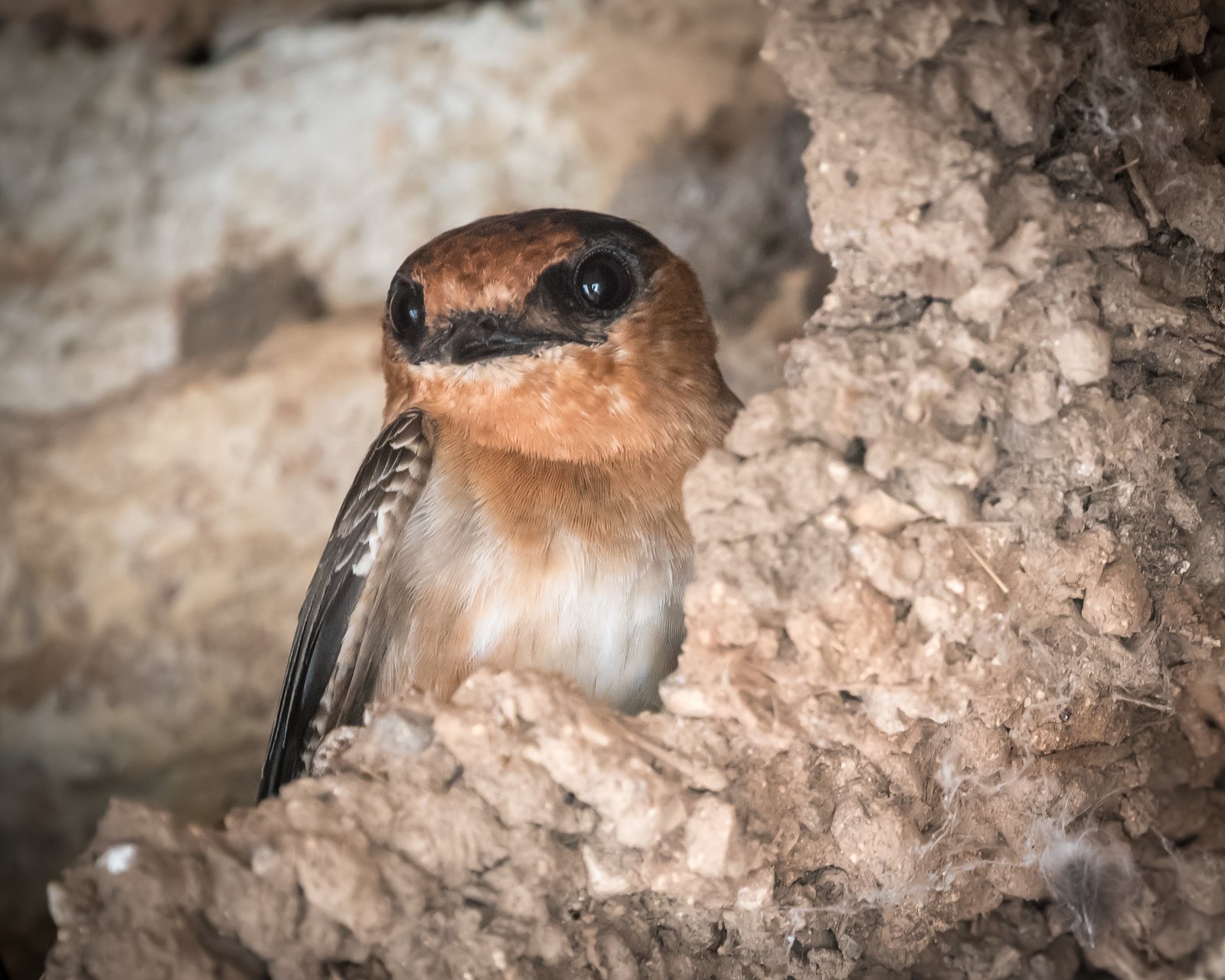
13–14 cm, stocky, with a short, square tail. The crown and back are dark steel-blue, the back with pale streaks. The forehead is dark rufous; the cheeks, throat and nape are pale orange-buff, without a dark throat patch. The rump is warm cinnamon. The underparts are dingy white, with an orange-buff wash on the breast and flanks. The sexes are alike. Juveniles are duller, with a less clearly patterned head.
Confusion species
American Cliff Swallow Petrochelidon pyrrhonota has a dark chestnut throat with a blackish patch and usually a pale forehead; it passes through the guide area in flocks and is much more likely there. Chestnut-collared Swallow Petrochelidon rufocollaris has a white throat, a rufous collar and a rufous band across the breast. Barn Swallow Hirundo rustica has a forked tail and a dark rump.
Habitat
Open lowland country, often near water, villages and roads. It hunts flying insects, often together with other swallows. It does not breed in the guide area; elsewhere it builds cups of mud in caves, sinkholes, under bridges, in culverts and on buildings.
Where the bird is most at home, classified by the vegetation units of the Andes and the west coast.


Range and movements
In the guide area only as a rare vagrant; there are only a few isolated records. Vagrants are most likely in the north, among migrating flocks of American Cliff Swallows and Barn Swallows. It does not breed in the Galápagos or on the mainland. Outside the guide area it breeds in the southern United States, Mexico and the Greater Antilles; northern birds move in winter to southern Mexico and Central America.
How and when to look
Check flocks of cliff swallows carefully: a bird with a pale orange-buff throat without a dark patch and with a dark forehead deserves closer attention and documentation with photographs.
Conservation status
Least Concern. The species has greatly expanded its breeding range in the southern United States thanks to bridges and culverts as nest sites.
Scientific name
Petrochelidon fulva | (Vieillot, 1808)
Vieillot described the species in 1808 as Hirundo fulva; because it was later moved to another genus, the author and year stand in brackets. The genus Petrochelidon was introduced in 1851 by Cabanis. The genus name comes from Greek petra, 'rock', and khelidōn, 'swallow'. Latin fulvus means 'tawny', after the tawny throat and rump. The specimen the first description was based on came from Hispaniola.