All species › Passerines › Swallows › Northern Rough-winged Swallow
Northern Rough-winged Swallow | Stelgidopteryx serripennis
Noord-Amerikaanse ruwvleugelzwaluw | Golondrina aserrada norteña | Andorinha-serradora-do-norte
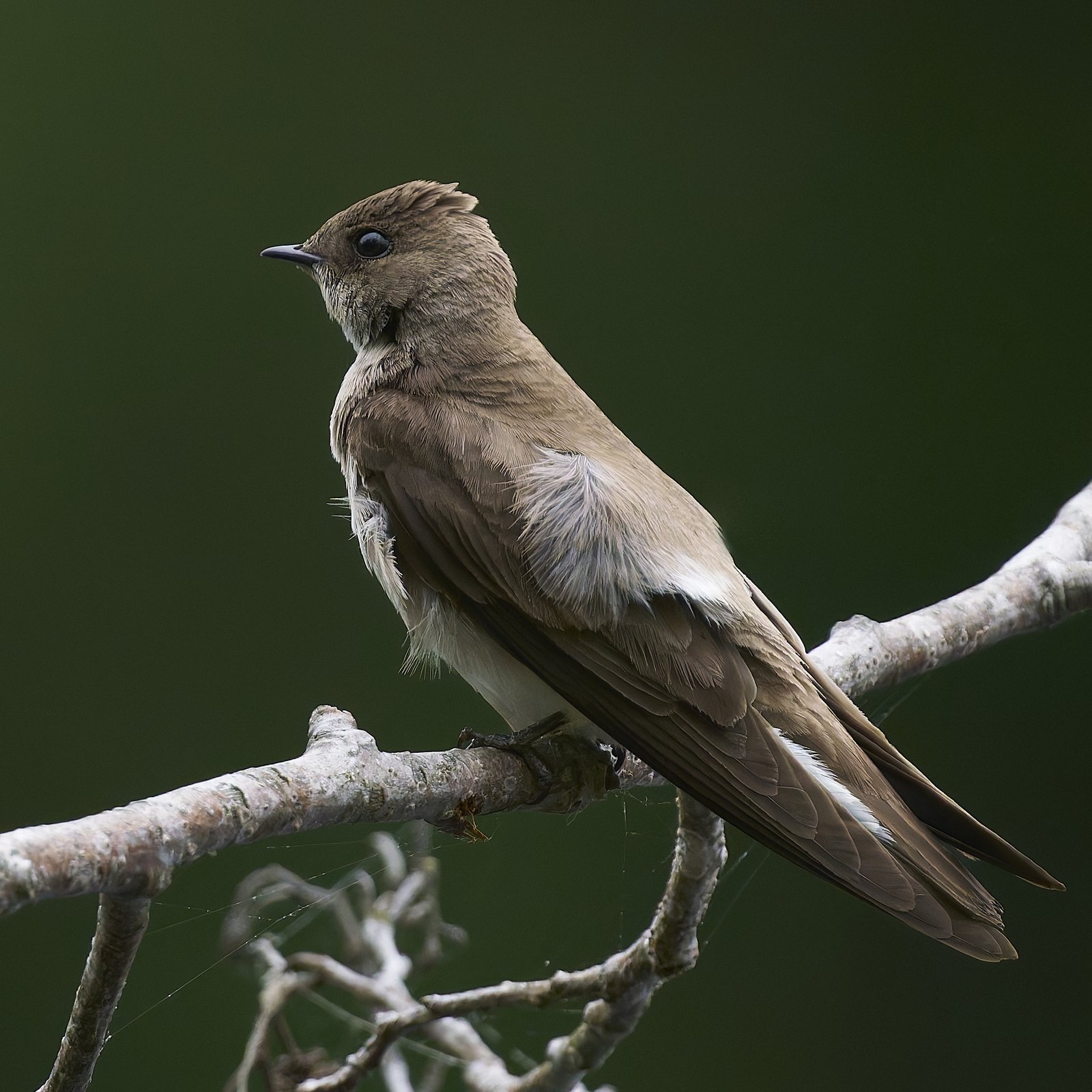
The Northern Rough-winged Swallow is a plain brown swallow without conspicuous markings that breeds from Canada to Central America. Northern birds winter south to Panama. In the guide area it is only a rare vagrant in northern Colombia.
Voice
A low, rough prrrt, often repeated in short series.
Recording: Manuel Grosselet — CC BY-NC-SA 4.0 · xeno-canto
Identification
13–14 cm, with a square or slightly notched tail. The upperparts are plain greyish brown, without a pale rump. The throat and breast are dingy greyish brown and grade into the white belly and undertail coverts. The sexes are nearly alike; the male has tiny hooks on the outer primary. Juveniles have cinnamon edges to the wing coverts.
Confusion species
Southern Rough-winged Swallow Stelgidopteryx ruficollis has a cinnamon throat, a yellower belly and often a pale rump. Bank Swallow Riparia riparia is smaller, with a white throat and a sharply defined brown breast band. Juvenile Barn Swallows Hirundo rustica have a forked tail, a dark breast band and a pale rufous throat.
Habitat
In winter, open country near water: rivers, lakes, marshes and pasture, mostly in the lowlands. It hunts flying insects low over water and open ground. It breeds in burrows in banks and in structures, outside the guide area.
Where the bird is most at home, classified by the vegetation units of the Andes and the west coast.


Range and movements
In Colombia only a few records in the north. Absent from Ecuador, Peru, Bolivia and the Galápagos. Outside the guide area it breeds from southern Canada to Costa Rica and winters from the southern United States to Panama.
How and when to look
In the northern winter in northern Colombia, check for brown swallows without a cinnamon throat among flocks of Southern Rough-winged and Bank Swallows. A good photograph of the throat and rump is needed to document the species.
Conservation status
Listed here as Not Evaluated. In its large breeding range in North and Central America the species is common and widespread.
Scientific name
Stelgidopteryx serripennis | (Audubon, 1838)
Audubon described the species in 1838 as Hirundo serripennis; because it was later moved to another genus, the author and year stand in brackets. The genus Stelgidopteryx was introduced in 1858 by Baird. The genus name comes from Greek stelgis, 'scraper', and pterux, 'wing', after the rough, serrated edge of the outer primary. From Latin serra, 'saw', and penna, 'feather', after the serrated edge of the outer primary. The specimen the first description was based on came from Charleston, South Carolina, United States.