All species › Passerines › Swallows › Caribbean Martin
Caribbean Martin | Progne dominicensis
Caribische purperzwaluw | Golondrina caribeña | Andorinha-caribenha
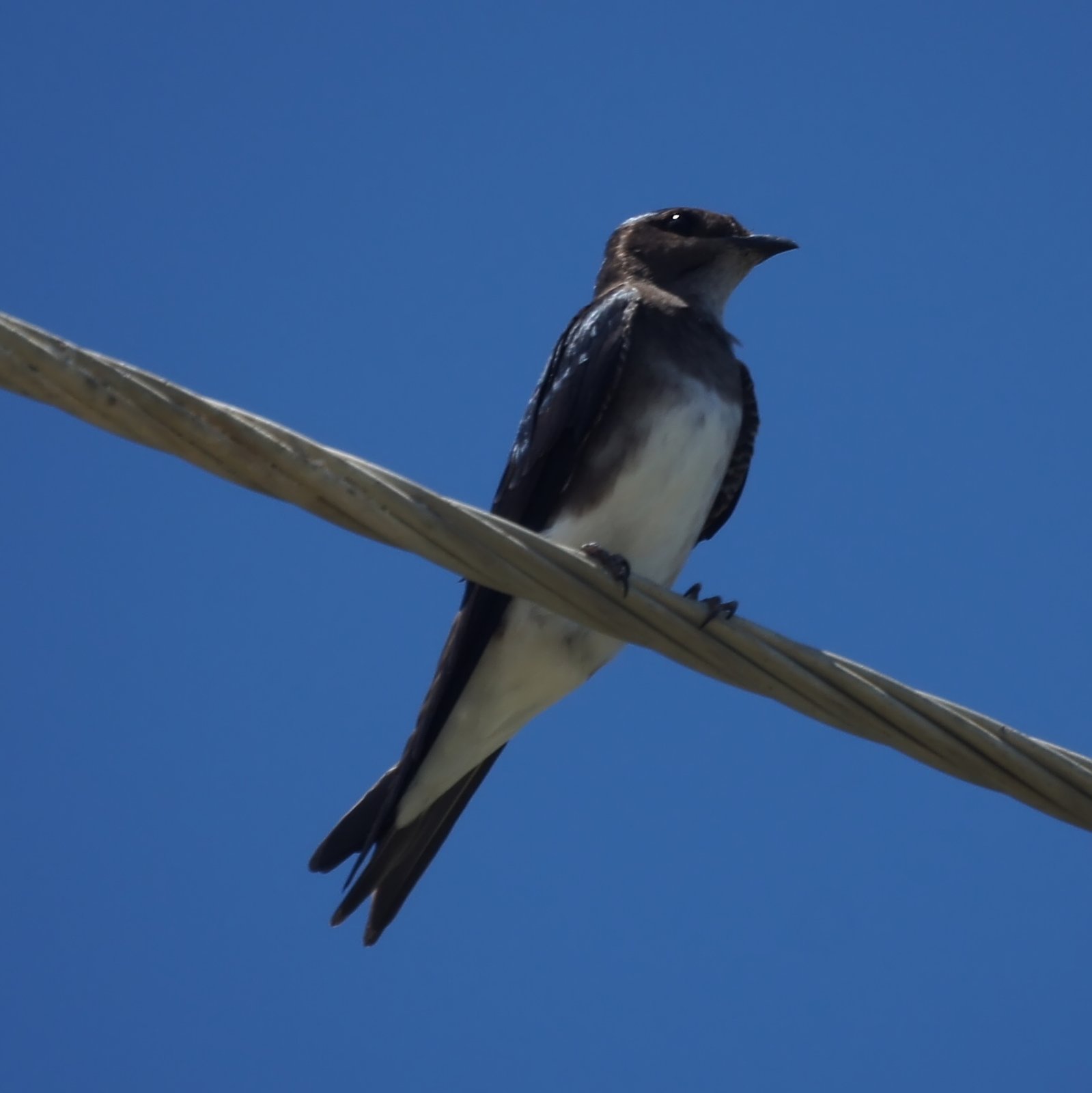
The Caribbean Martin breeds on the islands of the Caribbean and moves to South America outside the breeding season, where its wintering grounds are poorly known. In the guide area it is only a very rare vagrant. The male is the only martin in the region with a sharply demarcated white belly combined with entirely glossy blue-black upperparts, head and breast.
Voice
A gurgling twitter and a warm call, similar to those of other martins.
Recording: David Boyle — CC BY-NC-SA 4.0 · xeno-canto
Identification
18–20 cm, a sturdy swallow with broad, pointed wings and a clearly forked tail. The male is glossy blue-black on the head, upperparts, throat and breast, with a white belly and undertail coverts; the border between dark and white is sharp. The female is duller above, with a greyish-brown throat and breast that merge gradually into the white belly. Juveniles are browner than the female.
Confusion species
Grey-breasted Martin Progne chalybea is smaller and has a greyish-brown throat and breast in both sexes; the female Caribbean Martin is very similar to it and practically inseparable in the field. Male Purple Martin Progne subis and male Southern Martin Progne elegans are dark on the belly as well. Brown-chested Martin Progne tapera is brown above.
Habitat
In the breeding range coasts, villages, open country and forest edges, also over water. It hunts flying insects in the air. It nests in cavities in trees, rocks and buildings. Little is known of its habitat in the wintering range.
Where the bird is most at home, classified by the vegetation units of the Andes and the west coast.


Range and movements
In the guide area recorded only as a very rare vagrant, with just a few records; there is no regular site or season of occurrence. Absent from the Galápagos. Breeds in the Greater and Lesser Antilles and on Tobago; the wintering grounds are presumably in northern and central South America, but are poorly known.
How and when to look
A vagrant may turn up among other martins over rivers or villages in the lowlands, mainly in the northern winter. Only the male with its sharply demarcated white belly can be identified reliably in the field; females cannot be separated with certainty from Grey-breasted Martin without photographs.
Conservation status
Least Concern. Little is known about its numbers and wintering grounds.
Scientific name
Progne dominicensis | (Gmelin, 1789)
Gmelin described the species in 1789 as Hirundo dominicensis; because it was later moved to another genus, the author and year stand in brackets. The genus Progne was introduced in 1826 by Boie. The genus name refers to Procne (Greek Proknē), a queen in Greek mythology who was turned into a swallow. The name refers to Santo Domingo (Saint-Domingue), the island of Hispaniola. The specimen the first description was based on came from Hispaniola.