All species › Passerines › Swallows › Chestnut-collared Swallow
Chestnut-collared Swallow | Petrochelidon rufocollaris
Peruaanse klifzwaluw | Golondrina cuellirrufa | Andorinha-de-colar-castanho
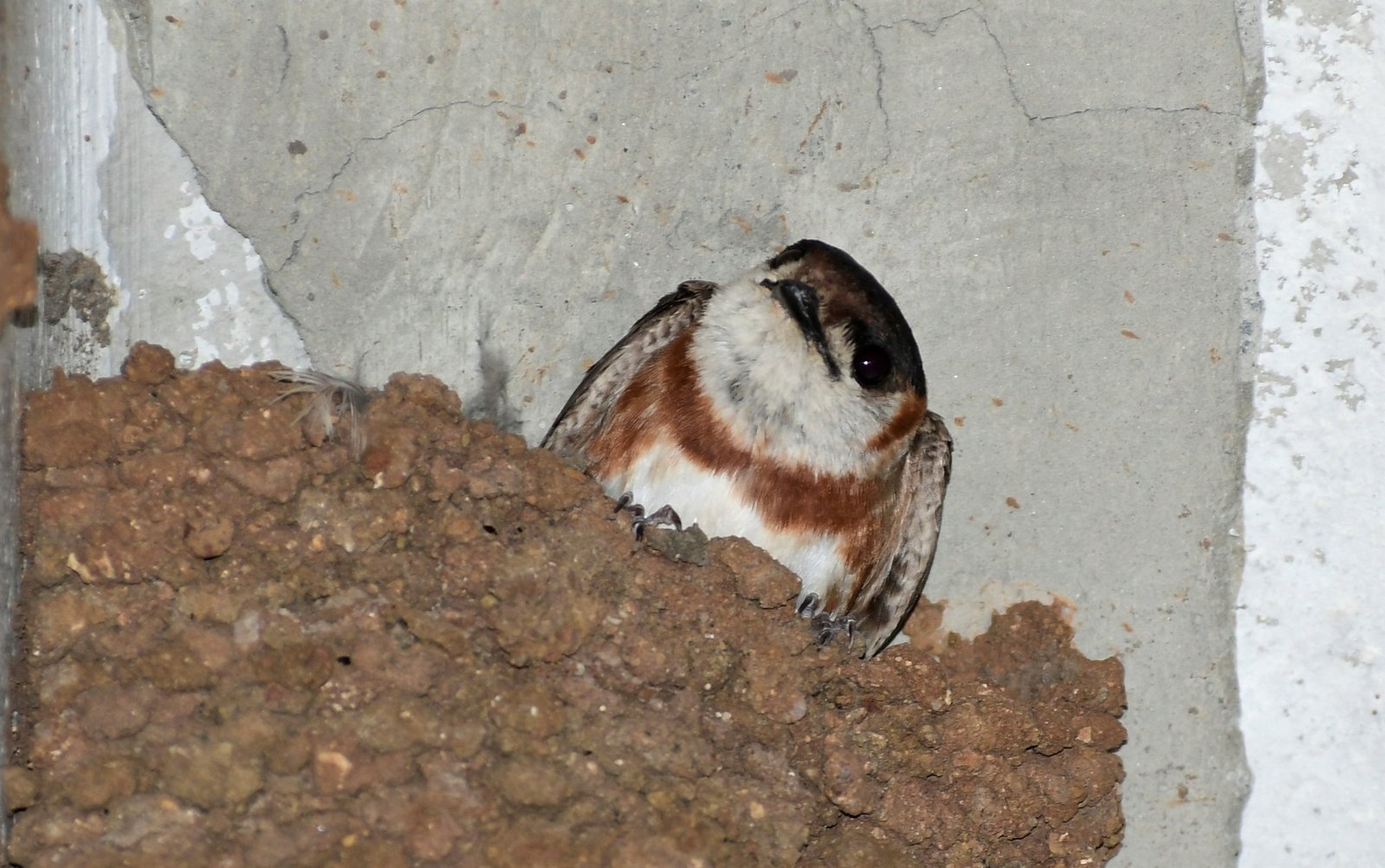
The Chestnut-collared Swallow is a small cliff swallow of the dry Pacific coast of Ecuador and Peru, with a rufous collar and a rufous rump. It breeds in colonies of closed mud nests, nowadays mostly under eaves and bridges in villages and towns. For a long time it was regarded as a subspecies of Cave Swallow.
Voice
A quiet chit, a creaking grrree and a gravelly chrrt, mainly around the colony.
Recording: John V. Moore — CC BY-NC-SA 4.0 · xeno-canto
Identification
12 cm, compact, with a short, square tail. The crown and back are glossy blue-black, the back with white streaks. A rufous collar runs from the nape around the neck and forms a narrow band across the breast. The throat and the rest of the underparts are white, with some rufous on the flanks. The rump is rufous. The sexes are alike. Juveniles are duller and browner, with a fainter collar.
Confusion species
American Cliff Swallow Petrochelidon pyrrhonota is larger, with a dark chestnut throat, a pale forehead and a pale, creamy rump; in the guide area it is only a passage migrant. Barn Swallow Hirundo rustica has a deeply forked tail, a rufous throat and a dark rump. Blue-and-white Swallow Pygochelidon cyanoleuca lacks rufous and has a blue rump. Southern Rough-winged Swallow Stelgidopteryx ruficollis is brown above, with a pale rump.
Habitat
Farmland with villages and towns, irrigated fields, river valleys and dry scrub in the lowlands and Andean foothills, in Ecuador from sea level to about 2000 m, in Peru to about 1000 m. It hunts flying insects low over fields and around buildings, often together with other swallows. The nest is a closed cup of mud, usually under eaves, bridges and other structures; formerly probably mainly on cliffs. In Ecuador it breeds from January to August.
Where the bird is most at home, classified by the vegetation units of the Andes and the west coast.


Range and movements
Absent from Colombia and Bolivia. In Ecuador in the west, from central Manabí south to Loja and the Peruvian border. In Peru along the coast and the lower western slope from Tumbes south to the department of Lima. Absent from the Galápagos. It does not occur outside the guide area.
- Resident
- dark = core range, pale = thinly spread
How and when to look
In villages and small towns in the dry west of Ecuador and north-western Peru, check eaves, bridges and overpasses for colonies of mud nests. Over irrigated fields in the coastal valleys the birds often hunt low.
Conservation status
Least Concern. The species has a limited range, but benefits from buildings as nest sites and appears to be increasing.
Scientific name
Petrochelidon rufocollaris | (Peale, 1849)
Peale described the species in 1849 as Hirundo rufocollaris; because it was later moved to another genus, the author and year stand in brackets. The genus Petrochelidon was introduced in 1851 by Cabanis. The genus name comes from Greek petra, 'rock', and khelidōn, 'swallow'. From Latin rufus, 'red', and collaris, 'of the neck', after the chestnut collar. The specimen the first description was based on came from Callao, Peru.