All species › Passerines › Swallows › American Cliff Swallow
American Cliff Swallow | Petrochelidon pyrrhonota
Amerikaanse klifzwaluw | Golondrina risquera | Andorinha-de-dorso-acanelado
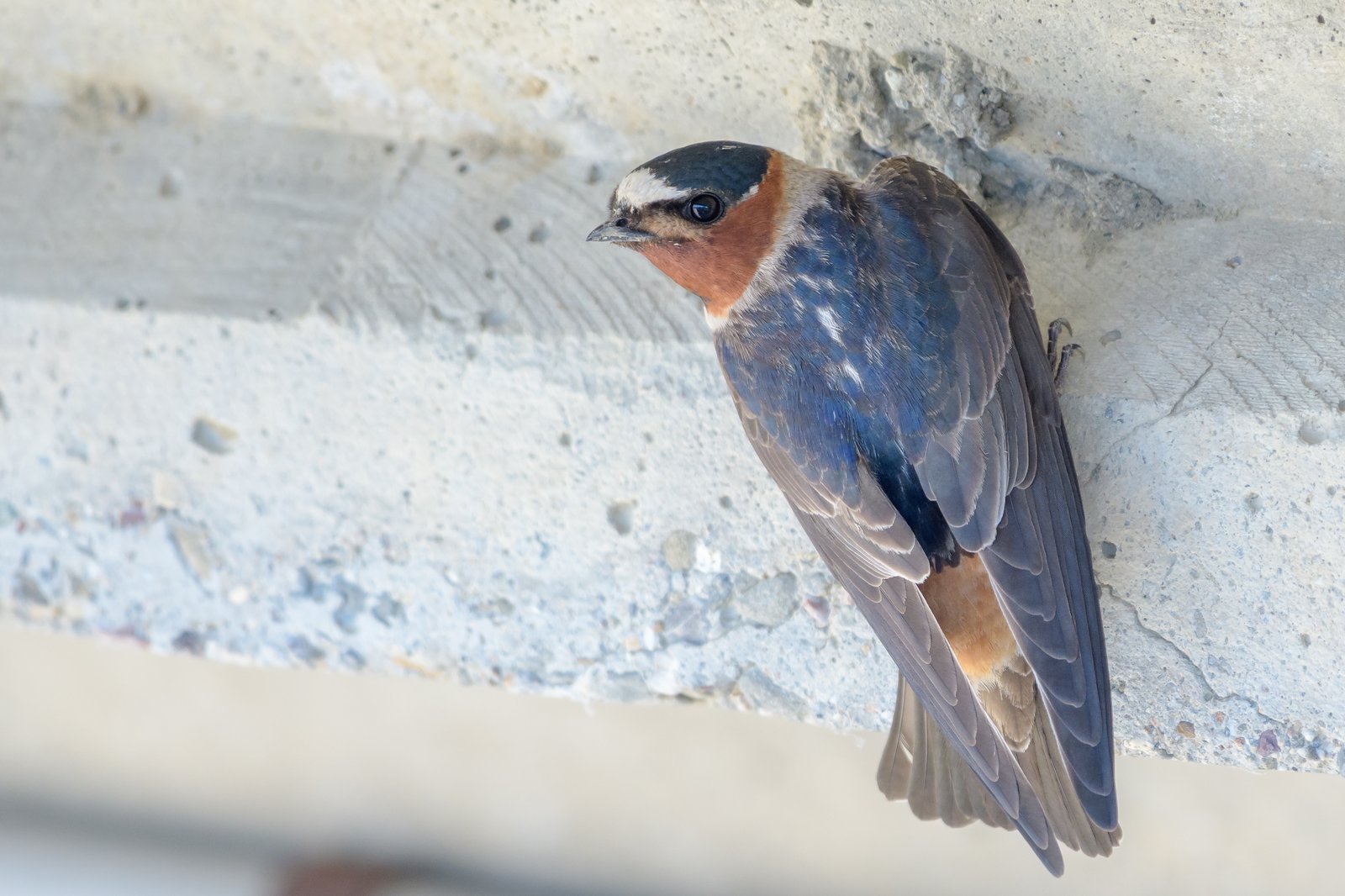
The American Cliff Swallow is a sturdy swallow with a square tail and a pale rump, which builds mud nests in large colonies in North America. On its way to the wintering grounds in southern South America it passes through the guide area in flocks, often together with Barn Swallows. In spring and autumn flocks can number hundreds of birds.
Voice
A low, purring churr and a soft, creaking twitter, in flocks often mixed together.
Recording: Stanislas Wroza — CC BY-NC-SA 4.0 · xeno-canto
Identification
13–14 cm, stocky, with broad wings and a short, square tail. The crown and back are dark steel-blue, the back with pale streaks. The forehead is white to pale cream, the cheeks and throat are dark chestnut, with a blackish patch on the throat. A greyish-brown band crosses the nape. The rump is pale cream to pale orange-buff, and the underparts are dingy white. The sexes are alike. Juveniles are duller, with a dark forehead and a less patterned head.
Confusion species
Chestnut-collared Swallow Petrochelidon rufocollaris is smaller, with a white throat, a rufous collar and a rufous rump; it is resident in western Ecuador and Peru. Cave Swallow Petrochelidon fulva has a pale orange-buff throat and a dark rufous forehead. Barn Swallow Hirundo rustica has a deeply forked tail and a dark rump.
Habitat
On migration over open country from sea level into the Andean valleys, often over water: rivers, lakes, marshes, rice fields and pastures. It hunts flying insects in flocks, sometimes high in the air. It rests on wires and bare branches. It does not breed in the guide area; in North America it forms colonies of gourd-shaped mud nests under bridges, on buildings and on cliffs.
Where the bird is most at home, classified by the vegetation units of the Andes and the west coast.


Range and movements
In Colombia a passage migrant through almost the whole country, mainly in the eastern lowlands and the Andean valleys. In Ecuador a passage migrant, mainly in the east, scarcer in the west. In Peru a passage migrant, mainly in the eastern lowlands, with records along the coast and in the Andes. In Bolivia a passage migrant and locally a winter visitor in the lowlands. Not regular in the Galápagos. Outside the guide area it breeds in North America and Mexico; it winters mainly in southern Brazil, Paraguay, Uruguay and Argentina.
- Winter visitor (c. Oct–Mar)
- Passage (Mar–Apr, Oct–Nov)
- dark = core range, pale = thinly spread
How and when to look
In September–November and March–May look for swallow flocks over rivers, lakes and rice fields in the lowlands, and check flocks of Barn Swallows for birds with a square tail and a pale rump.
Conservation status
Least Concern. The species is very numerous and has expanded its breeding range in North America thanks to bridges and buildings as nest sites.
Scientific name
Petrochelidon pyrrhonota | (Vieillot, 1817)
Vieillot described the species in 1817 as Hirundo pyrrhonota; because it was later moved to another genus, the author and year stand in brackets. The genus Petrochelidon was introduced in 1851 by Cabanis. The genus name comes from Greek petra, 'rock', and khelidōn, 'swallow'. From Greek purrhos, 'flame-coloured', and -nōtos, 'backed', after the rufous rump. The specimen the first description was based on came from Paraguay.