All species › Passerines › Swallows › Barn Swallow
Barn Swallow | Hirundo rustica
Boerenzwaluw | Golondrina común | Andorinha-de-bando
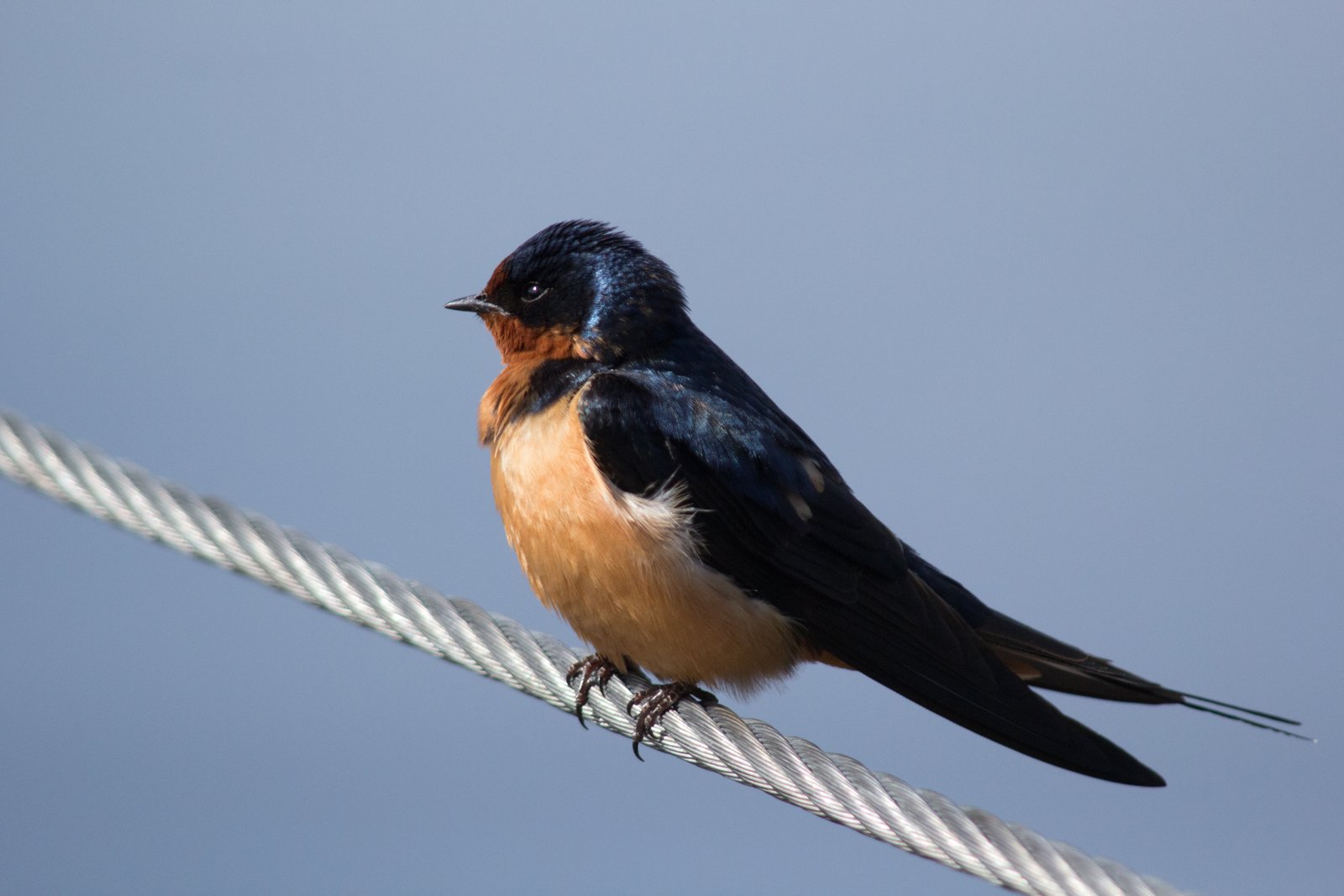
The Barn Swallow is the most familiar swallow of the northern hemisphere and in the guide area a numerous winter visitor and passage migrant from North America. Flocks hunt low over pastures, rice fields, marshes and beaches, and gather in the evening at roosts in reeds and sugar cane. It is the only swallow in the region with long tail streamers.
Voice
A clear, repeated witt witt and, when alarmed, a sharp siflit. The song, a fast twitter ending in a rattle, is only occasionally heard in winter.
Recording: Andrew McCafferty — CC BY-NC-SA 4.0 · xeno-canto
Identification
15–19 cm, including the long outer tail feathers, which are shorter in juveniles and moulting birds. The upperparts are glossy dark blue. The forehead and throat are rufous, bordered by a narrow, dark blue breast band. The underparts of North American birds are cream to warm rufous-buff. The tail is deeply forked, with a row of white spots that shows when the tail is spread. The female has shorter streamers. Juveniles are duller, with a pale throat and a shorter tail.
Confusion species
American Cliff Swallow Petrochelidon pyrrhonota has a square tail and a pale, creamy rump. Chestnut-collared Swallow Petrochelidon rufocollaris is smaller, with a rufous rump and a square tail. Southern Rough-winged Swallow Stelgidopteryx ruficollis is brown above, without streamers. Short-tailed juvenile Barn Swallows are told from the other species by the dark breast band and the white tail spots.
Habitat
Open country from sea level to over 3000 m: pastures, fields, rice paddies, marshes, riverbanks, beaches and villages. It hunts low over the ground and water for flying insects. It roosts in flocks, sometimes of thousands of birds, in reeds, sugar cane or on wires. It does not breed in the guide area; the nest, an open cup of mud, is built in buildings in North America.
Where the bird is most at home, classified by the vegetation units of the Andes and the west coast.


Range and movements
In Colombia a widespread winter visitor and passage migrant, from the Caribbean coast to the Andean valleys and the eastern lowlands. In Ecuador widespread, mainly in the west and in the Andean valleys. In Peru widespread, with the largest numbers along the coast and in the lowlands. In Bolivia widespread in the lowlands and valleys. In the Galápagos a rare passage migrant. Outside the guide area it breeds in North America; it winters south to southern South America, where a small breeding population has also become established in Argentina.
- Resident
- Winter visitor (c. Oct–Mar)
- Passage (Mar–Apr, Oct–Nov)
- dark = core range, pale = thinly spread
How and when to look
Watch over pastures, rice fields and marshes in the lowlands, especially between October and March. Roosts in reeds or sugar cane attract large numbers in the evening.
Conservation status
Least Concern. The species is very widespread and numerous, although numbers are declining in parts of North America, probably because of fewer insects and fewer suitable nest sites.
Scientific name
Hirundo rustica | Linnaeus, 1758
Linnaeus described the species in 1758 and placed it straight away in the genus where it still stands. He introduced the genus Hirundo in that same work. The genus name is Latin hirundo, 'swallow'. The species name is Latin rusticus, 'of the countryside'. The specimen the first description was based on came from Sweden.