All species › Passerines › Swallows › Andean Swallow
Andean Swallow | Orochelidon andecola
Andeszwaluw | Golondrina andina | Andorinha-andina
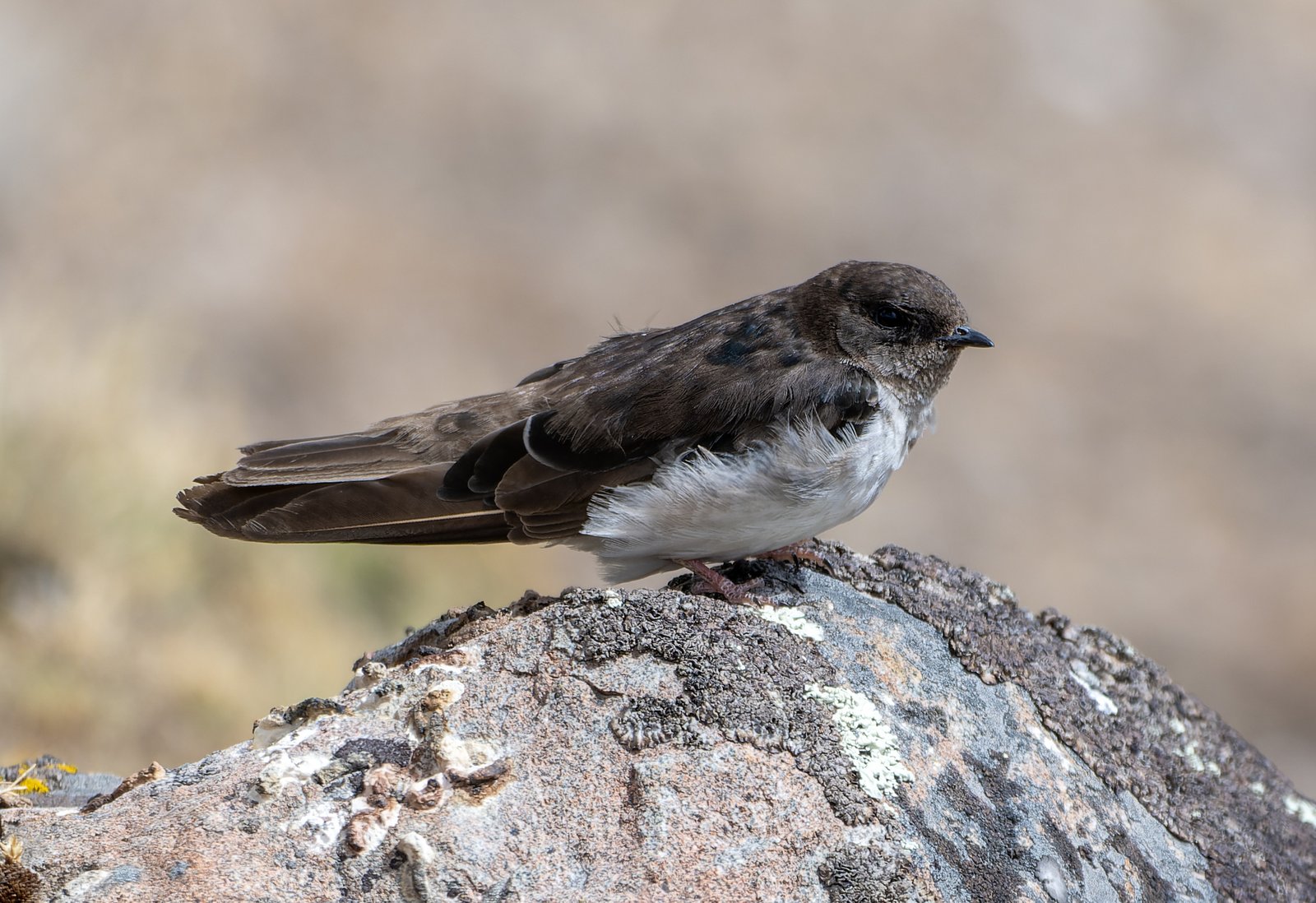
The Andean Swallow is a stocky swallow of the puna and altiplano, with long wings and a short, almost square tail. It hunts alone or in loose groups over grassland, lakes and villages high in the central and southern Andes. Its flight is powerful, with short series of wingbeats and long glides.
Voice
A dry, scratchy chrt and a soft, rasping twitter.
Recording: Cristian Pinto — CC BY-NC-SA 4.0 · xeno-canto
Identification
13–14 cm, sturdily built, with long, broad wings and a short, barely notched tail. The upperparts are dark, with a bluish-green gloss on the back and mantle; the head and wings are browner. The throat and breast are dingy greyish brown, sharply demarcated from the white belly and white undertail coverts. The sexes are alike. Juveniles are duller and browner above.
Confusion species
Brown-bellied Swallow Orochelidon murina is slimmer, with a longer, forked tail and entirely grey underparts without a white belly; it lives further north. Blue-and-white Swallow Pygochelidon cyanoleuca is smaller, with a white throat and black undertail coverts. Chilean Swallow Tachycineta leucopyga has a white rump and white underparts. Southern Rough-winged Swallow Stelgidopteryx ruficollis is brown above, with a rufous throat.
Habitat
Open puna, altiplano, rocky slopes, gorges, the shores of lakes and marshes, fields and villages, roughly between 2500 and 4600 m; in the cold season partly lower, including on the western slope. It hunts flying insects, often low over water or along rock faces. It nests in holes and crevices in banks, rocks, walls and buildings.
Where the bird is most at home, classified by the vegetation units of the Andes and the west coast.


Range and movements
Absent from Colombia and Ecuador. In Peru in the Andes of the centre and south, with the largest numbers on the altiplano around Lake Titicaca. In Bolivia in the Andes and on the altiplano in the west. Absent from the Galápagos. Outside the guide area in northern Chile and north-western Argentina.
- Resident
- dark = core range, pale = thinly spread
How and when to look
Watch over lake shores on the altiplano, around rock faces in high valleys and near villages on the puna. Note the short tail and the sharp contrast between the greyish-brown breast and white belly.
Conservation status
Least Concern. The species is widespread in a sparsely populated region and adapts to villages and buildings.
Scientific name
Orochelidon andecola | (d'Orbigny, ACVMD & de Lafresnaye, 1837) (GBIF: Haplochelidon andecola)
D'Orbigny, ACVMD & de Lafresnaye described the species in 1837 as Hirundo andecola; because it was later moved to another genus, the author and year stand in brackets. The genus Orochelidon was introduced in 1903 by Ridgway. The genus name combines Ancient Greek oros, 'mountain', with khelidōn, 'swallow'. The species name combines the Andes with Latin -cola, 'dweller', meaning 'Andes-dweller'. The specimen the first description was based on came from La Paz, Bolivia.