All species › Passerines › Swallows › Brown-bellied Swallow
Brown-bellied Swallow | Orochelidon murina
Bruinbuikzwaluw | Golondrina ventricafé | Andorinha-de-ventre-pardo
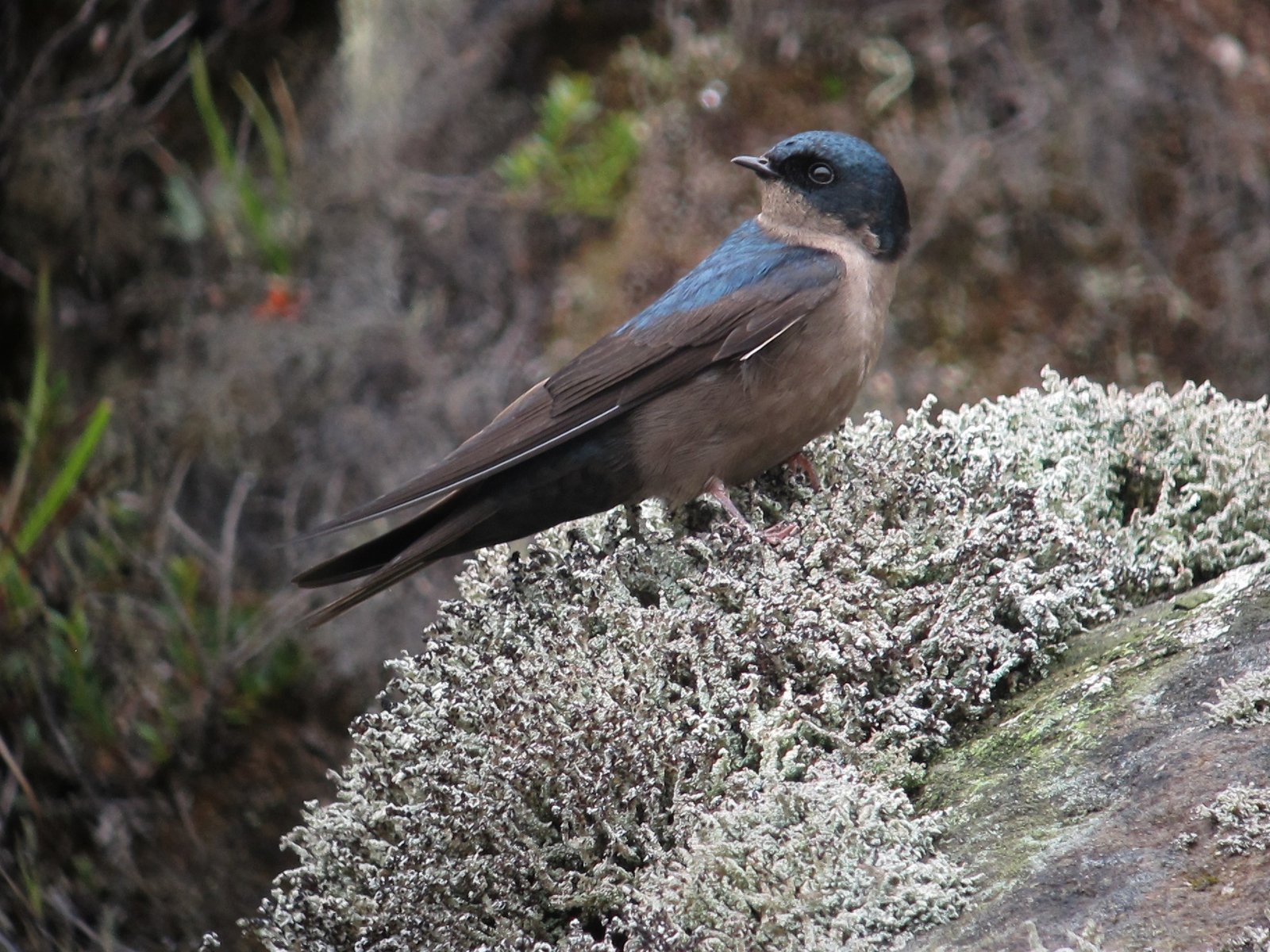
The Brown-bellied Swallow is a dark swallow of the high mountains of the northern and central Andes, with entirely smoky grey underparts. It hunts in small groups over páramo, fields and villages up to well above the treeline. Among the swallows of the high Andes it is the only one without a white belly.
Voice
A dry, rasping dzheet and a soft, hoarse twitter, often repeated in flight.
Recording: Carlos Delgado JUMABITA — CC BY-NC-SA 4.0 · xeno-canto
Identification
13–14 cm, slim, with long wings and a clearly forked tail. The upperparts are dark, with a greenish-blue to steel-blue gloss. The entire underparts, from throat to belly, are uniform smoky grey to greyish brown, slightly paler on the throat. The undertail coverts are darker greyish brown. The sexes are alike. Juveniles are browner and duller above.
Confusion species
Andean Swallow Orochelidon andecola is stockier, with a shorter, almost square tail, a white belly and white undertail coverts; it lives further south. Pale-footed Swallow Orochelidon flavipes is smaller, with a cinnamon throat and a white belly. Blue-and-white Swallow Pygochelidon cyanoleuca has white underparts with black undertail coverts. Southern Rough-winged Swallow Stelgidopteryx ruficollis is brown above, with a rufous throat and a pale rump.
Habitat
Open country in the high mountains: páramo, jalca, fields, pastures, shrubby slopes, forest edges and villages, roughly between 2500 and 4200 m, locally lower. It hunts low over the ground and along slopes for flying insects. It nests in holes and crevices in banks, rocks and buildings; the nest is a cup of grass and feathers.
Where the bird is most at home, classified by the vegetation units of the Andes and the west coast.


Range and movements
In Colombia in all three ranges of the Andes. In Ecuador widespread in the Andes. In Peru along almost the whole length of the Andes. In Bolivia in the Andes of the north-west. Absent from the Galápagos. Outside the guide area in the Andes of western Venezuela.
- Resident
- dark = core range, pale = thinly spread
How and when to look
Watch over páramo and high fields and around villages in the Andes, especially in calm weather, when the birds hunt low. Compare the uniform grey underparts with those of the Blue-and-white Swallows that often fly nearby.
Conservation status
Least Concern. The species is widespread and locally common, and benefits from open, man-made landscapes in the high mountains.
Scientific name
Orochelidon murina | (Cassin, 1853) (GBIF: Notiochelidon murina)
Cassin described the species in 1853 as Petrochelidon murina; because it was later moved to another genus, the author and year stand in brackets. The genus Orochelidon was introduced in 1903 by Ridgway. The genus name combines Ancient Greek oros, 'mountain', with khelidōn, 'swallow'. The species name comes from Latin murinus, 'mouse-coloured'. The specimen the first description was based on came from Ecuador.