All species › Passerines › Swallows › Pale-footed Swallow
Pale-footed Swallow | Orochelidon flavipes
Bleekpootzwaluw | Golondrina paticlara | Andorinha-de-pés-claros
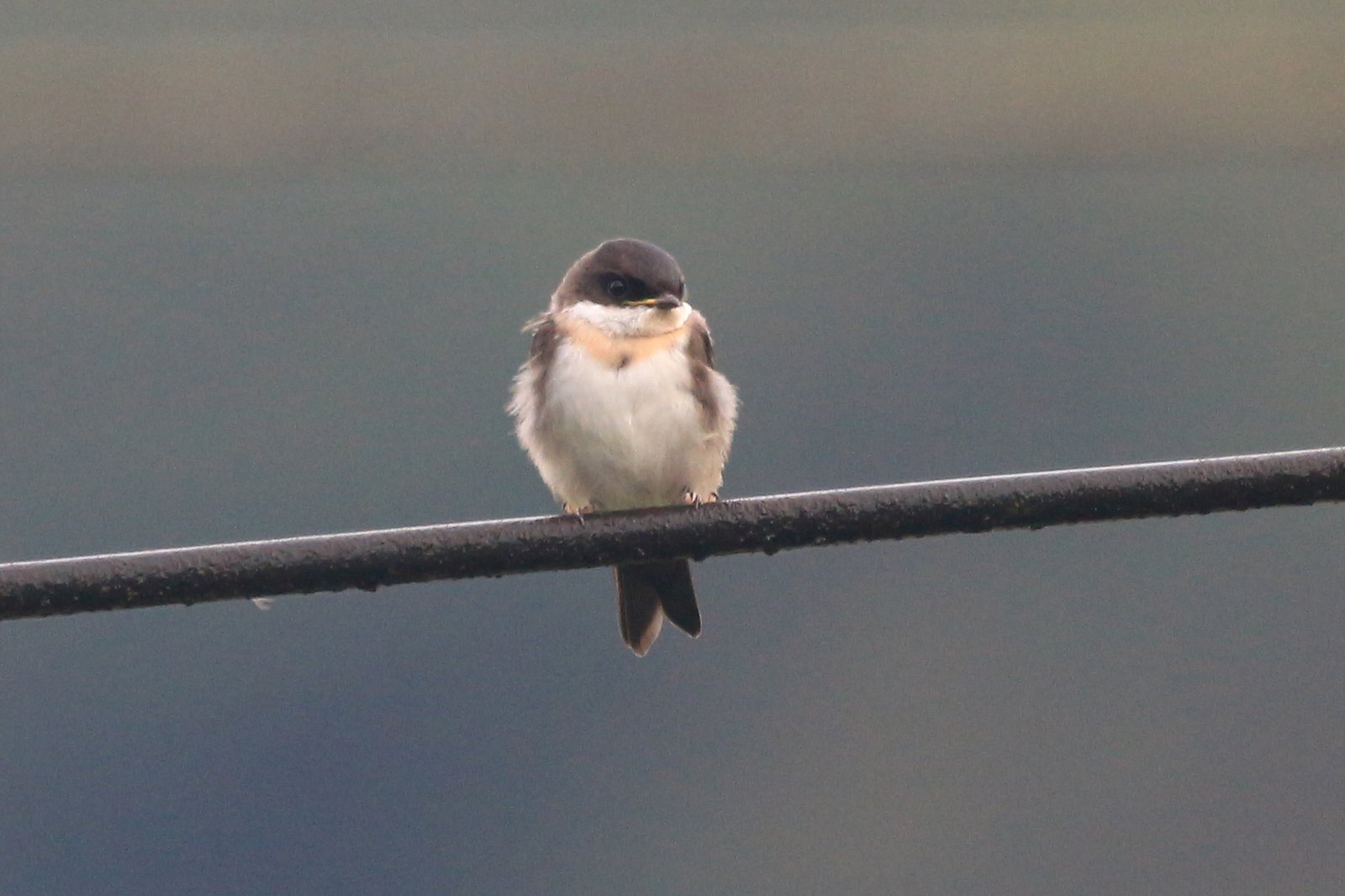
The Pale-footed Swallow is a small, dark blue swallow of high cloud forest and the treeline in the Andes. Small groups hunt low and fast over the canopy and along forest edges, often together with Blue-and-white Swallows. The name refers to the pale pinkish-brown legs, which are rarely seen in the field.
Voice
A soft, buzzy dzzt and a fine, dry twitter, mainly in flight.
Recording: John V. Moore — CC BY-NC-SA 4.0 · xeno-canto
Identification
12 cm, small and compact, with a short, slightly forked tail. The upperparts are glossy dark steel-blue. The throat and upper breast are pale cinnamon to creamy buff, the belly is white and the flanks are dark greyish brown. The undertail coverts are blackish. The legs are pale pink. The sexes are alike. Juveniles are duller and browner above, with a less tinged throat.
Confusion species
Blue-and-white Swallow Pygochelidon cyanoleuca is slightly larger and longer-tailed, with a pure white throat and white flanks; it usually lives in open country and around buildings, not over closed forest. Brown-bellied Swallow Orochelidon murina is larger, with entirely smoky grey underparts and a longer, more deeply forked tail. White-banded Swallow Atticora fasciata lives in the lowlands and has a white breast band on black underparts.
Habitat
Airspace over cloud forest, elfin forest and scrub near the treeline, roughly between 2300 and 3700 m, also over clearings and roads through the forest. It hunts small flying insects, often just above the treetops. Its breeding biology is poorly known; the nest is placed in cavities, including tree holes and holes in banks.
Where the bird is most at home, classified by the vegetation units of the Andes and the west coast.


Range and movements
In Colombia locally in the Central and Eastern Andes. In Ecuador on both slopes of the Andes, locally. In Peru along the eastern slope of the Andes over almost the whole length of the country. In Bolivia on the eastern slope of the Andes in La Paz and Cochabamba. Absent from the Galápagos. Outside the guide area also in the Andes of western Venezuela.
- Resident
- dark = core range, pale = thinly spread
How and when to look
On clear days watch from a viewpoint over high cloud forest or along a mountain road at treeline elevation. In flocks of Blue-and-white Swallows look for smaller birds with a tinged throat and dark flanks.
Conservation status
Least Concern. The species depends on high montane forest and declines locally through deforestation, but it occurs over a large area.
Scientific name
Orochelidon flavipes | (Chapman, 1922) (GBIF: Notiochelidon flavipes)
Chapman described the species in 1922 as Pygochelidon flavipes; because it was later moved to another genus, the author and year stand in brackets. The genus Orochelidon was introduced in 1903 by Ridgway. The genus name combines Ancient Greek oros, 'mountain', with khelidōn, 'swallow'. The species name comes from Latin flavus, 'yellow', and pes, 'foot'. The specimen the first description was based on came from Maraynioc, Junín, Peru.