All species › Jacamars and puffbirds › Puffbirds › Collared Puffbird
Collared Puffbird | Bucco capensis
Gekraagde baardkoekoek | Buco collarejo | Rapazinho-de-colar
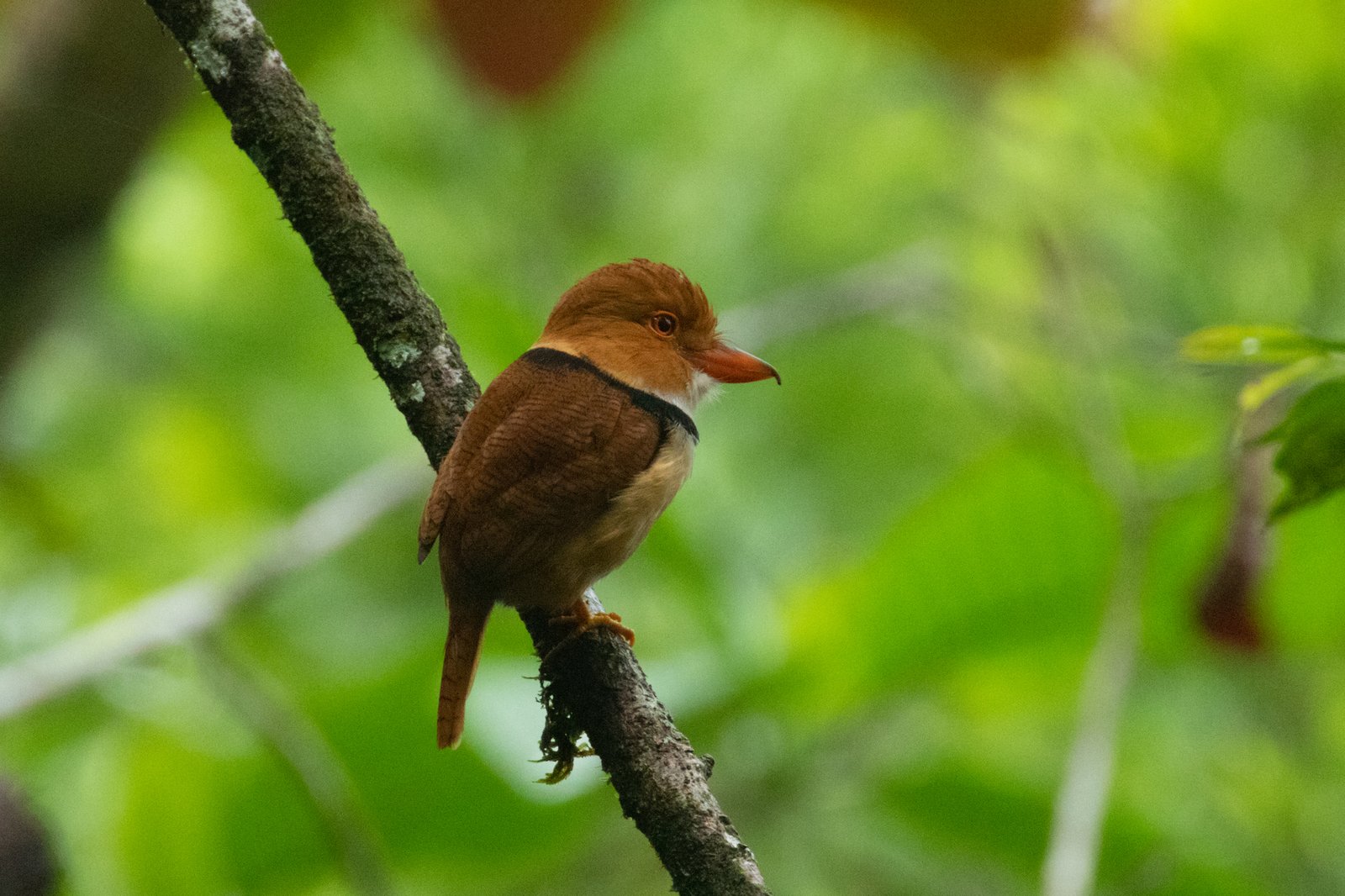
The Collared Puffbird is a rufous puffbird with an orange bill that lives in the middle storey of tall Amazonian forest. It sits still for long periods and is therefore rarely recorded, despite its large range. The black collar and orange bill make it unmistakable within the family.
Voice
A rhythmic series of two-syllabled, soft, slightly nasal whistles, like kwa-will, kwa-will, often long sustained; pairs sometimes sing in duet.
Recording: JAYRSON ARAUJO DE OLIVEIRA — CC BY-NC-SA 4.0 · xeno-canto
Identification
18–20 cm, with a large head, a heavy, bright orange bill and a fairly short tail. The head and upperparts are rufous with fine black barring, most marked on the crown and tail. A narrow orange-rufous band crosses the hindneck, bordered below by a black collar that continues as a broad black breast band. The throat is white, the rest of the underparts pale buff to white. The iris is orange. The sexes are alike.
Confusion species
Rufous-necked Puffbird Malacoptila rufa has a rufous neck and grey head, but no black breast band, and is streaked brown. Chestnut-capped Puffbird Bucco macrodactylus is smaller, with a black bill and a black face. Spotted Puffbird Bucco tamatia has a black bill and heavily scalloped underparts.
Habitat
Tall humid terra firme lowland forest, less often várzea forest and lower foothill forest, from the lowlands up to about 1000 m, locally higher. It perches in the middle storey and lower canopy and sallies for large insects, spiders and small vertebrates. It nests in a cavity in a termite nest or in the ground.
Where the bird is most at home, classified by the vegetation units of the Andes and the west coast.


Range and movements
In Colombia east of the Andes, in Amazonia in the south-east. In Ecuador in the eastern lowlands. In Peru in the Amazonian lowlands. In Bolivia in the northern lowlands. Absent from the Galápagos. Outside the guide area in southern Venezuela, the Guianas and Amazonian Brazil.
- Resident
- dark = core range, pale = thinly spread
How and when to look
In undisturbed terra firme forest, preferably in the early morning, when the rhythmic song is heard. A bird often sits still for minutes on the same branch in the middle storey.
Conservation status
Least Concern. The species depends on undisturbed forest and disappears where it is cleared, but the range is very large.
Scientific name
Bucco capensis | Linnaeus, 1766
Linnaeus described the species in 1766 and placed it straight away in the genus where it still stands. The genus Bucco was introduced in 1760 by Brisson. The genus name comes from Latin bucca, 'cheek', for the large head with puffed cheeks. The species name refers to the Cape of Good Hope, which Linnaeus gave in error as its origin. The specimen the first description was based on came from the Guianas.