All species › Jacamars and puffbirds › Puffbirds › Sooty-capped Puffbird
Sooty-capped Puffbird | Bucco noanamae
Roetkapbaardkoekoek | Buco de Noanamá | Rapazinho-de-boné-fuliginoso
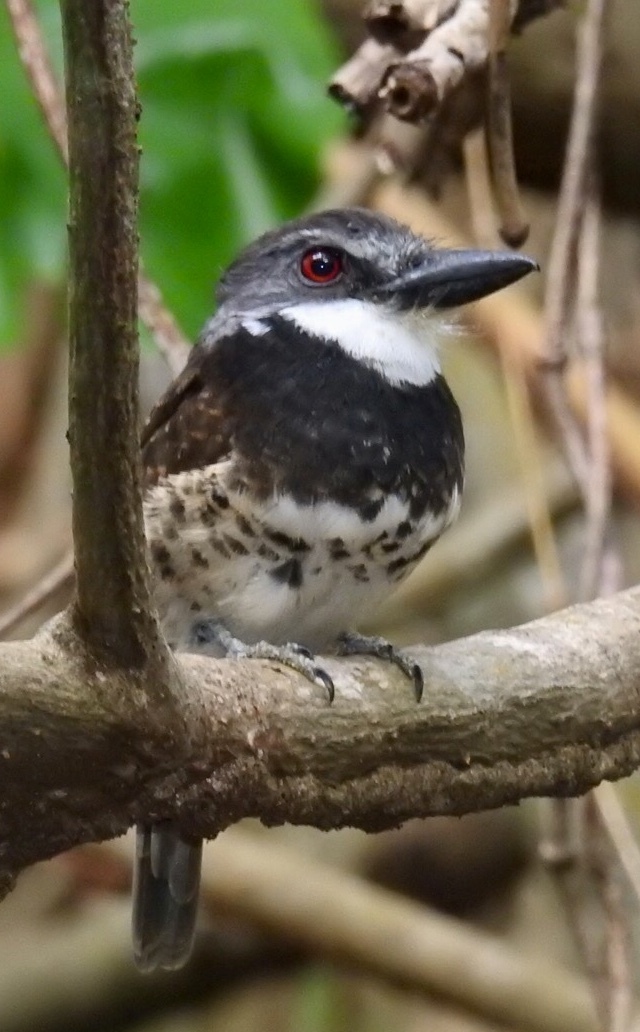
The Sooty-capped Puffbird is a puffbird endemic to Colombia, restricted to the wet lowlands along the Pacific coast. It often sits low in the vegetation, motionless and upright, and is most often found by its long song series. The species lives only a few tens of metres above sea level.
Voice
A long series of 20 to 40 whistles, starting almost as a trill and then slowing, with longer, more emphatic notes.
Recording: Diego Calderon-F. — CC BY-NC-SA 4.0 · xeno-canto
Identification
18 cm, with a large head, a heavy black bill and a fairly short tail. The crown and hindneck are sooty black to greyish black, with a broad white supercilium that turns grey towards the rear, and a broad black stripe through and below the eye. The upperparts and tail are dark brown. The chin is white, with a broad black breast band below. The belly is pale buffy white with black scaling. The iris is red, the legs pale grey. The sexes are alike.
Confusion species
Black-breasted Puffbird Notharchus pectoralis is glossy blue-black above, with a white ear patch and a white belly without scaling, and usually sits higher in the trees. White-whiskered Puffbird Malacoptila panamensis is brown with pale streaks and lacks a black breast band. Barred Puffbird Nystalus radiatus is entirely tawny-buff with fine black barring.
Habitat
Humid and wet primary and secondary lowland forest, forest edges, scrub and semi-open country with trees close to forest, from sea level to about 100 m. It perches low in the vegetation and sallies for large insects and other small animals. Little is known of the nest; presumably in a cavity, as in related species.
Where the bird is most at home, classified by the vegetation units of the Andes and the west coast.


Range and movements
Endemic to Colombia: in the Pacific lowlands of the north-west, from the area around the Gulf of Urabá south to about the Río San Juan. Absent from Ecuador, Peru, Bolivia and the Galápagos.
- Resident
- dark = core range, pale = thinly spread
How and when to look
Search in the lowlands of the northern Chocó, along forest edges and in second growth near rivers; listen in the morning for the long song series that speeds up and then slows down again.
Conservation status
Near Threatened. The small lowland range is being degraded by logging and conversion of forest to farmland and pasture; the population is thought to be declining fairly rapidly.
Scientific name
Bucco noanamae | Hellmayr, 1909
Hellmayr described the species in 1909 and placed it straight away in the genus where it still stands. The genus Bucco was introduced in 1760 by Brisson. The genus name comes from Latin bucca, 'cheek', for the large head with puffed cheeks. The species name refers to Noanamá on the Río San Juan in Chocó, Colombia. The specimen the first description was based on came from Noanamá, Río San Juan, Chocó, Colombia.