All species › Jacamars and puffbirds › Puffbirds › Spotted Puffbird
Spotted Puffbird | Bucco tamatia
Gevlekte baardkoekoek | Buco moteado | Rapazinho-carijó
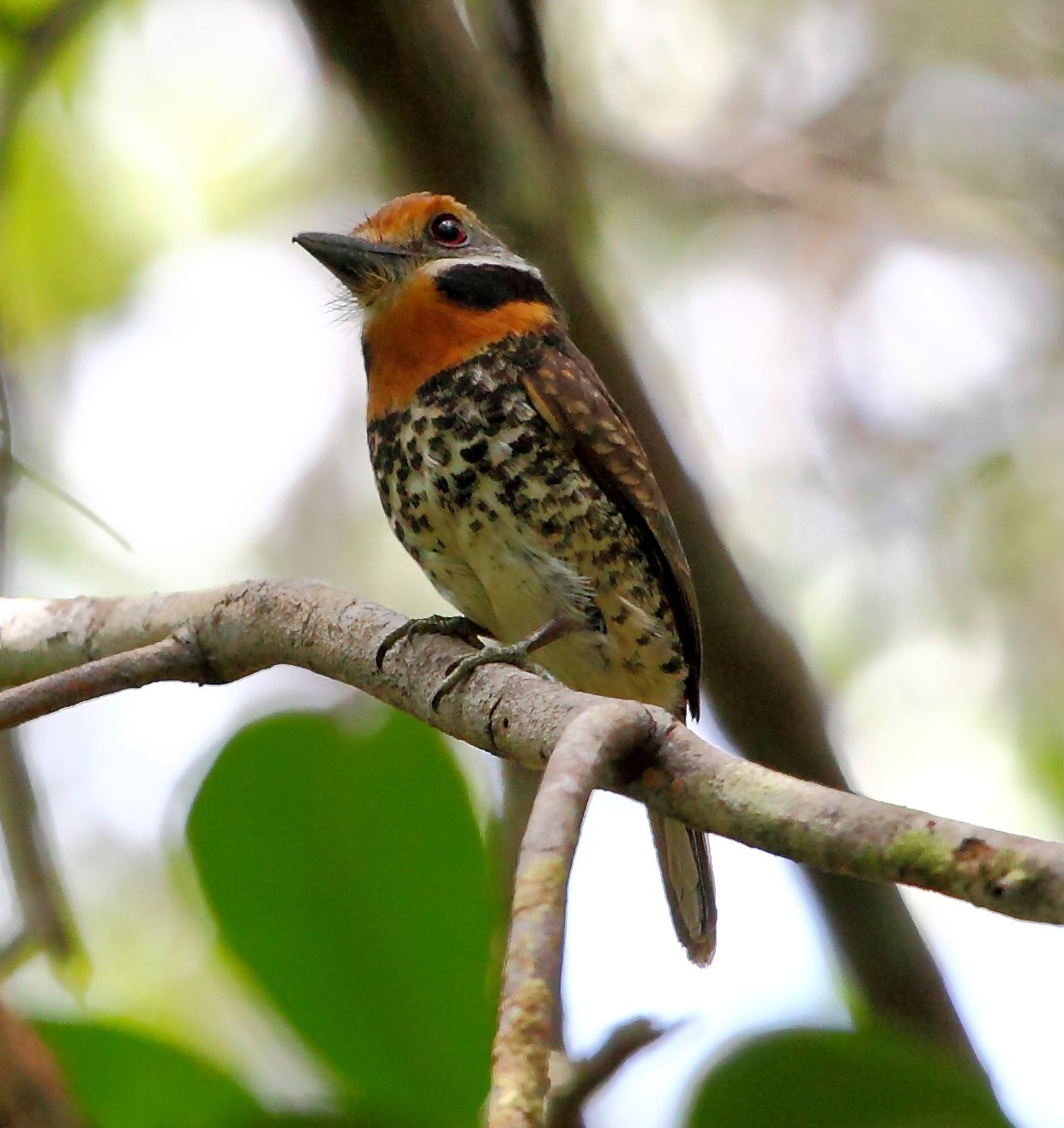
The Spotted Puffbird is a stocky, heavily scalloped puffbird of wet forests in Amazonia. It often sits motionless for long periods in the shade at mid-level, with its head drawn in. Its orange-rufous throat and the black patch on the side of the neck are the best features.
Voice
A long series of plaintive whistles, like kwee-kwee-kwee, which first rises and increases in volume and then fades; mainly at dusk and dawn.
Recording: Jacob Wijpkema — CC BY-NC-SA 4.0 · xeno-canto
Identification
18 cm, with a large head, a heavy, hook-tipped black bill and a short tail. The upperparts are brown with fine pale scaling. The forehead and a stripe above the eye are tawny-buff, below the eye is a white moustachial stripe with a large black patch on the side of the neck below it. The throat and upper breast are orange-rufous. The rest of the underparts are white with dense black scaling and spots. The iris is red. The sexes are alike.
Confusion species
Chestnut-capped Puffbird Bucco macrodactylus is smaller, with a chestnut crown, a white throat and a black breast band. Collared Puffbird Bucco capensis has an orange bill and a black collar. White-chested Puffbird Malacoptila fusca is streaked brown, with a white breast patch and an orange bill. Western Striolated Puffbird Nystalus obamai is streaked rather than scalloped.
Habitat
Várzea and igapó forest, swamp forest, riverine forest along blackwater rivers, white-sand forest and forest edges, in the lowlands up to about 500 m. It perches in the lower and middle storeys and sallies for large insects and other invertebrates, sometimes small lizards. It nests in a cavity in a termite nest or in the ground.
Where the bird is most at home, classified by the vegetation units of the Andes and the west coast.


Range and movements
In Colombia in the eastern lowlands, east of the Andes. In Ecuador in the eastern lowlands. In Peru in the Amazonian lowlands. In Bolivia in the northern lowlands. Absent from the Galápagos. Outside the guide area in Venezuela, the Guianas and Amazonian Brazil.
- Resident
- dark = core range, pale = thinly spread
How and when to look
Along the banks of blackwater rivers and lakes and in flooded forest, preferably from a boat. At dusk the long series of whistles gives away its position.
Conservation status
Least Concern. The range is very large; locally the species suffers from deforestation.
Scientific name
Bucco tamatia | Gmelin, 1788
Gmelin described the species in 1788 and placed it straight away in the genus where it still stands. The genus Bucco was introduced in 1760 by Brisson. The genus name comes from Latin bucca, 'cheek', for the large head with puffed cheeks. The species name comes from the Tupi name tîmatíâi, 'crooked bill', for the Boat-billed Heron; Marcgrave mistakenly used the name for a spotted, thrush-like bird. The specimen the first description was based on came from Cayenne, French Guiana, and Brazil.