All species › Jacamars and puffbirds › Puffbirds › Chestnut-capped Puffbird
Chestnut-capped Puffbird | Bucco macrodactylus
Bruinkapbaardkoekoek | Buco gorricastaño | Rapazinho-de-boné-vermelho
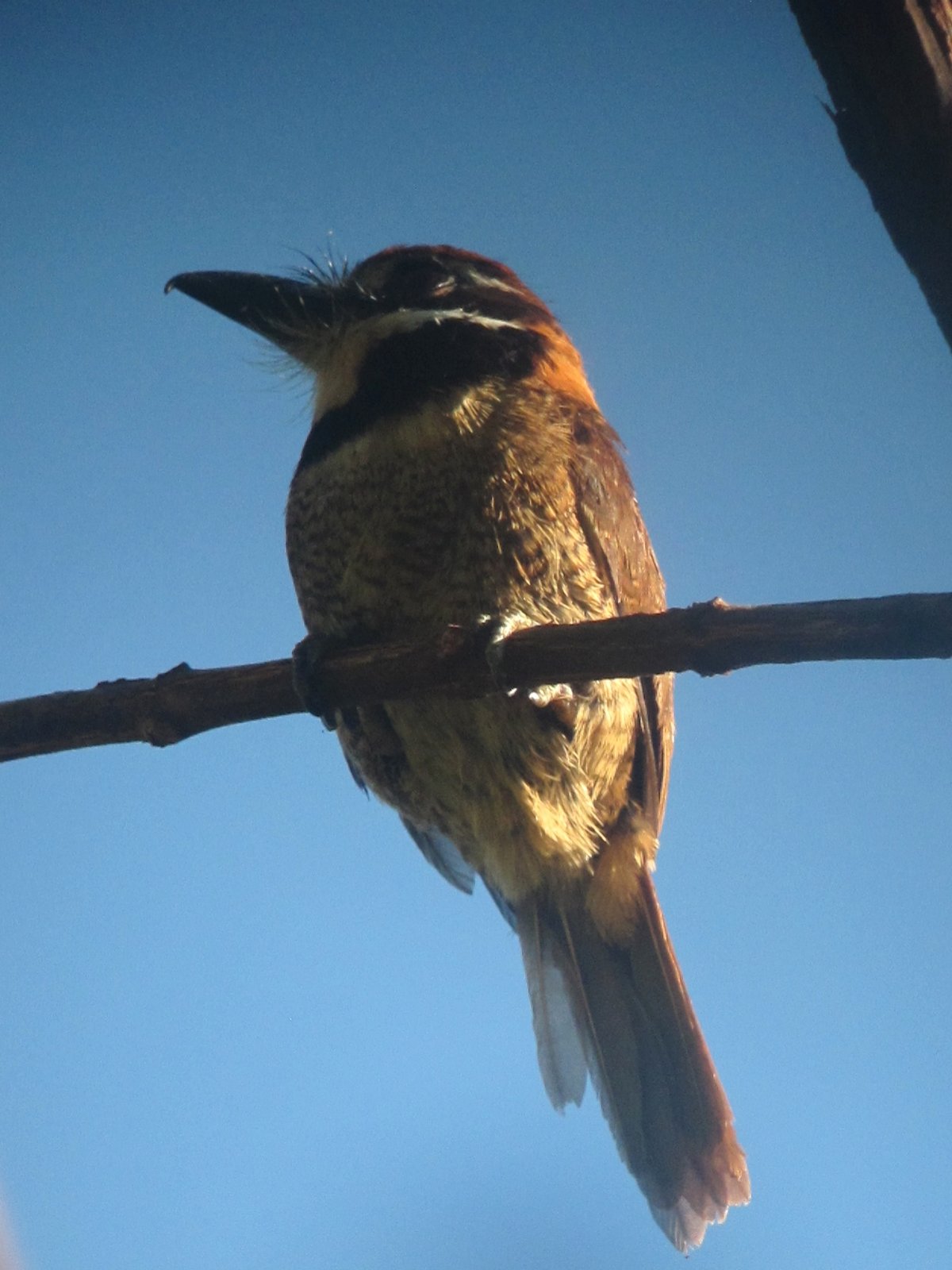
The Chestnut-capped Puffbird is a small, stocky puffbird of forest edges and riverbanks in western Amazonia. It often sits motionless on a branch at mid-level for long periods and then suddenly sallies out after an insect. Its chestnut crown and black breast band set it apart within its family.
Voice
Rather quiet. The song is a series of thin, high, slightly falling whistles, like weeeeuu, repeated at intervals.
Recording: Juan Freile — CC BY-NC-SA 4.0 · xeno-canto
Identification
14–15 cm, with a large head, a short, heavy black bill and a short tail. The crown is chestnut, the face black with a narrow white moustachial stripe. An orange-rufous band crosses the hindneck. The throat is white, with a broad black breast band below. The rest of the underparts are pale buff with fine dusky barring. The upperparts are brown with fine pale spots and edges. The sexes are alike.
Confusion species
Spotted Puffbird Bucco tamatia is larger, with an orange-rufous throat, a black patch on the side of the neck and heavily scalloped underparts, but lacks the chestnut crown and black breast band. Collared Puffbird Bucco capensis is larger and rufous, with an orange bill. Lanceolated Monklet Micromonacha lanceolata is smaller and has streaked white underparts.
Habitat
Edges of humid lowland forest, várzea forest, riverine forest along rivers and oxbow lakes, secondary forest and vine tangles, mostly below 600 m, locally higher. It perches at mid-level and takes large insects and other invertebrates from branches and leaves. It nests in a cavity in an arboreal termite nest.
Where the bird is most at home, classified by the vegetation units of the Andes and the west coast.


Range and movements
In Colombia in Amazonia in the south-east. In Ecuador in the eastern lowlands. In Peru in the Amazonian lowlands. In Bolivia in the northern lowlands. Absent from the Galápagos. Outside the guide area in southern Venezuela and western Amazonian Brazil.
- Resident
- dark = core range, pale = thinly spread
How and when to look
Search along forest edges by rivers and lakes and around clearings in várzea forest; the bird often sits still on a bare branch in half-shade and is noticed only when it sallies.
Conservation status
Least Concern. The species has a large range and tolerates forest edges and secondary forest.
Scientific name
Bucco macrodactylus | (Spix, 1824)
Spix described the species in 1824 as Cyphos macrodactylus; because it was later moved to another genus, the author and year stand in brackets. The genus Bucco was introduced in 1760 by Brisson. The genus name comes from Latin bucca, 'cheek', for the large head with puffed cheeks. The species name comes from Greek makros, 'long', and daktulos, 'toe' or 'finger'. The specimen the first description was based on came from Fonte Boa, Amazonas, Brazil.