All species › Jacamars and puffbirds › Jacamars › Paradise Jacamar
Paradise Jacamar | Galbula dea
Paradijsglansvogel | Jacamará paraíso | Ariramba-do-paraíso
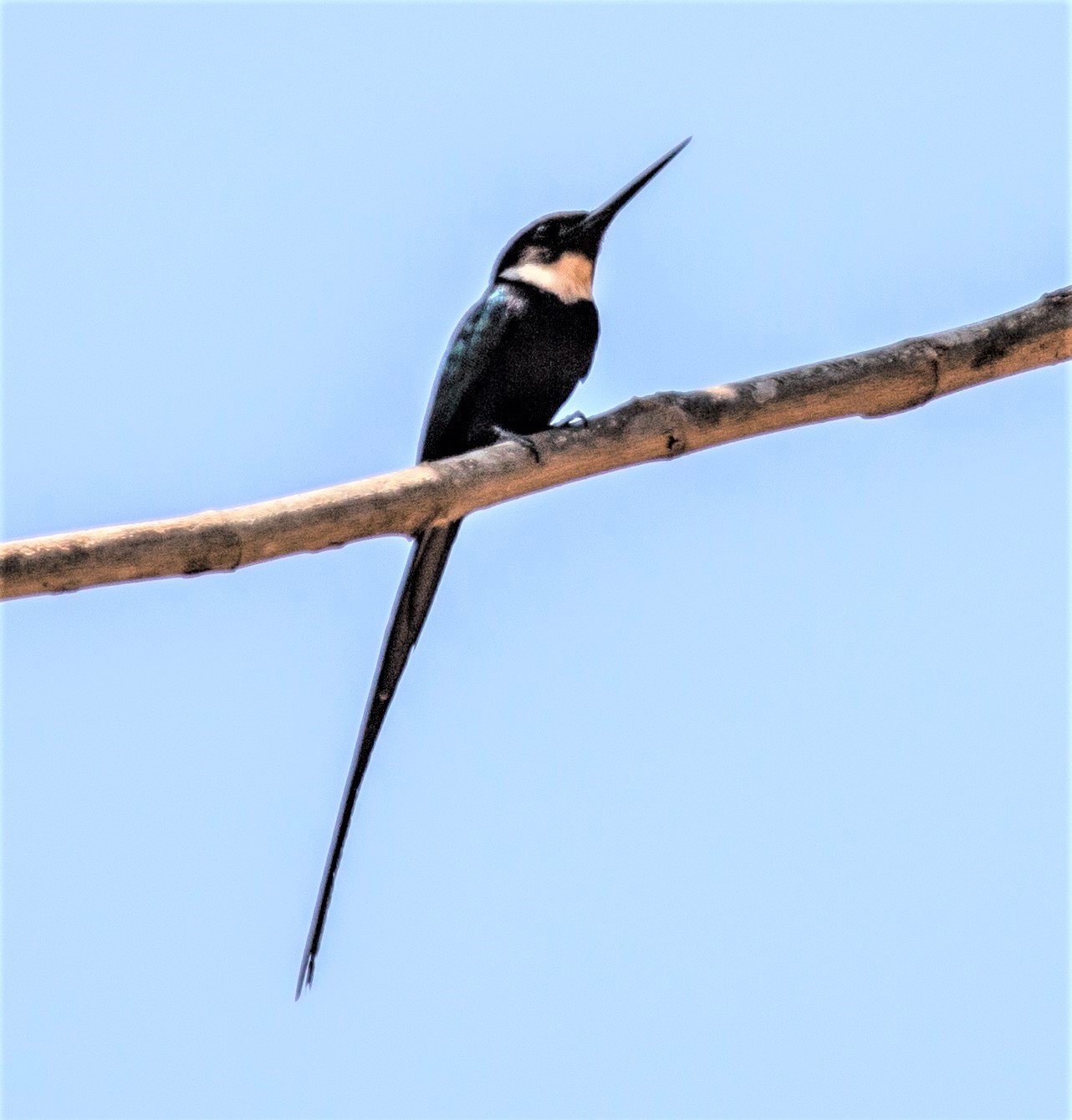
The Paradise Jacamar is a dark jacamar with a very long, pointed tail that makes up more than half of its length. It perches high on bare branches above the canopy and at forest edges, from where it makes long sallies. It is the most widespread jacamar of the Amazonian lowlands in the guide area.
Voice
A series of high, clear whistles, pee pee pee, often slightly descending; also a fast, thin trill and single sharp calls.
Recording: JAYRSON ARAUJO DE OLIVEIRA — CC BY-NC-SA 4.0 · xeno-canto
Identification
29–32 cm, of which more than half is tail; the central tail feathers are long and narrow. The bill is long, straight and black. The plumage is mostly blackish with a blue-green to bronze gloss, especially on the wings and back. The crown is paler, grey-brown. The throat is white. The sexes are almost alike; juveniles are duller, with a shorter tail.
Confusion species
Purplish Jacamar Galbula chalcothorax and Bronzy Jacamar Galbula leucogastra have a much shorter tail and a dark crown. Great Jacamar Jacamerops aureus is larger and heavier, with a thicker, slightly decurved bill, a green back and a rufous belly.
Habitat
The canopy and edges of humid terra firme forest and várzea, along rivers, lakes and clearings, also in swamp forest and tall secondary growth, from the lowlands up to about 600 m, locally higher. It perches high on dead, bare branches and catches flying insects in long sallies. It nests in a self-dug tunnel in an earth bank or in a termite nest.
Where the bird is most at home, classified by the vegetation units of the Andes and the west coast.


Range and movements
In Colombia in the lowlands east of the Andes, in Amazonia and the Orinoco basin. In Ecuador rare and local in the eastern lowlands. In Peru over most of the Amazonian lowlands. In Bolivia in the northern and central lowlands. Absent from the Galápagos. Outside the guide area in southern Venezuela, the Guianas and Brazilian Amazonia.
- Resident
- dark = core range, pale = thinly spread
How and when to look
From canopy towers and from the river in the lowlands of south-eastern Peru and northern Bolivia, where the bird perches on the highest bare branches. The silhouette with the long, narrow tail can be seen from far away.
Conservation status
Least Concern. The species has a very large range, but depends on tall forest.
Scientific name
Galbula dea | (Linnaeus, 1758)
Linnaeus described the species in 1758 as Alcedo Dea; because it was later moved to another genus, the author and year stand in brackets. The genus Galbula was introduced in 1760 by Brisson. The genus name comes from Latin galbula, the name for a small yellow bird. The species name is Latin dea, 'goddess'. The specimen the first description was based on came from Suriname.