All species › Waterfowl › Ducks, swans and geese › Comb Duck
Comb Duck | Sarkidiornis sylvicola
Amerikaanse knobbeleend | Pato crestudo | Pato-de-crista
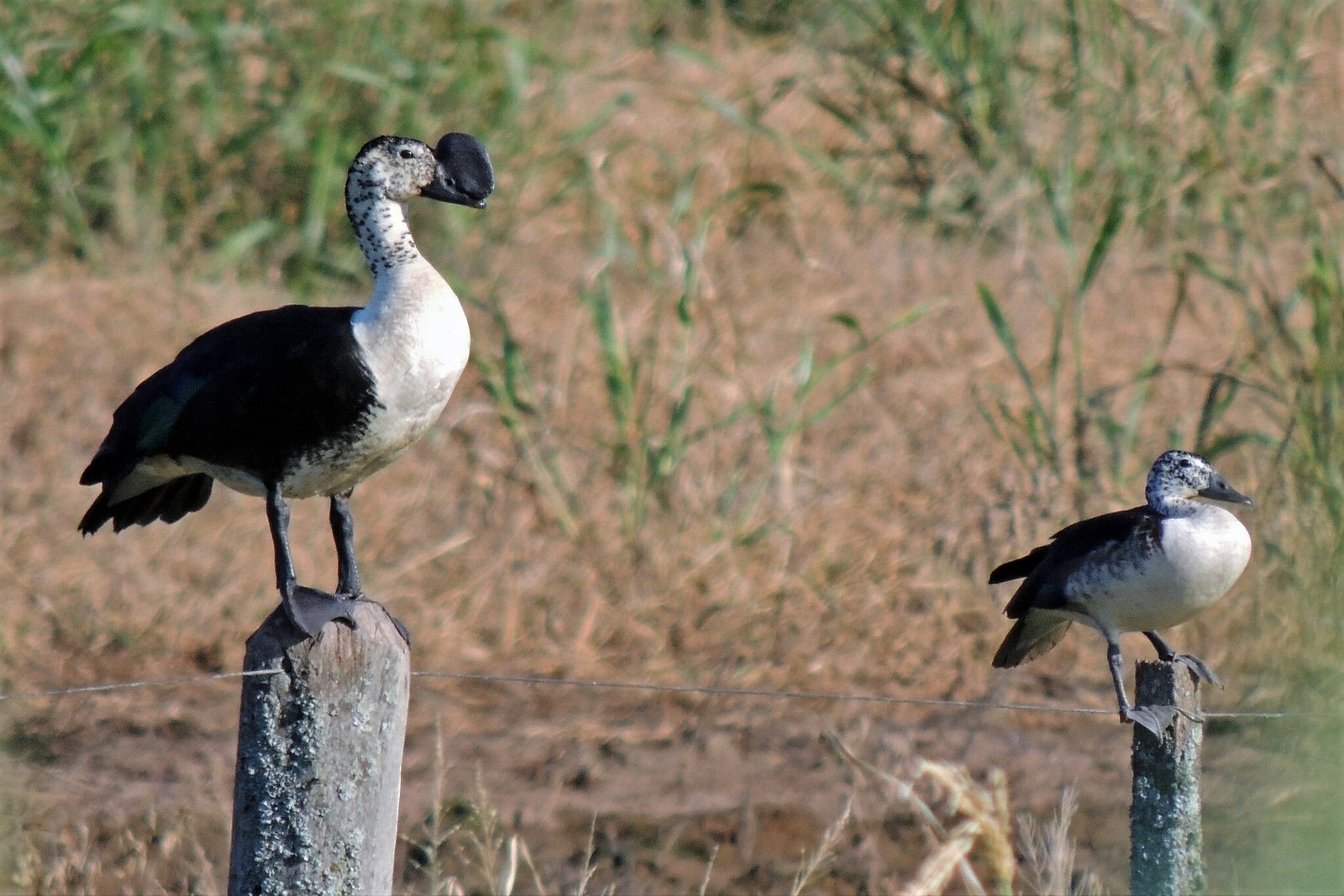
The Comb Duck is a large, black-and-white duck of lowland marshes, flooded savannas and rice fields. The male carries a large, black knob on the bill, which grows even larger in the breeding season. The species often perches in trees and nests in tree cavities.
Voice
Usually silent. In the breeding season the male gives a low grunt or whistle; otherwise a soft, hoarse quack.
Recording: John V. Moore — CC BY-NC-SA 4.0 · xeno-canto
Identification
56–76 cm; the male is much larger than the female. The head and neck are white, densely speckled with black, sometimes with a yellowish wash on the side of the head. The upperparts and wings are black, with a green and bronze gloss. The underparts are white, with a black patch on the side of the breast and greyish to dark flanks. The male has a large, black, flat knob on top of the bill; the female is smaller and lacks the knob. Juveniles are browner, with a pale supercilium and buff underparts.
Confusion species
Muscovy Duck Cairina moschata is almost entirely black, with white wing patches and no white head and neck. White-faced Whistling Duck Dendrocygna viduata also has a white face, but a black hindhead and neck, a chestnut breast and an upright, long-necked stance.
Habitat
Freshwater marshes, flooded savannas, lagoons, lakes with trees along the shore and rice fields, from sea level to about 1000 m, locally higher. It grazes on banks and in shallow water, feeding on seeds, rice, aquatic plants and invertebrates. It often rests in trees. The nest is in a tree cavity.
Where the bird is most at home, classified by the vegetation units of the Andes and the west coast.


Range and movements
In Colombia in the Caribbean lowlands, the Magdalena and Cauca valleys and the Llanos. In Ecuador in the west, mainly in Guayas and Loja. In Peru in the north-west along the coast, where the species appears to be spreading south along rice fields, and in the rice fields of San Martín; scarce in the Amazonian lowlands. In Bolivia in the eastern lowlands, mainly in Santa Cruz and Beni. Absent from the Galápagos. Outside the guide area from Panama through Venezuela and the Guianas to Brazil, Paraguay and northern Argentina.
- Resident
- dark = core range, pale = thinly spread
How and when to look
In the rice fields and marshes of north-western Peru, such as in Lambayeque and Piura, and around Moyobamba in San Martín, flocks are often seen, sometimes resting in trees along the fields. In the Cauca Valley mainly at lagoons and wet pastures.
Conservation status
Least Concern. The species benefits locally from rice farming, but is hunted and affected by the draining of marshes.
Scientific name
Sarkidiornis sylvicola | Ihering & Ihering, 1907
Ihering & Ihering described the species in 1907 and placed it straight away in the genus where it still stands. The genus Sarkidiornis was introduced in 1838 by Eyton. The genus name comes from Greek sarkidion, 'small piece of flesh, caruncle', and ornis, 'bird', after the fleshy comb on the male's bill. The species name sylvicola comes from Latin silva, 'forest', and -cola, 'dweller', so 'forest dweller'. The specimen the first description was based on came from Iguape, São Paulo, Brazil, and Buenos Aires, Argentina.